
Textbook Question
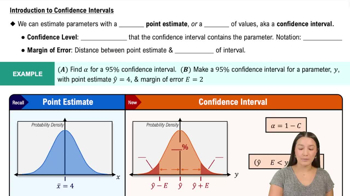
In Exercises 7–10, use the confidence interval to find the margin of error and the sample proportion.
(0.512, 0.596)
117
views

 Verified step by step guidance
 06:33
06:33
 06:14
06:14 08:45
08:45In Exercises 7–10, use the confidence interval to find the margin of error and the sample proportion.
(0.512, 0.596)
"Finding p^ and q^ In Exercises 3–6, let p be the population proportion for the situation. Find point estimates of p and q.
Social Security In a survey of 351 retired Americans, 200 said that they rely on Social Security as major source of income. (Adapted from Gallup)"
Translating Statements In Exercises 29–34, translate the statement into a confidence interval. Approximate the level of confidence.
In a survey of 1502 U.S. adults, 31% said that they use Pinterest. The survey’s margin of error is ±2.9%. (Source: Pew Research Center)
The data set represents the amounts of time (in minutes) spent checking email for a random sample of employees at a company.
c. Repeat part (b), assuming σ = 3.5 minutes. Compare the results.
[APPLET] The winning times (in hours) for a sample of 20 randomly selected Boston Marathon Women’s Open Division champions from 1980 to 2019 are shown in the table at the left. Assume the population standard deviation is 0.068 hour. (Source: Boston Athletic Association)
a. Find the point estimate of the population mean.
[APPLET] The winning times (in hours) for a sample of 20 randomly selected Boston Marathon Women’s Open Division champions from 1980 to 2019 are shown in the table at the left. Assume the population standard deviation is 0.068 hour. (Source: Boston Athletic Association)
d. Does it seem likely that the population mean could be greater than 2.52 hours? Explain.