Ch. 7 - Hypothesis Testing with One Sample
Larson - Elementary Statistics: Picturing the World 8th Edition
Larson8th EditionElementary Statistics: Picturing the WorldISBN: 9780137493470Not the one you use?Change textbook
Chapter 7, Problem 7.4.12

Hypothesis Testing Using Rejection Regions In Exercises 7–12, (a) identify the claim and state H0 and Ha, (b) find the critical value(s) and identify the rejection region(s), (c) find the standardized test statistic z, (d) decide whether to reject or fail to reject the null hypothesis, and (e) interpret the decision in the context of the original claim.


Changing Jobs A researcher claims that 40% of U.S. adults would consider changing jobs. In a random sample of 50 U.S. adults, 25 say they would consider changing jobs. At α=0.10, is there enough evidence to reject the researcher’s claim?

Verified step by step guidance
1
Step 1: Identify the claim and state the null hypothesis (H0) and alternative hypothesis (Ha). The claim is that 40% of U.S. adults would consider changing jobs. This translates to the null hypothesis H0: p = 0.40, where p is the population proportion. The alternative hypothesis Ha depends on the context; since the problem does not specify a direction, we assume Ha: p ≠ 0.40 (two-tailed test).
Step 2: Determine the critical value(s) and rejection region(s). For a significance level of α = 0.10 and a two-tailed test, divide α by 2 to find the area in each tail (α/2 = 0.05). Use a z-table or standard normal distribution to find the critical z-values corresponding to these tail areas. The rejection regions are z < -z_critical or z > z_critical.
Step 3: Calculate the standardized test statistic z. Use the formula z = (p̂ - p) / √(p(1-p)/n), where p̂ is the sample proportion, p is the hypothesized population proportion, and n is the sample size. Substitute the values: p̂ = 25/50 = 0.50, p = 0.40, and n = 50, then compute the z-statistic.
Step 4: Compare the calculated z-statistic to the critical z-values. If the z-statistic falls within the rejection regions (z < -z_critical or z > z_critical), reject the null hypothesis H0. Otherwise, fail to reject H0.
Step 5: Interpret the decision in the context of the original claim. If H0 is rejected, conclude that there is enough evidence to reject the researcher’s claim that 40% of U.S. adults would consider changing jobs. If H0 is not rejected, conclude that there is not enough evidence to reject the claim.

Verified video answer for a similar problem:

This video solution was recommended by our tutors as helpful for the problem above.
Video duration:
3m
Was this helpful?

Key Concepts

Here are the essential concepts you must grasp in order to answer the question correctly.

Hypothesis Testing

Hypothesis testing is a statistical method used to make decisions about a population based on sample data. It involves formulating two competing hypotheses: the null hypothesis (H0), which represents a statement of no effect or no difference, and the alternative hypothesis (Ha), which represents the claim being tested. The goal is to determine whether there is enough evidence in the sample to reject H0 in favor of Ha.
Recommended video:
Guided course
06:21
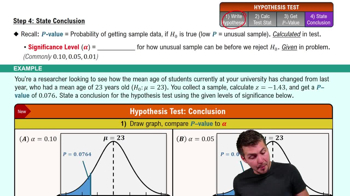
Step 1: Write Hypotheses

Rejection Region

The rejection region is a set of values for the test statistic that leads to the rejection of the null hypothesis. It is determined by the significance level (α), which defines the probability of making a Type I error (rejecting H0 when it is true). For a given α, critical values are calculated, and if the test statistic falls within this region, the null hypothesis is rejected.
Recommended video:
Guided course
09:56
Step 4: State Conclusion

Standardized Test Statistic

The standardized test statistic, often denoted as z, measures how many standard deviations an observed sample statistic is from the hypothesized population parameter under the null hypothesis. It is calculated using the formula z = (observed proportion - hypothesized proportion) / standard error. This statistic is crucial for determining whether the sample provides sufficient evidence to reject the null hypothesis.
Recommended video:
Guided course
06:34
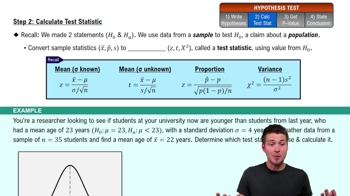
Step 2: Calculate Test Statistic
Related Practice
Textbook Question

In Exercises 13–18, test the claim about the population mean μ at the level of significance α. Assume the population is normally distributed.

Claim: μ=4915; α=0.01. Sample statistics: x_bar=5017, s=5613, n=51

111
views

Textbook Question

Identifying the Nature of a Hypothesis Test In Exercises 37–42, state and in words and in symbols. Then determine whether the hypothesis test is left-tailed, right-tailed, or two-tailed. Explain your reasoning. Sketch a normal sampling distribution and shade the area for the P-value.


Survey A polling organization reports that the number of responses to a survey mailed to 100,000 U.S. residents is not 100,000.

58
views
Textbook Question

Finding a P-Value In Exercises 13–18, find the P-value for the hypothesis test with the standardized test statistic z. Decide whether to reject H0 for the level of significance alpha.

Left-tailed test


z= 1.95

alpha=0.08

57
views
Textbook Question

Stating Hypotheses In Exercises 11–16, the statement represents a claim. Write its complement and state which is H0 and which is Ha.


μ < 128

47
views
Textbook Question

Stating Hypotheses In Exercises 11–16, the statement represents a claim. Write its complement and state which is H0 and which is Ha.


p = 0.21

66
views
Textbook Question

Hypothesis Testing Using Rejection Regions In Exercises 7–12, (a) identify the claim and state H0 and Ha, (b) find the critical value(s) and identify the rejection region(s), (c) find the standardized test statistic z, (d) decide whether to reject or fail to reject the null hypothesis, and (e) interpret the decision in the context of the original claim.


Vaccinations In 2021, a reporter claims that at least 55% of U.S. adults feel that COVID-19 vaccinations should be required for high school students to attend school in the fall. In a random sample of 200 U.S. adults, 56% feel that COVID-19 vaccinations should be required for high school students to attend school in the fall. At α=0.10, is there enough evidence to reject the reporter’s claim?

104
views