Ch. 7 - Hypothesis Testing with One Sample
Larson - Elementary Statistics: Picturing the World 8th Edition
Larson8th EditionElementary Statistics: Picturing the WorldISBN: 9780137493470Not the one you use?Change textbook
Chapter 7, Problem 7.RE.16

In Exercises 13–16, find the critical value(s) and rejection region(s) for the type of z-test with level of significance . Include a graph with your answer.


Two-tailed test, α=0.03

Verified step by step guidance
1
Step 1: Understand the problem. A two-tailed z-test is being conducted with a significance level (α) of 0.03. This means the rejection regions will be split equally between the two tails of the standard normal distribution.
Step 2: Determine the critical value(s). For a two-tailed test, the critical z-values correspond to the points where the cumulative probability equals α/2 in the lower tail and 1 - α/2 in the upper tail. Use a z-table or statistical software to find these values.
Step 3: Calculate the rejection regions. The rejection regions are the areas in the tails of the standard normal distribution where the test statistic falls outside the critical z-values. Specifically, the rejection regions are z < -z_critical and z > z_critical.
Step 4: Visualize the graph. Draw a standard normal distribution curve. Mark the critical z-values on the x-axis, and shade the areas in the tails that correspond to the rejection regions. Label the graph with α = 0.03 and indicate the two-tailed nature of the test.
Step 5: Interpret the setup. The critical z-values and rejection regions help determine whether the null hypothesis should be rejected based on the test statistic. If the test statistic falls within the rejection regions, the null hypothesis is rejected; otherwise, it is not.

Verified video answer for a similar problem:

This video solution was recommended by our tutors as helpful for the problem above.
Video duration:
4m
Was this helpful?

Key Concepts

Here are the essential concepts you must grasp in order to answer the question correctly.

Critical Value

The critical value is a threshold that determines the boundary for rejecting the null hypothesis in hypothesis testing. For a two-tailed test, it divides the significance level (α) into two equal parts, indicating the points beyond which the null hypothesis can be rejected. In this case, with α = 0.03, the critical values will be found at the 1.5% tails of the standard normal distribution.
Recommended video:
05:50
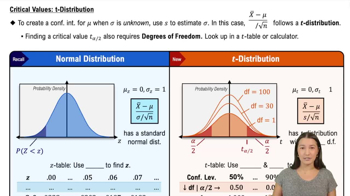
Critical Values: t-Distribution

Rejection Region

The rejection region is the area in the tails of the distribution where, if the test statistic falls, the null hypothesis is rejected. For a two-tailed test with α = 0.03, the rejection regions are located in both tails of the distribution, specifically beyond the critical values. This region represents the extreme values that are unlikely to occur if the null hypothesis is true.
Recommended video:
Guided course
09:56
Step 4: State Conclusion

Z-Test

A z-test is a statistical test used to determine whether there is a significant difference between sample and population means when the population variance is known. It utilizes the standard normal distribution to calculate the z-score, which indicates how many standard deviations an element is from the mean. In the context of this question, the z-test is applied to assess hypotheses based on the critical values and rejection regions derived from the significance level.
Recommended video:
Guided course
07:09
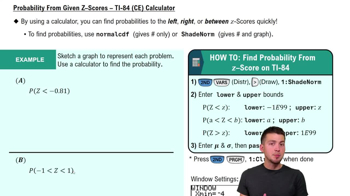
Probability From Given Z-Scores - TI-84 (CE) Calculator