Ch. 7 - Hypothesis Testing with One Sample
Larson - Elementary Statistics: Picturing the World 8th Edition
Larson8th EditionElementary Statistics: Picturing the WorldISBN: 9780137493470Not the one you use?Change textbook
Chapter 7, Problem 7.4.7

In Exercises 3–8, find the critical value(s) and rejection region(s) for the type of t-test with level of significance alpha and sample size n.


Two-tailed test, α=0.05, n=27

Verified step by step guidance
1
Determine the degrees of freedom (df) for the t-test. The formula for degrees of freedom in a one-sample t-test is df = n - 1, where n is the sample size. Substitute n = 27 into the formula to calculate df.
Identify the level of significance (α) for the test. In this case, α = 0.05. Since it is a two-tailed test, divide α by 2 to account for both tails of the distribution. This gives α/2 = 0.025 for each tail.
Use a t-distribution table or statistical software to find the critical t-value corresponding to df = 26 (calculated in step 1) and α/2 = 0.025. The critical t-value is the value where the cumulative probability in the tail equals 0.025.
Define the rejection regions for the two-tailed test. The rejection regions are the areas in the tails of the t-distribution where the test statistic falls beyond the critical t-values. For a two-tailed test, the rejection regions are t < -t_critical and t > t_critical.
Summarize the critical values and rejection regions. State the critical t-values (positive and negative) and the corresponding rejection regions based on the results from the t-distribution table or software.

Verified video answer for a similar problem:

This video solution was recommended by our tutors as helpful for the problem above.
Video duration:
3m
Was this helpful?

Key Concepts

Here are the essential concepts you must grasp in order to answer the question correctly.

Critical Value

A critical value is a point on the scale of the test statistic that separates the region where the null hypothesis is rejected from the region where it is not rejected. In a two-tailed test, critical values are determined based on the significance level (alpha) and the degrees of freedom, which is calculated as n-1 for a t-test. For α=0.05 and n=27, the critical values help define the rejection regions.
Recommended video:
05:50
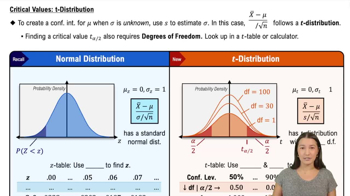
Critical Values: t-Distribution

Rejection Region

The rejection region is the range of values for the test statistic that leads to the rejection of the null hypothesis. In a two-tailed test, this region is split between both tails of the distribution. For a significance level of α=0.05, the rejection regions are located in the extreme ends of the t-distribution, beyond the critical values determined for the test.
Recommended video:
Guided course
09:56
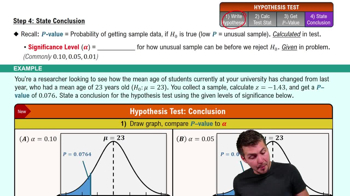
Step 4: State Conclusion

Two-Tailed Test

A two-tailed test is a statistical test that evaluates whether a sample mean is significantly different from a population mean in either direction (higher or lower). This type of test is appropriate when the alternative hypothesis does not specify a direction of the effect. In this case, with α=0.05, the test assesses the likelihood of observing a sample mean that is either significantly greater than or less than the hypothesized population mean.
Recommended video:
Guided course
09:27
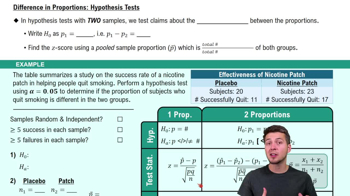
Difference in Proportions: Hypothesis Tests
Related Practice
Textbook Question

Finding Critical Values and Rejection Regions In Exercises 23–28, find the critical value(s) and rejection region(s) for the type of z-test with level of significance α. Include a graph with your answer.


Right-tailed test, α = 0.08

70
views
Textbook Question

In Exercises 3–8, find the critical value(s) and rejection region(s) for the type of t-test with level of significance alpha and sample size n.


Left-tailed test, α=0.10, n=38

87
views
Textbook Question

True or False? In Exercises 5–10, determine whether the statement is true or false. If it is false, rewrite it as a true statement.


In a hypothesis test, you assume the alternative hypothesis is true.

77
views
Textbook Question

Explain how to test a population proportion p.

114
views
Textbook Question

Hypothesis Testing Using Rejection Region(s) In Exercises 39–44, (a) identify the claim and state H0 and Ha, (b) find the critical value(s) and identify the rejection region(s), (c) find the standardized test statistic z, (d) decide whether to reject or fail to reject the null hypothesis, and (e) interpret the decision in the context of the original claim.


Light Bulbs A light bulb manufacturer guarantees that the mean life of a certain type of light bulb is at least 750 hours. A random sample of 25 light bulbs has a mean life of 745 hours. Assume the population is normally distributed and the population standard deviation is 60 hours. At alpha= 0.02, do you have enough evidence to reject the manufacturer’s claim?

91
views
Textbook Question

Identifying a Test In Exercises 21–24, determine whether the hypothesis test is left-tailed, right-tailed, or two-tailed.


Ha: p = 0.25

H0: p ≠ 0.25

57
views