
Textbook Question
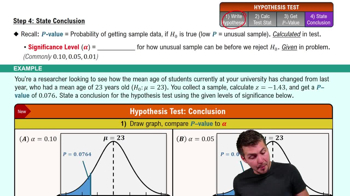
Does failing to reject the null hypothesis mean that the null hypothesis is true? Explain.
397
views

 Verified step by step guidance
 05:50
05:50
 09:56 05:50
Does failing to reject the null hypothesis mean that the null hypothesis is true? Explain.
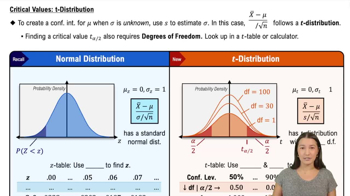
Explain how to use a t-test to test a hypothesized mean mu when sigma is unknown. What assumptions are necessary?
Writing In a right-tailed test where P < alpha, does the standardized test statistic lie to the left or the right of the critical value? Explain your reasoning.
Dive Duration An oceanographer claims that the mean dive duration of a North Atlantic right whale is 11.5 minutes. A random sample of 34 dive durations has a mean of 12.2 minutes and a standard deviation of 2.2 minutes. Is there enough evidence to reject the claim at α=0.10?
Hypothesis Testing Using Rejection Regions In Exercises 7–12, (a) identify the claim and state H0 and Ha, (b) find the critical value(s) and identify the rejection region(s), (c) find the standardized test statistic z, (d) decide whether to reject or fail to reject the null hypothesis, and (e) interpret the decision in the context of the original claim.
Working Students An education researcher claims that 65% of full-time college students work year-round. In a random sample of 105 college students, 66 say they work year-round. At α=0.10, is there enough evidence to reject the researcher’s claim?
Hypothesis Testing Using a P-Value In Exercises 33–38,
a. identify the claim and state and .
b. find the standardized test statistic z.
c. find the corresponding P-value.
d. decide whether to reject or fail to reject the null hypothesis.
e. interpret the decision in the context of the original claim.
Sprinkler Systems A manufacturer of sprinkler systems designed for fire protection claims that the average activating temperature is at least 135°F. To test this claim, you randomly select a sample of 32 systems and find the mean activation temperature to be 133°F. Assume the population standard deviation is 3.3°F. At alpha=0.10, do you have enough evidence to reject the manufacturer’s claim?