Ch. 7 - Hypothesis Testing with One Sample
Larson - Elementary Statistics: Picturing the World 8th Edition
Larson8th EditionElementary Statistics: Picturing the WorldISBN: 9780137493470Not the one you use?Change textbook
Chapter 7, Problem 7.1.29

Stating the Null and Alternative Hypotheses In Exercises 25–30, write the claim as a mathematical statement. State the null and alternative hypotheses, and identify which represents the claim.


Paying for College According to a recent survey, 54% of today’s college students used student loans to pay for college.

Verified step by step guidance
1
Identify the claim: The problem states that 54% of today's college students used student loans to pay for college. This is the claim we will test.
Define the population proportion: Let p represent the proportion of college students who use student loans to pay for college.
Write the claim as a mathematical statement: The claim is that p = 0.54.
State the null hypothesis (H₀): The null hypothesis always includes equality. Here, H₀: p = 0.54.
State the alternative hypothesis (H₁): The alternative hypothesis depends on the context. If we are testing whether the proportion is different from 54%, then H₁: p ≠ 0.54. If we are testing whether it is greater or less than 54%, the alternative hypothesis would be H₁: p > 0.54 or H₁: p < 0.54, respectively.

Verified video answer for a similar problem:

This video solution was recommended by our tutors as helpful for the problem above.
Video duration:
2m
Was this helpful?

Key Concepts

Here are the essential concepts you must grasp in order to answer the question correctly.

Null Hypothesis

The null hypothesis (H0) is a statement that indicates no effect or no difference in a statistical test. It serves as a default position that assumes any observed effect is due to sampling variability. In this context, it would state that the proportion of college students using loans is equal to 54%, suggesting that there is no significant change from the reported figure.
Recommended video:
Guided course
06:21
Step 1: Write Hypotheses

Alternative Hypothesis

The alternative hypothesis (H1) is a statement that contradicts the null hypothesis, indicating that there is an effect or a difference. It represents the claim that researchers aim to support. In this case, it would assert that the proportion of college students using loans is not equal to 54%, suggesting a significant change in the usage of student loans.
Recommended video:
Guided course
06:21
Step 1: Write Hypotheses

Statistical Significance

Statistical significance refers to the likelihood that a relationship observed in data is not due to chance. It is often determined through p-values in hypothesis testing. If the results show statistical significance, it implies that the alternative hypothesis may be accepted, indicating a meaningful difference in the proportion of students using loans compared to the stated 54%.
Recommended video:
Guided course
05:53
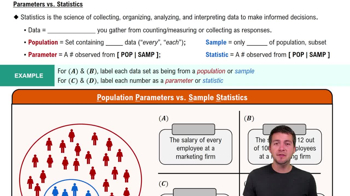
Parameters vs. Statistics
Related Practice
Textbook Question

Finding Critical Values and Rejection Regions In Exercises 23–28, find the critical value(s) and rejection region(s) for the type of z-test with level of significance α. Include a graph with your answer.


Two-tailed test, α = 0.12

135
views
Textbook Question

Hypothesis Testing Using Rejection Regions In Exercises 19–26, (a) identify the claim and state H0 and Ha, (b) find the critical value(s) and identify the rejection region(s), (c) find the standardized test statistic t, (d) decide whether to reject or fail to reject the null hypothesis, and (e) interpret the decision in the context of the original claim. Assume the population is normally distributed.


Annual Salary An employment information service claims the mean annual salary for senior level statisticians is more than \(124,000. The annual salaries (in dollars) for a random sample of 12 senior level statisticians are shown in the table at the left. At α=0.01, is there enough evidence to support the claim that the mean salary is more than \)124,000?


46
views
Textbook Question

In Exercises 13–18, test the claim about the population mean μ at the level of significance α. Assume the population is normally distributed.

Claim: μ≠52,200; α=0.05. Sample statistics: x_bar=53,220, s=2700, n=34

74
views
Textbook Question

In Exercises 15–22, test the claim about the population variance or standard deviation at the level of significance Assume the population is normally distributed.

Claim: σ^2=63, α=0.01 . Sample statistics: s^2=58, n=29

68
views
Textbook Question

Getting at the Concept Explain why a level of significance of α=0 is not used.

90
views
Textbook Question

Graphical Analysis In Exercises 17–20, match the alternative hypothesis with its graph. Then state the null hypothesis and sketch its graph.


Ha: μ > 3


71
views