
Ch. 7 - Hypothesis Testing with One Sample
Larson - Elementary Statistics: Picturing the World 8th Edition
Larson8th EditionElementary Statistics: Picturing the WorldISBN: 9780137493470Not the one you use?Change textbook
Chapter 7, Problem 7.T.3

When you reject a true claim with a level of significance that is virtually zero, what can you infer about the randomness of your sampling process?

Verified step by step guidance
1
Understand the context: Rejecting a true claim is known as a Type I error in hypothesis testing. The level of significance (denoted as \( \alpha \)) represents the probability of making this error. A level of significance that is 'virtually zero' implies that the probability of making a Type I error is extremely small.
Recall the role of randomness in sampling: In statistics, random sampling ensures that every individual in the population has an equal chance of being selected. This randomness is crucial for the validity of inferential statistics, as it minimizes bias and ensures that the sample is representative of the population.
Analyze the situation: If you reject a true claim despite having a virtually zero level of significance, it suggests that the observed data is highly unusual under the null hypothesis. This could indicate a problem with the randomness of the sampling process, as non-random sampling can introduce bias and lead to misleading results.
Consider potential issues: Non-random sampling could occur due to selection bias, systematic errors, or external factors influencing the sample. These issues can cause the sample to deviate from the population characteristics, leading to incorrect conclusions even with a low \( \alpha \).
Conclude the inference: The occurrence of a Type I error with a virtually zero level of significance strongly suggests that the sampling process may not have been truly random. Investigate the sampling methodology to identify and address any potential sources of bias or non-randomness.

Verified video answer for a similar problem:

This video solution was recommended by our tutors as helpful for the problem above.
Video duration:
3m
Was this helpful?

Key Concepts

Here are the essential concepts you must grasp in order to answer the question correctly.

Level of Significance

The level of significance, often denoted as alpha (α), is the threshold for determining whether to reject the null hypothesis in hypothesis testing. A level of significance close to zero indicates a very stringent criterion for rejecting the null hypothesis, suggesting that only extremely strong evidence against it will lead to rejection.
Recommended video:
03:33
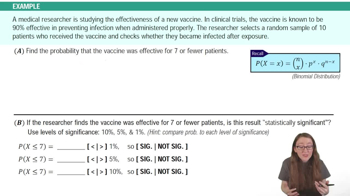
Finding Binomial Probabilities Using TI-84 Example 1

Type I Error

A Type I error occurs when a true null hypothesis is incorrectly rejected. In the context of a very low level of significance, the likelihood of committing a Type I error is minimized, meaning that if you reject a true claim, it raises concerns about the validity of the sampling process or the data collected.
Recommended video:
Guided course
04:24
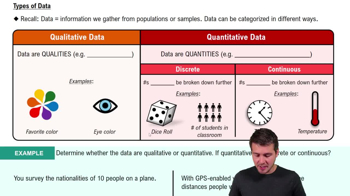
Types of Data

Random Sampling

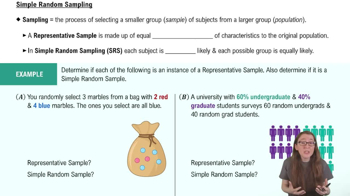
Random sampling is a technique used to ensure that every individual in a population has an equal chance of being selected for a study. If the sampling process is not random, it can lead to biased results, which may explain why a true claim is rejected, as the sample may not accurately represent the population.
Recommended video:
04:17
Simple Random Sampling
Related Practice
Textbook Question

Interpreting a Decision In Exercises 43–48, determine whether the claim represents the null hypothesis or the alternative hypothesis. If a hypothesis test is performed, how should you interpret a decision that


a. rejects the null hypothesis?


Gas Mileage An automotive manufacturer claims that the standard deviation for the gas mileage of one of the vehicles it manufactures is 3.9 miles per gallon.

54
views
Textbook Question

A nutrition bar manufacturer claims that the standard deviation of the number of grams of carbohydrates in a bar is 1.11 grams. A random sample of 26 bars has a standard deviation of 1.19 grams. At α=0.05, is there enough evidence to reject the manufacturer’s claim? Assume the population is normally distributed.

68
views
Textbook Question

[APPLET] A researcher claims that the mean age of the residents of a small town is more than 38 years. The ages (in years) of a random sample of 30 residents are listed below. At α=0.10, is there enough evidence to support the researcher’s claim? Assume the population standard deviation is 9 years.


370
views
Textbook Question

Graphical Analysis In Exercises 9–12, state whether each standardized test statistic t allows you to reject the null hypothesis. Explain.


a. t = -1.755


32
views
Textbook Question

A research center claims that more than 80% of U.S. adults think that mothers should have paid maternity leave. In a random sample of 50 U.S. adults, 82% think that mothers should have paid maternity leave. At α=0.05, is there enough evidence to support the center’s claim?

60
views
Textbook Question

A travel analyst says that the mean price of a meal for a family of 4 in a resort restaurant is at most \$100. A random sample of 33 meal prices for families of 4 has a mean of \$110 and a standard deviation of \$19. At α=0.01, is there enough evidence to reject the analyst’s claim?

54
views