Ch. 8 - Hypothesis Testing with Two Samples
Larson - Elementary Statistics: Picturing the World 8th Edition
Larson8th EditionElementary Statistics: Picturing the WorldISBN: 9780137493470Not the one you use?Change textbook
Chapter 8, Problem 8.CR.14a

[APPLET] The annual earnings (in dollars) for 30 randomly selected locksmiths are shown below. Assume the population is normally distributed. (Adapted from Salary.com)


48,69446,85642,91261,67271,11254,861


69,45471,84159,75169,61254,28452,166


66,36048,16465,27235,25061,12765,397


58,92558,91659,01753,07045,19969,941


69,49257,08553,82952,69268,29853,792


Construct a 95% confidence interval for the population mean annual earnings for locksmiths.

Verified step by step guidance
1
Step 1: Identify the key components of the problem. We are tasked with constructing a 95% confidence interval for the population mean annual earnings of locksmiths. The sample size (n) is 30, and the population is assumed to be normally distributed. The sample data is provided, so we will calculate the sample mean (x̄) and sample standard deviation (s).
Step 2: Calculate the sample mean (x̄). To do this, sum all the earnings data provided and divide by the sample size (n = 30). Use the formula: =xn, where Σx is the sum of all data points.
Step 3: Calculate the sample standard deviation (s). Use the formula: s=(x-)2n-1, where x̄ is the sample mean, x represents each data point, and n is the sample size.
Step 4: Determine the critical value (t*) for a 95% confidence level. Since the sample size is 30, use a t-distribution table with degrees of freedom (df = n - 1 = 29) to find the t* value corresponding to a 95% confidence level.
Step 5: Construct the confidence interval using the formula: [-t*sn,+t*sn], where x̄ is the sample mean, t* is the critical value, s is the sample standard deviation, and n is the sample size.

Verified video answer for a similar problem:

This video solution was recommended by our tutors as helpful for the problem above.
Video duration:
9m
Was this helpful?

Key Concepts

Here are the essential concepts you must grasp in order to answer the question correctly.

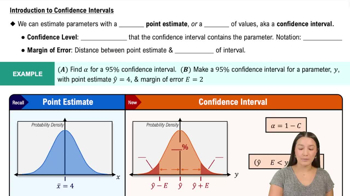
Confidence Interval

A confidence interval is a range of values, derived from sample statistics, that is likely to contain the population parameter with a specified level of confidence, typically expressed as a percentage. For example, a 95% confidence interval suggests that if we were to take many samples and construct intervals in the same way, approximately 95% of those intervals would contain the true population mean.
Recommended video:
06:33
Introduction to Confidence Intervals

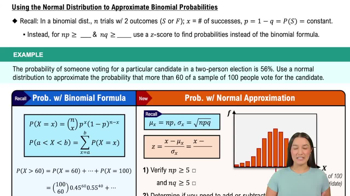
Normal Distribution

Normal distribution is a probability distribution that is symmetric about the mean, showing that data near the mean are more frequent in occurrence than data far from the mean. In the context of this question, assuming the population of locksmiths' earnings is normally distributed allows us to use specific statistical methods to calculate the confidence interval for the mean.
Recommended video:
06:23
Using the Normal Distribution to Approximate Binomial Probabilities

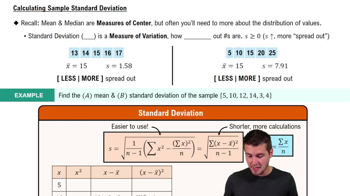
Sample Mean and Standard Deviation

The sample mean is the average of a set of values, calculated by summing all observations and dividing by the number of observations. The sample standard deviation measures the amount of variation or dispersion in a set of values. Both the sample mean and standard deviation are essential for constructing the confidence interval, as they provide the necessary statistics to estimate the range around the population mean.
Recommended video:
Guided course
08:45
Calculating Standard Deviation
Related Practice
Textbook Question

In Exercises 3–6, construct the indicated confidence interval for the population mean . Which distribution did you use to create the confidence interval?


c=0.90, x̅=8.21, σ=0.62, n=8

82
views

Textbook Question

Take this quiz as you would take a quiz in class. After you are done, check your work against the answers given in the back of the book.For each exercise, perform the steps below.

b. Determine whether the hypothesis test is left-tailed, right-tailed, or two-tailed, and whether to use a z-test or a t-test. Explain your reasoning.

The mean score on a reading assessment test for 49 randomly selected male high school students was 279. Assume the population standard deviation is 41. The mean score on the same test for 50 randomly selected female high school students was 292. Assume the population standard deviation is 39. At α=0.05, can you support the claim that the mean score on the reading assessment test for male high school students is less than the mean score for female high school students? (Adapted from National Center for Education Statistics)

55
views
Textbook Question

In Exercises 7–10, the statement represents a claim. Write its complement and state which is Ho and which is Ha.


σ=0.63

42
views
Textbook Question

Take this quiz as you would take a quiz in class. After you are done, check your work against the answers given in the back of the book.For each exercise, perform the steps below.


a. Identify the claim and state Ho and Ha


b. Determine whether the hypothesis test is left-tailed, right-tailed, or two-tailed, and whether to use a z-test or a t-test. Explain your reasoning.


c. Find the critical value(s) and identify the rejection region(s).


d. Find the appropriate standardized test statistic.


e. Decide whether to reject or fail to reject the null hypothesis.


f. Interpret the decision in the context of the original claim.


[APPLET] The table shows the credit scores for 12 randomly selected adults who are considered high-risk borrowers before and two years after they attend a personal finance seminar. At α=0.01, is there enough evidence to support the claim that the personal finance seminar helps adults increase their credit scores? Assume the populations are normally distributed.

68
views
Textbook Question

The mean room rate for two adults for a random sample of 26 three-star hotels in Cincinnati has a sample standard deviation of \$31. Assume the population is normally distributed. (Adapted from Expedia)


Construct a 99% confidence interval for the population variance.

44
views
Textbook Question

[APPLET] The annual earnings (in dollars) for 30 randomly selected locksmiths are shown below. Assume the population is normally distributed. (Adapted from Salary.com)


48,69446,85642,91261,67271,11254,861


69,45471,84159,75169,61254,28452,166


66,36048,16465,27235,25061,12765,397


58,92558,91659,01753,07045,19969,941


69,49257,08553,82952,69268,29853,792


A researcher claims that the mean annual earnings for locksmiths is \$55,000. At α=0.05, can you reject the researcher’s claim? Interpret the decision in the context of the original claim.

40
views