Ch. 8 - Hypothesis Testing with Two Samples
Larson - Elementary Statistics: Picturing the World 8th Edition
Larson8th EditionElementary Statistics: Picturing the WorldISBN: 9780137493470Not the one you use?Change textbook
Chapter 8, Problem 8.2.15

Blue Crabs A marine researcher claims that the stomachs of blue crabs from one location contain more fish than the stomachs of blue crabs from another location. The stomach contents of a sample of 25 blue crabs from Location A contain a mean of 320 milligrams of fish and a standard deviation of 60 milligrams. The stomach contents of a sample of 15 blue crabs from Location B contain a mean of 280 milligrams of fish and a standard deviation of 80 milligrams. At , α= 0.01can you support the marine researcher’s claim? Assume the population variances are equal.

Verified step by step guidance
1
Step 1: Formulate the null and alternative hypotheses. The null hypothesis (H₀) states that the mean amount of fish in the stomachs of blue crabs from Location A is equal to the mean amount from Location B (μ₁ = μ₂). The alternative hypothesis (H₁) states that the mean amount of fish in the stomachs of blue crabs from Location A is greater than that from Location B (μ₁ > μ₂).
Step 2: Identify the test statistic to use. Since the population variances are assumed to be equal, use a two-sample t-test for the difference in means. The test statistic formula is: t = (x̄₁ - x̄₂) / √(sp²(1/n₁ + 1/n₂)), where sp² is the pooled variance, x̄₁ and x̄₂ are the sample means, n₁ and n₂ are the sample sizes, and sp² = [(n₁-1)s₁² + (n₂-1)s₂²] / (n₁ + n₂ - 2).
Step 3: Calculate the pooled variance (sp²). Use the formula sp² = [(n₁-1)s₁² + (n₂-1)s₂²] / (n₁ + n₂ - 2), where s₁ and s₂ are the sample standard deviations, and n₁ and n₂ are the sample sizes. Substitute the given values: n₁ = 25, s₁ = 60, n₂ = 15, s₂ = 80.
Step 4: Compute the t-test statistic. Substitute the values of x̄₁ = 320, x̄₂ = 280, n₁ = 25, n₂ = 15, and the pooled variance (sp²) into the t-test formula: t = (x̄₁ - x̄₂) / √(sp²(1/n₁ + 1/n₂)).
Step 5: Determine the critical value and make a decision. For a one-tailed test at α = 0.01 with degrees of freedom df = n₁ + n₂ - 2, find the critical t-value from the t-distribution table. Compare the calculated t-value to the critical t-value. If the calculated t-value is greater than the critical t-value, reject the null hypothesis and conclude that the marine researcher’s claim is supported. Otherwise, fail to reject the null hypothesis.

Verified video answer for a similar problem:

This video solution was recommended by our tutors as helpful for the problem above.
Video duration:
4m
Was this helpful?

Key Concepts

Here are the essential concepts you must grasp in order to answer the question correctly.

Hypothesis Testing

Hypothesis testing is a statistical method used to make decisions about a population based on sample data. It involves formulating a null hypothesis (H0) that represents no effect or difference, and an alternative hypothesis (H1) that indicates the presence of an effect or difference. In this case, the null hypothesis would state that there is no difference in the mean stomach contents of blue crabs from the two locations.
Recommended video:
Guided course
06:21
Step 1: Write Hypotheses

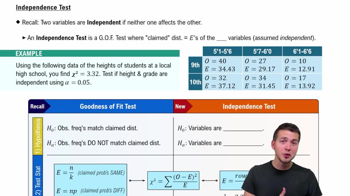
T-test for Independent Samples

A t-test for independent samples is used to compare the means of two groups to determine if they are statistically different from each other. This test assumes that the populations have equal variances and is appropriate when the sample sizes are small. In this scenario, the t-test will help assess whether the mean stomach contents of blue crabs from Location A significantly differ from those in Location B.
Recommended video:
Guided course
06:28
Independence Test

Significance Level (α)

The significance level, denoted as α, is the threshold for determining whether to reject the null hypothesis. It represents the probability of making a Type I error, which occurs when the null hypothesis is incorrectly rejected. In this case, with α set at 0.01, the researcher is allowing only a 1% chance of concluding that there is a difference in means when there is none, thus requiring strong evidence to support the claim.
Recommended video:
03:33
Finding Binomial Probabilities Using TI-84 Example 1
Related Practice
Textbook Question

What conditions are necessary in order to use the z-test to test the difference between two population means?

56
views

Textbook Question

Test the claim about the difference between two population means and at the level of significance α. Assume the samples are random and independent, and the populations are normally distributed.

Claim: μ1=μ2, α=0.01, Assume (σ1)^2=(σ2)^2

93
views
Textbook Question

What conditions are necessary to use the t-test for testing the difference between two population means?

195
views
Textbook Question

[APPLET] Teaching Methods

A new method of teaching reading is being tested on third grade students. A group of third grade students is taught using the new curriculum. A control group of third grade students is taught using the old curriculum. The reading test scores for the two groups are shown in the back-to-back stem-and-leaf plot.

At , α=0.10 is there enough evidence to support the claim that the new method of teaching reading produces higher reading test scores than the old method does? Assume the population variances are equal.

79
views
Textbook Question

Testing the Difference Between Two Means In Exercises 15–24, (a) identify the claim and state Ho and Ha, (b) find the critical value(s) and identify the rejection region(s), (c) find the standardized test statistic z, (d) decide whether to reject or fail to reject the null hypothesis, and (e) interpret the decision in the context of the original claim. Assume the samples are random and independent, and the populations are normally distributed.

Braking Distances To compare the dry braking distances from 60 to 0 miles per hour for two makes of automobiles, a safety engineer conducts braking tests for 16 compact SUVs and 11 midsize SUVs. The mean braking distance for the compact SUVs is 131.8 feet. Assume the population standard deviation is 5.5 feet. The mean braking distance for the midsize SUVs is 132.8 feet. Assume the population standard deviation is 6.7 feet. At α=0.10 , can the engineer support the claim that the mean braking distances are different for the two categories of SUVs? (Adapted from Consumer Reports)

76
views
Textbook Question

In Exercises 11–14, test the claim about the difference between two population means and at the level of significance . Assume the samples are random and independent, and the populations are normally distributed.

Claim: μ1<μ2; α=0.03

Population statistics:σ1=136 and σ2=215

Sample Statistics: x̅1=5004, n1=144, x̅2=4895, n2=156

57
views