
Ch. 8 - Hypothesis Testing with Two Samples
Larson - Elementary Statistics: Picturing the World 8th Edition
Larson8th EditionElementary Statistics: Picturing the WorldISBN: 9780137493470Not the one you use?Change textbook
Chapter 8, Problem 8.2.4

Find the critical value(s) for the alternative hypothesis, level of significance , and sample sizes and . Assume that the samples are random and independent, the populations are normally distributed, and the population variances are (a) equal and (b) not equal.
Ha:μ1>μ2 , α=0.01 , n1=12 , n2=15

Verified step by step guidance
1
Step 1: Identify the type of test. Since the alternative hypothesis is Ha: μ1 > μ2, this is a one-tailed test. The level of significance (α) is given as 0.01.
Step 2: Determine the degrees of freedom. For case (a) where the population variances are equal, use the pooled variance formula to calculate the degrees of freedom: df = n1 + n2 - 2. For case (b) where the population variances are not equal, use the Welch-Satterthwaite approximation: df = [(s1^2/n1 + s2^2/n2)^2] / [(s1^2/n1)^2/(n1-1) + (s2^2/n2)^2/(n2-1)].
Step 3: Locate the critical value for the t-distribution. Use a t-distribution table or statistical software to find the critical t-value corresponding to the one-tailed test with α = 0.01 and the degrees of freedom calculated in Step 2.
Step 4: For case (a), use the pooled standard deviation formula to calculate the test statistic: Sp = sqrt[((n1-1)s1^2 + (n2-1)s2^2) / (n1 + n2 - 2)]. Then, use this pooled standard deviation in the t-test formula: t = (x̄1 - x̄2) / (Sp * sqrt(1/n1 + 1/n2)).
Step 5: For case (b), use the separate variances formula for the test statistic: t = (x̄1 - x̄2) / sqrt(s1^2/n1 + s2^2/n2). Compare the calculated t-value to the critical t-value from Step 3 to determine whether to reject the null hypothesis.

Verified video answer for a similar problem:

This video solution was recommended by our tutors as helpful for the problem above.
Video duration:
5m
Was this helpful?

Key Concepts

Here are the essential concepts you must grasp in order to answer the question correctly.

Critical Value

A critical value is a point on the scale of the test statistic beyond which we reject the null hypothesis. It is determined based on the level of significance (α) and the distribution of the test statistic. In hypothesis testing, critical values help define the rejection region for the test, guiding decisions about whether to accept or reject the null hypothesis.
Recommended video:
05:50
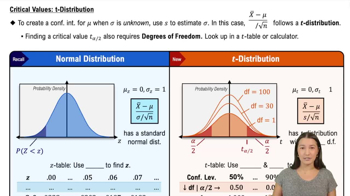
Critical Values: t-Distribution

Level of Significance (α)

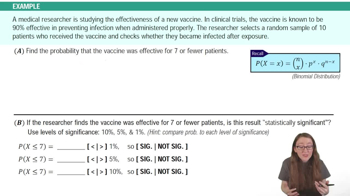
The level of significance, denoted as α, is the probability of rejecting the null hypothesis when it is actually true (Type I error). It represents the threshold for determining whether the observed data is statistically significant. In this case, α is set at 0.01, indicating a 1% risk of making a Type I error, which is a stringent criterion for hypothesis testing.
Recommended video:
03:33
Finding Binomial Probabilities Using TI-84 Example 1

Independent Samples and Population Variances

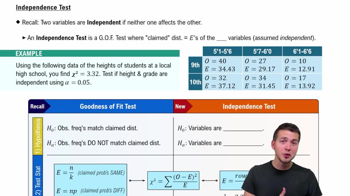
Independent samples refer to two groups that are not related or paired in any way, allowing for the comparison of their means. When testing hypotheses, the assumption about population variances is crucial; if they are equal, a pooled variance approach is used, while unequal variances require a different method, such as Welch's t-test. This distinction affects the calculation of the critical values and the test statistic.
Recommended video:
Guided course
06:28
Independence Test
Related Practice
Textbook Question

Testing the Difference Between Two Means In Exercises 15–24, (a) identify the claim and state Ho and Ha, (b) find the critical value(s) and identify the rejection region(s), (c) find the standardized test statistic z, (d) decide whether to reject or fail to reject the null hypothesis, and (e) interpret the decision in the context of the original claim. Assume the samples are random and independent, and the populations are normally distributed.

ACT Mathematics and Science Scores The mean ACT mathematics score for 60 high school students is 20.2. Assume the population standard deviation is 5.7. The mean ACT science score for 75 high school students is 20.6. Assume the population standard deviation is 5.9. At α=0.01, can you reject the claim that ACT mathematics and science scores are equal? (Source: ACT, Inc.)

47
views
Textbook Question

Test the claim about the difference between two population means and at the level of significance α. Assume the samples are random and independent, and the populations are normally distributed.

Claim: μ1<μ2, α=0.10, Assume (σ1)^2=(σ2)^2

Sample statistics:

x̅1=0.345, s1=0.305 , n1=11 and x̅2=0.515, s2=0.215, n2=9

52
views
Textbook Question

Testing the Difference Between Two Means In Exercises 15–24, (a) identify the claim and state Ho and Ha, (b) find the critical value(s) and identify the rejection region(s), (c) find the standardized test statistic z, (d) decide whether to reject or fail to reject the null hypothesis, and (e) interpret the decision in the context of the original claim. Assume the samples are random and independent, and the populations are normally distributed.

Braking Distances To compare the dry braking distances from 60 to 0 miles per hour for two makes of automobiles, a safety engineer conducts braking tests for 16 compact SUVs and 11 midsize SUVs. The mean braking distance for the compact SUVs is 131.8 feet. Assume the population standard deviation is 5.5 feet. The mean braking distance for the midsize SUVs is 132.8 feet. Assume the population standard deviation is 6.7 feet. At α=0.10 , can the engineer support the claim that the mean braking distances are different for the two categories of SUVs? (Adapted from Consumer Reports)

76
views
Textbook Question

In Exercises 11–14, test the claim about the difference between two population means and at the level of significance . Assume the samples are random and independent, and the populations are normally distributed.

Claim: μ1<μ2; α=0.03

Population statistics:σ1=136 and σ2=215

Sample Statistics: x̅1=5004, n1=144, x̅2=4895, n2=156

57
views
Textbook Question

Independent and Dependent Samples In Exercises 5–8, classify the two samples as independent or dependent and justify your answer.

Sample 1: The IQ scores of 60 females

Sample 2: The IQ scores of 60 males

71
views
Textbook Question

Testing the Difference Between Two Means In Exercises 15–24, (a) identify the claim and state Ho and Ha, (b) find the critical value(s) and identify the rejection region(s), (c) find the standardized test statistic z, (d) decide whether to reject or fail to reject the null hypothesis, and (e) interpret the decision in the context of the original claim. Assume the samples are random and independent, and the populations are normally distributed.

ACT English and Reading Scores The mean ACT English score for 120 high school students is 19.9. Assume the population standard deviation is 7.2. The mean ACT reading score for 150 high school students is 21.2. Assume the population standard deviation is 7.1. At α=0.10, can you support the claim that ACT reading scores are higher than ACT English scores? (Source: ACT, Inc.)

52
views