
Ch. 8 - Hypothesis Testing with Two Samples
Larson - Elementary Statistics: Picturing the World 8th Edition
Larson8th EditionElementary Statistics: Picturing the WorldISBN: 9780137493470Not the one you use?Change textbook
Chapter 8, Problem 8.2.8a

Find the critical value(s) for the alternative hypothesis, level of significance , and sample sizes and . Assume that the samples are random and independent, the populations are normally distributed, and the population variances are (a) equal .
Ha:μ1<μ2 , α=0.10 , n1=30 , n2=32

Verified step by step guidance
1
Identify the type of test based on the alternative hypothesis. Since the alternative hypothesis is \(H_a: \mu_1 < \mu_2\), this is a left-tailed test.
Determine the level of significance \(\alpha = 0.10\). This means the critical region is in the left tail of the distribution with an area of 0.10.
Since the population variances are assumed equal, use the pooled variance \(s_p^2\) and the \(t\)-distribution with degrees of freedom \(df = n_1 + n_2 - 2\).
Calculate the degrees of freedom: \(df = 30 + 32 - 2 = 60\).
Find the critical value \(t_{\alpha, df}\) from the \(t\)-distribution table corresponding to \(\alpha = 0.10\) in the left tail and \(df = 60\). This critical value will be negative because it is a left-tailed test.

Verified video answer for a similar problem:

This video solution was recommended by our tutors as helpful for the problem above.
Video duration:
2m
Was this helpful?

Key Concepts

Here are the essential concepts you must grasp in order to answer the question correctly.

Hypothesis Testing and Alternative Hypothesis

Hypothesis testing is a statistical method used to decide whether there is enough evidence to reject a null hypothesis. The alternative hypothesis (Ha: μ1 < μ2) specifies the direction of the test, indicating that the mean of population 1 is less than that of population 2. Understanding the alternative hypothesis guides the selection of the critical region for the test.
Recommended video:
05:52
Performing Hypothesis Tests: Proportions

Level of Significance (α)

The level of significance, denoted by α, is the probability of rejecting the null hypothesis when it is actually true (Type I error). In this question, α = 0.10 means there is a 10% risk of a false positive. It determines the critical value(s) that define the rejection region for the test statistic.
Recommended video:
03:33
Finding Binomial Probabilities Using TI-84 Example 1

Two-Sample t-Test with Equal Variances

When population variances are assumed equal, a pooled two-sample t-test is used to compare means from two independent samples. The test statistic follows a t-distribution with degrees of freedom based on sample sizes (n1 + n2 - 2). Critical values are found from this distribution to decide whether to reject the null hypothesis.
Recommended video:
Guided course
08:24
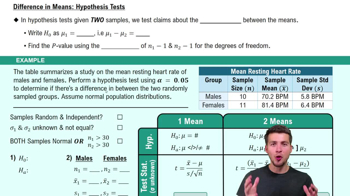
Difference in Means: Hypothesis Tests
Related Practice
Textbook Question

Find the critical value(s) for the alternative hypothesis, level of significance , and sample sizes and . Assume that the samples are random and independent, the populations are normally distributed, and the population variances are (a) equal

Ha:μ1≠μ2 , α=0.01 , n1=19 , n2=22

52
views
Textbook Question

Testing the Difference Between Two Means, (b) find the critical value(s) and identify the rejection region(s), Assume the samples are random and dependent, and the populations are normally distributed.

[APPLET] Migraines

A researcher claims that injections of onabotulinumtoxinA reduce the number of days per month that chronic migraine sufferers have headaches. The table shows the number of days chronic migraine sufferers suffered migraines before and after using the treatment. At , α= 0.01 is there enough evidence to support the researcher’s claim? (Adapted from Journal of Headache and Pain)

44
views
Textbook Question

The mean room rate for two adults for a random sample of 26 three-star hotels in Cincinnati has a sample standard deviation of \$31. Assume the population is normally distributed. (Adapted from Expedia)


Construct a 99% confidence interval for the population standard deviation.

39
views
Textbook Question

Find the critical value(s) for the alternative hypothesis, level of significance , and sample sizes and . Assume that the samples are random and independent, the populations are normally distributed, and the population variances are (a) equal

Ha:μ1<μ2 , α=0.05 , n1=7 , n2=11

54
views
Textbook Question

Testing the Difference Between Two Means (a) identify the claim and state Ho and Ha ,Assume the samples are random and dependent, and the populations are normally distributed.

Interval Training

A researcher claims that sprint interval training improves running performance in trained athletes. The table shows the maximum aerobic speed (MAS), in kilometers per hour, of trained athletes before and after six sessions of sprint interval training. At , α=0.10 is there enough evidence to support the researcher’s claim? (Adapted from National Strength and Conditioning Association)

44
views
Textbook Question

Testing the Difference Between Two Means (b) find the critical value(s) and identify the rejection region(s), Assume the samples are random and dependent, and the populations are normally distributed.

[APPLET] Passing Play Percentages The passing play percentages of 10 randomly selected NCAA Division 1A college football teams for home and away games in the 2020–2021 season are shown in the table. At , α=0.20 is there enough evidence to support the claim that passing play percentage is different for home and away games? (Source: TeamRankings)

42
views