Ch. 8 - Hypothesis Testing with Two Samples
Larson - Elementary Statistics: Picturing the World 8th Edition
Larson8th EditionElementary Statistics: Picturing the WorldISBN: 9780137493470Not the one you use?Change textbook
Chapter 8, Problem 8.RE.18a

In Exercises 17 and 18, (a) identify the claim and state Ho and Ha, Assume the samples are random and independent, and the populations are normally distributed.


A real estate agent claims that there is no difference between the mean household incomes of two neighborhoods. The mean income of 12 randomly selected households from the first neighborhood is \$52,750 with a standard deviation of \$2900. In the second neighborhood, 10 randomly selected households have a mean income of \$51,200 with a standard deviation of \$2225. At α=0.01, can you reject the real estate agent’s claim? Assume the population variances are equal.

Verified step by step guidance
1
Step 1: Identify the claim and state the null hypothesis (H\_0) and the alternative hypothesis (H\_a). The claim is that there is no difference between the mean household incomes of the two neighborhoods. Therefore, the null hypothesis is H\_0: \(\mu\)_1 = \(\mu\)_2, and the alternative hypothesis is H\_a: \(\mu\)_1 \(\neq\) \(\mu\)_2, where \(\mu\)_1 and \(\mu\)_2 are the population means of the first and second neighborhoods, respectively.
Step 2: Note the given sample statistics: For the first neighborhood, sample size n_1 = 12, sample mean \(\bar{x}\)_1 = 52750, and sample standard deviation s_1 = 2900. For the second neighborhood, sample size n_2 = 10, sample mean \(\bar{x}\)_2 = 51200, and sample standard deviation s_2 = 2225. The significance level is \(\alpha\) = 0.01.
Step 3: Since the population variances are assumed equal, calculate the pooled sample variance (s_p^2) using the formula: \(s\_p^2 = \frac{(n_1 - 1)s_1^2 + (n_2 - 1)s_2^2}{n_1 + n_2 - 2}\)
Step 4: Calculate the test statistic t using the formula for two independent samples with equal variances: \(t = \frac{\bar{x}_1 - \bar{x}_2}{s_p \sqrt{\frac{1}{n_1} + \frac{1}{n_2}}}\)
Step 5: Determine the degrees of freedom, which is \(df = n_1 + n_2 - 2\). Then, find the critical t-value(s) from the t-distribution table for a two-tailed test at significance level \(\alpha\) = 0.01. Compare the calculated t statistic with the critical t-value(s) to decide whether to reject or fail to reject the null hypothesis.

Verified video answer for a similar problem:

This video solution was recommended by our tutors as helpful for the problem above.
Video duration:
2m
Was this helpful?

Key Concepts

Here are the essential concepts you must grasp in order to answer the question correctly.

Hypothesis Testing

Hypothesis testing is a statistical method used to decide whether there is enough evidence to reject a claim about a population parameter. It involves stating a null hypothesis (Ho) representing no effect or difference, and an alternative hypothesis (Ha) representing the claim to be tested. The test evaluates sample data to determine if the observed effect is statistically significant at a chosen significance level (α).
Recommended video:
05:52
Performing Hypothesis Tests: Proportions

Two-Sample t-Test for Means with Equal Variances

This test compares the means of two independent samples to determine if there is a significant difference between their population means, assuming equal population variances. It uses a pooled estimate of variance and calculates a t-statistic based on sample means, standard deviations, and sizes. The test is appropriate when samples are random, independent, and populations are normally distributed.
Recommended video:
Guided course
08:24
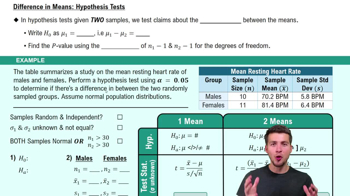
Difference in Means: Hypothesis Tests

Significance Level and Decision Rule

The significance level (α) defines the threshold for rejecting the null hypothesis, commonly set at 0.01 or 0.05. It represents the probability of making a Type I error—rejecting a true null hypothesis. After calculating the test statistic, it is compared to critical values from the t-distribution; if the statistic falls in the rejection region, the null hypothesis is rejected, supporting the alternative claim.
Recommended video:
03:53
Conditional Probability Rule
Related Practice
Textbook Question

In Exercises 11–16, test the claim about the difference between two population means μ1 and μ2 at the level of significance α. Assume the samples are random and independent, and the populations are normally distributed.


Claim: μ1>= μ2; α=0.01. Assume (σ1)^2 = (σ2)^2


Sample statistics: x̅1= 44.5, s1= 5.85, n1= 17 and x̅2= 49.1, s2= 5.25, n2= 18

55
views
Textbook Question

In Exercises 25–28, determine whether a normal sampling distribution can be used. If it can be used, test the claim about the difference between two population proportions p1 and p2 at the level of significance α. Assume the samples are random and independent.


Claim: p1<p2; α=0.05


Sample statistics: x1 = 86, n1=900 and x2 = 107, n2 = 1200

90
views
Textbook Question

In Exercises 1–4, classify the two samples as independent or dependent and justify your answer.


Sample 1: The weights of 45 oranges

Sample 2: The weights of 40 grapefruits


71
views
Textbook Question

In Exercises 11–16, test the claim about the difference between two population means μ1 and μ2 at the level of significance α. Assume the samples are random and independent, and the populations are normally distributed.


Claim: μ1≠ μ2; α=0.01. Assume (σ1)^2 = (σ2)^2


Sample statistics: x̅1= 61, s1= 3.3, n1= 5 and x̅2= 55.1, s2= 1.2, n2= 7

50
views
Textbook Question

"In Exercises 9 and 10, (a) identify the claim and state Ho and Ha , (b) find the critical value(s) and identify the rejection region(s), (c) find the standardized test statistic z, (d) decide whether to reject or fail to reject the null hypothesis, and (e) interpret the decision in the context of the original claim. Assume the samples are random and independent, and the populations are normally distributed.


A career counselor claims that the mean annual salaries of entry level paralegals in Dayton, Ohio, and Coventry, Rhode Island, are the same. The mean annual salary of 40 randomly selected entry level paralegals in Dayton is \$58,180. Assume the population standard deviation is \$10,990. The mean annual salary of 35 randomly selected entry level paralegals in Coventry is \$61,120. Assume the population standard deviation is \$11,850. At α=0.10, is there enough evidence to reject the counselor’s claim? (Adapted from Salary.com)"

40
views
Textbook Question

In Exercises 5–8, test the claim about the difference between two population means μ1 and μ2 at the level of significance α. Assume the samples are random and independent, and the populations are normally distributed.


Claim: μ1<μ2; α=0.10


Population statistics: σ1= 0.11 and σ2= 0.10


Sample statistics: x̅1 = 0.28, n1 = 41, and x̅2= 0.33, n2= 34

45
views