Ch. 8 - Hypothesis Testing with Two Samples
Larson - Elementary Statistics: Picturing the World 8th Edition
Larson8th EditionElementary Statistics: Picturing the WorldISBN: 9780137493470Not the one you use?Change textbook
Chapter 8, Problem 8.RE.6

In Exercises 5–8, test the claim about the difference between two population means μ1 and μ2 at the level of significance α. Assume the samples are random and independent, and the populations are normally distributed.


Claim: μ1=μ2; α=0.01


Population statistics: σ1= 52 and σ2= 68


Sample statistics: x̅1 = 5595, n1 = 156, and x̅2= 5575, n2= 216

Verified step by step guidance
1
Identify the null hypothesis \(H_0\) and the alternative hypothesis \(H_a\). Since the claim is \(\mu_1 = \mu_2\), the hypotheses are: \(H_0: \mu_1 = \mu_2\) and \(H_a: \mu_1 \neq \mu_2\) (two-tailed test).
Determine the significance level \(\alpha = 0.01\) and find the corresponding critical z-values for a two-tailed test. These critical values define the rejection regions for the test statistic.
Calculate the standard error of the difference between the two sample means using the population standard deviations and sample sizes with the formula: \(SE = \sqrt{\frac{\sigma_1^2}{n_1} + \frac{\sigma_2^2}{n_2}}\)
Compute the test statistic (z-score) for the difference between the sample means using the formula: \(z = \frac{(\bar{x}_1 - \bar{x}_2) - (\mu_1 - \mu_2)}{SE}\) Since the null hypothesis assumes \(\mu_1 - \mu_2 = 0\), this simplifies to: \(z = \frac{\bar{x}_1 - \bar{x}_2}{SE}\)
Compare the calculated z-value to the critical z-values. If the test statistic falls into the rejection region (beyond the critical values), reject the null hypothesis; otherwise, fail to reject it.

Verified video answer for a similar problem:

This video solution was recommended by our tutors as helpful for the problem above.
Video duration:
5m
Was this helpful?

Key Concepts

Here are the essential concepts you must grasp in order to answer the question correctly.

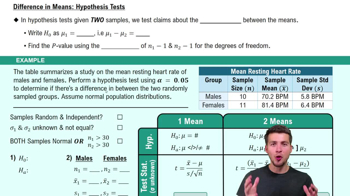
Hypothesis Testing for Two Population Means

This involves comparing two population means to determine if there is a statistically significant difference. The null hypothesis (H0) typically states that the means are equal (μ1 = μ2), while the alternative suggests a difference. The test uses sample data to decide whether to reject H0 at a given significance level (α).
Recommended video:
Guided course
08:24
Difference in Means: Hypothesis Tests

Level of Significance (α)

The level of significance, α, is the threshold probability for rejecting the null hypothesis when it is true (Type I error). A smaller α (e.g., 0.01) means stricter criteria for rejecting H0, reducing the chance of false positives but requiring stronger evidence from the data.
Recommended video:
03:33
Finding Binomial Probabilities Using TI-84 Example 1

Sampling Distribution and Standard Error

The sampling distribution of the difference between sample means is approximately normal if populations are normal and samples are independent. The standard error measures the variability of this difference and is calculated using population standard deviations and sample sizes, essential for computing the test statistic.
Recommended video:
05:11
Sampling Distribution of Sample Proportion
Related Practice
Textbook Question

In Exercises 25–28, determine whether a normal sampling distribution can be used. If it can be used, test the claim about the difference between two population proportions p1 and p2 at the level of significance α. Assume the samples are random and independent.


Claim: p1<p2; α=0.05


Sample statistics: x1 = 86, n1=900 and x2 = 107, n2 = 1200

90
views
Textbook Question

In Exercises 17 and 18, (e) interpret the decision in the context of the original claim. Assume the samples are random and independent, and the populations are normally distributed.


A real estate agent claims that there is no difference between the mean household incomes of two neighborhoods. The mean income of 12 randomly selected households from the first neighborhood is \$52,750 with a standard deviation of \$2900. In the second neighborhood, 10 randomly selected households have a mean income of \$51,200 with a standard deviation of \$2225. At α=0.01, can you reject the real estate agent’s claim? Assume the population variances are equal.

47
views
Textbook Question

In Exercises 19–22, test the claim about the mean of the differences for a population of paired data at the level of significance α. Assume the samples are random and dependent, and the populations are normally distributed.


Claim: μd≠0; α=0.05.


Sample statistics: d̄=17.5, sd=4.05, n=37


86
views
Textbook Question

In Exercises 1–4, classify the two samples as independent or dependent and justify your answer.


Sample 1: The heights of 37 children

Sample 2: The heights of the same 37 children after 1 year

68
views
Textbook Question

In Exercises 11–16, test the claim about the difference between two population means μ1 and μ2 at the level of significance α. Assume the samples are random and independent, and the populations are normally distributed.


Claim: μ1< μ2; α=0.10. Assume (σ1)^2 ≠ (σ2)^2


Sample statistics: x̅1=0.015, s1=0.011, n1= 8 and x̅2=0.019, s2=0.004, n2= 6

68
views
Textbook Question

"In Exercises 9 and 10, (a) identify the claim and state Ho and Ha , (b) find the critical value(s) and identify the rejection region(s), (c) find the standardized test statistic z, (d) decide whether to reject or fail to reject the null hypothesis, and (e) interpret the decision in the context of the original claim. Assume the samples are random and independent, and the populations are normally distributed.


A career counselor claims that the mean annual salaries of entry level paralegals in Dayton, Ohio, and Coventry, Rhode Island, are the same. The mean annual salary of 40 randomly selected entry level paralegals in Dayton is \$58,180. Assume the population standard deviation is \$10,990. The mean annual salary of 35 randomly selected entry level paralegals in Coventry is \$61,120. Assume the population standard deviation is \$11,850. At α=0.10, is there enough evidence to reject the counselor’s claim? (Adapted from Salary.com)"

40
views