
Ch. 8 - Hypothesis Testing with Two Samples
Larson - Elementary Statistics: Picturing the World 8th Edition
Larson8th EditionElementary Statistics: Picturing the WorldISBN: 9780137493470Not the one you use?Change textbook
Chapter 8, Problem 8.Q.1f

Take this quiz as you would take a quiz in class. After you are done, check your work against the answers given in the back of the book.For each exercise, perform the steps below.

f. Interpret the decision in the context of the original claim.

The mean score on a reading assessment test for 49 randomly selected male high school students was 279. Assume the population standard deviation is 41. The mean score on the same test for 50 randomly selected female high school students was 292. Assume the population standard deviation is 39. At α=0.05, can you support the claim that the mean score on the reading assessment test for male high school students is less than the mean score for female high school students? (Adapted from National Center for Education Statistics)

Verified step by step guidance
1
Identify the null and alternative hypotheses based on the claim. Since the claim is that the mean score for male students is less than that for female students, set up the hypotheses as: \(H_0: \mu_{male} \geq \mu_{female}\) and \(H_a: \mu_{male} < \mu_{female}\).
Determine the significance level \(\alpha = 0.05\) and note the sample sizes (\(n_{male} = 49\), \(n_{female} = 50\)), sample means (\(\bar{x}_{male} = 279\), \(\bar{x}_{female} = 292\)), and population standard deviations (\(\sigma_{male} = 41\), \(\sigma_{female} = 39\)).
Calculate the test statistic for the difference between two means when population standard deviations are known, using the formula: \(Z = \frac{(\bar{x}_{male} - \bar{x}_{female}) - (\mu_{male} - \mu_{female})}{\sqrt{\frac{\sigma_{male}^2}{n_{male}} + \frac{\sigma_{female}^2}{n_{female}}}}\) Since under the null hypothesis \(\mu_{male} - \mu_{female} = 0\), simplify accordingly.
Find the critical value for a left-tailed test at \(\alpha = 0.05\) from the standard normal distribution (Z-distribution). Compare the calculated test statistic to this critical value to decide whether to reject or fail to reject the null hypothesis.
Interpret the decision in the context of the original claim: if you reject \(H_0\), it supports the claim that the mean score for male students is less than that for female students; if you fail to reject \(H_0\), there is not enough evidence to support the claim.

Verified video answer for a similar problem:

This video solution was recommended by our tutors as helpful for the problem above.
Video duration:
6m
Was this helpful?

Key Concepts

Here are the essential concepts you must grasp in order to answer the question correctly.

Hypothesis Testing

Hypothesis testing is a statistical method used to decide whether there is enough evidence to support a specific claim about a population parameter. It involves formulating a null hypothesis (no effect or difference) and an alternative hypothesis (the claim), then using sample data to determine whether to reject the null hypothesis at a given significance level (α).
Recommended video:
05:52
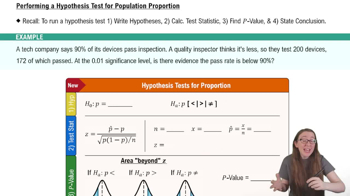
Performing Hypothesis Tests: Proportions

Two-Sample Z-Test for Means

A two-sample z-test compares the means of two independent populations when the population standard deviations are known. It calculates a z-score to assess whether the difference between sample means is statistically significant, considering sample sizes, means, and standard deviations, under the assumption of normality or large samples.
Recommended video:
06:53
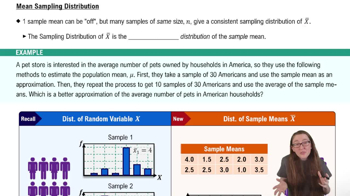
Sampling Distribution of Sample Mean

Significance Level and Decision Rule

The significance level (α) is the threshold probability for rejecting the null hypothesis, commonly set at 0.05. The decision rule compares the test statistic to critical values or p-values; if the test statistic falls in the rejection region or the p-value is less than α, the null hypothesis is rejected, supporting the alternative claim in context.
Recommended video:
03:53
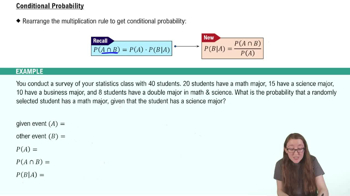
Conditional Probability Rule
Related Practice
Textbook Question

Take this quiz as you would take a quiz in class. After you are done, check your work against the answers given in the back of the book.For each exercise, perform the steps below.

b. Determine whether the hypothesis test is left-tailed, right-tailed, or two-tailed, and whether to use a z-test or a t-test. Explain your reasoning.

The mean score on a reading assessment test for 49 randomly selected male high school students was 279. Assume the population standard deviation is 41. The mean score on the same test for 50 randomly selected female high school students was 292. Assume the population standard deviation is 39. At α=0.05, can you support the claim that the mean score on the reading assessment test for male high school students is less than the mean score for female high school students? (Adapted from National Center for Education Statistics)

55
views
Textbook Question

Take this quiz as you would take a quiz in class. After you are done, check your work against the answers given in the back of the book.For each exercise, perform the steps below.


c. Find the critical value(s) and identify the rejection region(s).

The mean score on a reading assessment test for 49 randomly selected male high school students was 279. Assume the population standard deviation is 41. The mean score on the same test for 50 randomly selected female high school students was 292. Assume the population standard deviation is 39. At α=0.05, can you support the claim that the mean score on the reading assessment test for male high school students is less than the mean score for female high school students? (Adapted from National Center for Education Statistics)

62
views
Textbook Question

In Exercises 7–10, the statement represents a claim. Write its complement and state which is Ho and which is Ha.


σ=0.63

42
views
Textbook Question

Take this quiz as you would take a quiz in class. After you are done, check your work against the answers given in the back of the book.For each exercise, perform the steps below.


a. Identify the claim and state Ho and Ha


b. Determine whether the hypothesis test is left-tailed, right-tailed, or two-tailed, and whether to use a z-test or a t-test. Explain your reasoning.


c. Find the critical value(s) and identify the rejection region(s).


d. Find the appropriate standardized test statistic.


e. Decide whether to reject or fail to reject the null hypothesis.


f. Interpret the decision in the context of the original claim.


[APPLET] The table shows the credit scores for 12 randomly selected adults who are considered high-risk borrowers before and two years after they attend a personal finance seminar. At α=0.01, is there enough evidence to support the claim that the personal finance seminar helps adults increase their credit scores? Assume the populations are normally distributed.

68
views
Textbook Question

Take this quiz as you would take a quiz in class. After you are done, check your work against the answers given in the back of the book.For each exercise, perform the steps below.


a. Identify the claim and state Ho and Ha


The mean score on a reading assessment test for 49 randomly selected male high school students was 279. Assume the population standard deviation is 41. The mean score on the same test for 50 randomly selected female high school students was 292. Assume the population standard deviation is 39. (Adapted from National Center for Education Statistics)

33
views
Textbook Question

Take this quiz as you would take a quiz in class. After you are done, check your work against the answers given in the back of the book.For each exercise, perform the steps below.


a. Identify the claim and state Ho and Ha


b. Determine whether the hypothesis test is left-tailed, right-tailed, or two-tailed, and whether to use a z-test or a t-test. Explain your reasoning.


c. Find the critical value(s) and identify the rejection region(s).


d. Find the appropriate standardized test statistic.


e. Decide whether to reject or fail to reject the null hypothesis.


f. Interpret the decision in the context of the original claim.


A music teacher claims that the mean scores on a music assessment test for eighth grade students in public and private schools are equal. The mean score for 13 randomly selected public school students is 146 with a standard deviation of 49, and the mean score for 15 randomly selected private school students is 160 with a standard deviation of 42. At α=0.1, can you reject the teacher’s claim? Assume the populations are normally distributed and the population variances are equal. (Adapted from National Center for Education Statistics)

61
views