Ch. 8 - Hypothesis Testing with Two Samples
Larson - Elementary Statistics: Picturing the World 8th Edition
Larson8th EditionElementary Statistics: Picturing the WorldISBN: 9780137493470Not the one you use?Change textbook
Chapter 8, Problem 8.3.5

Test the claim about the mean of the differences for a population of paired data at the level of significance α. Assume the samples are random and dependent, and the populations are normally distributed.
Claim: μd≤0 , α=0.10, Sample statistics: d̄ =6.5, sd=9.54, n=16

Verified step by step guidance
1
Step 1: Identify the null hypothesis (H₀) and the alternative hypothesis (H₁). The claim is μd ≤ 0, so the null hypothesis is H₀: μd ≤ 0, and the alternative hypothesis is H₁: μd > 0 (this is a right-tailed test).
Step 2: Calculate the test statistic using the formula for a t-test for paired data: t = (d̄ - μ₀) / (sd / √n), where d̄ is the sample mean of the differences, μ₀ is the hypothesized mean difference (0 in this case), sd is the standard deviation of the differences, and n is the sample size.
Step 3: Determine the degrees of freedom (df) for the t-distribution. For paired data, df = n - 1. In this case, df = 16 - 1 = 15.
Step 4: Find the critical value for the t-distribution at the given significance level α = 0.10 for a right-tailed test with df = 15. Use a t-table or statistical software to find this value.
Step 5: Compare the calculated test statistic to the critical value. If the test statistic is greater than the critical value, reject the null hypothesis H₀. Otherwise, fail to reject H₀. Interpret the result in the context of the claim.

Verified video answer for a similar problem:

This video solution was recommended by our tutors as helpful for the problem above.
Video duration:
3m
Was this helpful?

Key Concepts

Here are the essential concepts you must grasp in order to answer the question correctly.

Paired Data

Paired data refers to two sets of related observations, often collected from the same subjects under different conditions. This dependency allows for the analysis of differences between paired observations, which is crucial for tests like the paired t-test. Understanding paired data is essential for accurately interpreting results and making valid inferences about the population from which the samples are drawn.
Recommended video:
4:01
Introduction to Collecting Data

Hypothesis Testing

Hypothesis testing is a statistical method used to determine whether there is enough evidence to reject a null hypothesis in favor of an alternative hypothesis. In this context, the null hypothesis states that the mean of the differences (μd) is less than or equal to zero. The level of significance (α) indicates the probability of making a Type I error, which is rejecting a true null hypothesis, and is set at 0.10 in this case.
Recommended video:
Guided course
06:21
Step 1: Write Hypotheses

t-Distribution

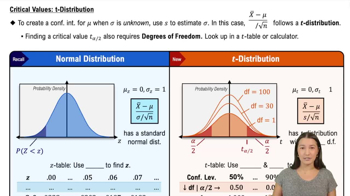
The t-distribution is a probability distribution used in hypothesis testing when the sample size is small and the population standard deviation is unknown. It is similar to the normal distribution but has heavier tails, which accounts for the increased variability in smaller samples. In this scenario, the t-distribution is used to calculate the test statistic based on the sample mean difference, standard deviation, and sample size, allowing for inference about the population mean difference.
Recommended video:
05:50
Critical Values: t-Distribution
Related Practice
Textbook Question

In Exercises 7–10, the statement represents a claim. Write its complement and state which is Ho and which is Ha.


μ≠2.28

40
views

Textbook Question

What conditions are necessary to use the z-test for testing the difference between two population proportions?

237
views
Textbook Question

Testing the Difference Between Two Means (a) identify the claim and state Ho and Ha , (b) find the critical value(s) and identify the rejection region(s), (c) calculate d̄ and Sd, (d) find the standardized test statistic t, (e) decide whether to reject or fail to reject the null hypothesis, and (f) interpret the decision in the context of the original claim. Assume the samples are random and dependent, and the populations are normally distributed.

[APPLET] Therapeutic Taping

A physical therapist claims that the use of a specific type of therapeutic tape reduces pain in patients with chronic tennis elbow. The table shows the pain levels on a scale of 0 to 10, where 0 is no pain and 10 is the worst pain possible, for 15 patients with chronic tennis elbow when holding a 1 kilogram weight. At , α=0.05 is there enough evidence to support the therapist’s claim? (Adapted from BioMed Central, Ltd.)

79
views
Textbook Question

Constructing Confidence Intervals for μ1-μ2, When the sampling distribution for x̅1-x̅2 is approximated by a t-distribution and the population variances are not equal, you can construct a confidence interval for μ1-μ2 , as shown below.

construct the indicated confidence interval for μ1-μ2 . Assume the populations are approximately normal with unequal variances.

10K Race

To compare the mean finishing times of male and female participants in a 10K race, you randomly select several finishing times from both sexes. The results are shown at the left. Construct an 80% confidence interval for the difference in mean finishing times of male and female participants in the race. (Adapted from Great Race)


75
views
Textbook Question

Gas Mileage The table shows the gas mileages (in miles per gallon) of eight cars with and without using a fuel additive. At α=0.10, is there enough evidence to conclude that the additive improved gas mileage? Assume the populations are normally distributed.


48
views
Textbook Question

A pediatrician claims that the mean birth weight of a single-birth baby is greater than the mean birth weight of a baby that has a twin. The mean birth weight of a random sample of 85 single-birth babies is 3086 grams. Assume the population standard deviation is 563 grams. The mean birth weight of a random sample of 68 babies that have a twin is 2263 grams. Assume the population standard deviation is 624 grams. At α=0.10, can you support the pediatrician’s claim? Interpret the decision in the context of the original claim.

55
views