
Ch. 8 - Hypothesis Testing with Two Samples
Larson - Elementary Statistics: Picturing the World 8th Edition
Larson8th EditionElementary Statistics: Picturing the WorldISBN: 9780137493470Not the one you use?Change textbook
Chapter 8, Problem 8.2.16

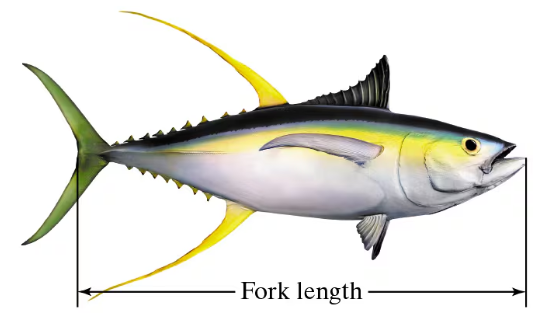
Yellowfin Tuna
A marine biologist claims that the mean fork length (see figure at the left) of yellowfin tuna is different in two zones in the eastern tropical Pacific Ocean. A sample of 26 yellowfin tuna collected in Zone A has a mean fork length of 76.2 centimeters and a standard deviation of 16.5 centimeters. A sample of 31 yellowfin tuna collected in Zone B has a mean fork length of 80.8 centimeters and a standard deviation of 23.4 centimeters. At ,α=0.01 can you support the marine biologist’s claim? Assume the population variances are equal. (Adapted from Fishery Bulletin)
Illustration of a yellowfin tuna with arrows indicating the fork length measurement from head to tail fork.

Verified step by step guidance
1
Step 1: Identify the hypotheses for the two-sample t-test. Since the marine biologist claims the mean fork lengths are different, set the null hypothesis as \(H_0: \mu_A = \mu_B\) and the alternative hypothesis as \(H_a: \mu_A \neq \mu_B\).
Step 2: Note the given data: Sample sizes \(n_A = 26\), \(n_B = 31\); sample means \(\bar{x}_A = 76.2\), \(\bar{x}_B = 80.8\); sample standard deviations \(s_A = 16.5\), \(s_B = 23.4\); and significance level \(\alpha = 0.01\). Assume equal population variances.
Step 3: Calculate the pooled standard deviation \(s_p\) using the formula: \[s_p = \sqrt{\frac{(n_A - 1)s_A^2 + (n_B - 1)s_B^2}{n_A + n_B - 2}}\]
Step 4: Compute the test statistic \(t\) using the formula: \[t = \frac{\bar{x}_A - \bar{x}_B}{s_p \sqrt{\frac{1}{n_A} + \frac{1}{n_B}}}\]
Step 5: Determine the degrees of freedom \(df = n_A + n_B - 2\), find the critical t-value for a two-tailed test at \(\alpha = 0.01\), and compare the calculated \(t\) to the critical value to decide whether to reject or fail to reject the null hypothesis.

Verified video answer for a similar problem:

This video solution was recommended by our tutors as helpful for the problem above.
Video duration:
8m
Was this helpful?

Key Concepts

Here are the essential concepts you must grasp in order to answer the question correctly.

Two-Sample t-Test for Means

This test compares the means of two independent samples to determine if there is a statistically significant difference between them. It is appropriate when comparing measurements like fork lengths from two different zones. The test uses sample means, standard deviations, and sizes to calculate a t-statistic.
Recommended video:
06:53
Sampling Distribution of Sample Mean

Assumption of Equal Population Variances

When performing a two-sample t-test, assuming equal variances means the variability in both populations is similar. This assumption allows pooling the sample variances to get a more accurate estimate of the common variance, which affects the calculation of the test statistic and degrees of freedom.
Recommended video:
04:48
Population Standard Deviation Known

Significance Level and Hypothesis Testing

The significance level (α = 0.01) defines the threshold for rejecting the null hypothesis, indicating a 1% risk of a Type I error. Hypothesis testing involves setting a null hypothesis (no difference in means) and an alternative hypothesis (means differ), then using the test statistic and critical value to decide whether to support the claim.
Recommended video:
05:52
Performing Hypothesis Tests: Proportions
Related Practice
Textbook Question

Testing the Difference Between Two Means In Exercises 15–24, (a) identify the claim and state Ho and Ha, (b) find the critical value(s) and identify the rejection region(s), (c) find the standardized test statistic z, (d) decide whether to reject or fail to reject the null hypothesis, and (e) interpret the decision in the context of the original claim. Assume the samples are random and independent, and the populations are normally distributed.

Repair Costs: Washing Machines You want to buy a washing machine, and a salesperson tells you that the mean repair costs for Model A and Model B are equal. You research the repair costs. The mean repair cost of 24 Model A washing machines is \$208. Assume the population standard deviation is \$18. The mean repair cost of 26 Model B washing machines is \$221. Assume the population standard deviation is \$22. At α=0.01, can you reject the salesperson’s claim?

72
views
Textbook Question

Parks and Mental Health In Exercises 13–18, use the figure, which shows the percentages from a survey of two hundred 18- to 24-year-olds in the United States who say that various park and recreation activities have a positive impact on their mental health. (Adapted from National Recreation and Park Association)


Taking Classes and Enjoying Nature At α=0.05, can you support the claim that the proportion of 18- to 24-year-olds who benefit mentally from taking classes in parks is less than the proportion who benefit mentally from enjoying nature in parks?

38
views
Textbook Question

Test the claim about the mean of the differences for a population of paired data at the level of significance α. Assume the samples are random and dependent, and the populations are normally distributed.

Claim: μd≠0 , α=0.10, Sample statistics: d̄ =-1, sd=2.75, n=20

86
views