Ch. 9 - Correlation and Regression
Larson - Elementary Statistics: Picturing the World 8th Edition
Larson8th EditionElementary Statistics: Picturing the WorldISBN: 9780137493470Not the one you use?Change textbook
Chapter 9, Problem 9.1.30

In Exercise 24, remove the data for the student who is 57 inches tall and scored 128 on the IQ test. Describe how this affects the correlation coefficient r.

Verified step by step guidance
1
Identify the formula for the correlation coefficient (r), which measures the strength and direction of the linear relationship between two variables. The formula is: r = (x-)(y-)(x-)2(y-)2.
Remove the data point for the student who is 57 inches tall and scored 128 on the IQ test. This means you will exclude this pair of values (x = 57, y = 128) from the dataset.
Recalculate the means of the x-values (height) and y-values (IQ scores) after removing the data point. The means are calculated as: = x/n and = y/n, where n is the new number of data points.
Recompute the numerator and denominator of the correlation coefficient formula using the updated dataset. Specifically, calculate the sum of the products of deviations for x and y, and the square root of the sum of squared deviations for x and y.
Compare the new correlation coefficient (r) with the original one. Removing an outlier (if the data point was an outlier) typically results in a stronger correlation (r moves closer to 1 or -1), but this depends on the specific dataset and the influence of the removed point.

Verified video answer for a similar problem:

This video solution was recommended by our tutors as helpful for the problem above.
Video duration:
4m
Was this helpful?

Key Concepts

Here are the essential concepts you must grasp in order to answer the question correctly.

Correlation Coefficient (r)

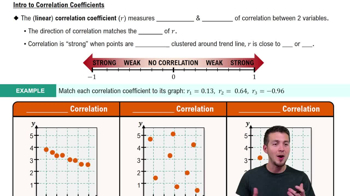
The correlation coefficient, denoted as r, quantifies the strength and direction of a linear relationship between two variables. It ranges from -1 to 1, where values close to 1 indicate a strong positive correlation, values close to -1 indicate a strong negative correlation, and values around 0 suggest no correlation. Understanding r is crucial for interpreting how changes in one variable may relate to changes in another.
Recommended video:
Guided course
05:43
Correlation Coefficient

Outliers

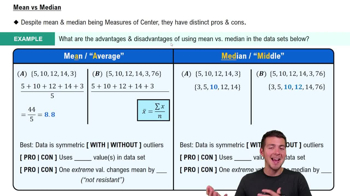
Outliers are data points that differ significantly from other observations in a dataset. They can skew results and affect statistical measures, including the correlation coefficient. In this context, removing the data for the student who is 57 inches tall and scored 128 on the IQ test may alter the correlation by either strengthening or weakening the relationship between height and IQ, depending on how this data point relates to the overall trend.
Recommended video:
Guided course
04:48
Comparing Mean vs. Median

Impact of Data Removal

Removing data points can significantly influence statistical analyses, particularly in correlation studies. The impact of data removal on the correlation coefficient depends on the nature of the removed data point—whether it is an outlier or part of the main trend. Analyzing how the correlation coefficient changes after data removal helps in understanding the robustness of the relationship between the variables being studied.
Recommended video:
4:01
Introduction to Collecting Data
Related Practice