Ch. 9 - Correlation and Regression
Larson - Elementary Statistics: Picturing the World 8th Edition
Larson8th EditionElementary Statistics: Picturing the WorldISBN: 9780137493470Not the one you use?Change textbook
Chapter 9, Problem 9.RE.13

"In Exercises 13-16, use the value of the correlation coefficient r to calculate the coefficient of determination r^2. What does this tell you about the explained variation of the data about the regression line? about the unexplained variation?
13. r =- 0.450"

Verified step by step guidance
1
Step 1: Understand the problem. The correlation coefficient (r) measures the strength and direction of a linear relationship between two variables. The coefficient of determination (r²) quantifies the proportion of the variation in the dependent variable that is explained by the independent variable in the regression model.
Step 2: Calculate the coefficient of determination (r²). To find r², square the given correlation coefficient (r). For this problem, r = -0.450, so r² = (-0.450)². Use the formula: r2 = (r)2.
Step 3: Interpret the coefficient of determination (r²). The value of r² represents the proportion of the total variation in the dependent variable that is explained by the regression line. For example, if r² = 0.2025 (after squaring -0.450), this means 20.25% of the variation is explained by the regression model.
Step 4: Determine the unexplained variation. The unexplained variation is the remaining proportion of the total variation that is not explained by the regression line. This is calculated as 1 - r². For example, if r² = 0.2025, then the unexplained variation is 1 - 0.2025 = 0.7975, or 79.75%.
Step 5: Summarize the findings. The coefficient of determination (r²) helps us understand how well the regression model fits the data. A higher r² value indicates a better fit, meaning more of the variation is explained by the model. Conversely, a lower r² value indicates that a larger proportion of the variation is unexplained.

Verified video answer for a similar problem:

This video solution was recommended by our tutors as helpful for the problem above.
Video duration:
4m
Was this helpful?

Key Concepts

Here are the essential concepts you must grasp in order to answer the question correctly.

Correlation Coefficient (r)

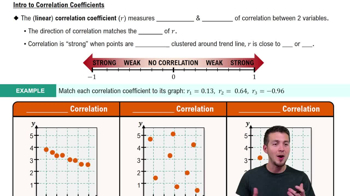
The correlation coefficient, denoted as r, measures the strength and direction of a linear relationship between two variables. Its value ranges from -1 to 1, where -1 indicates a perfect negative correlation, 1 indicates a perfect positive correlation, and 0 indicates no correlation. In this context, a negative r value suggests that as one variable increases, the other tends to decrease.
Recommended video:
Guided course
05:43
Correlation Coefficient

Coefficient of Determination (r^2)

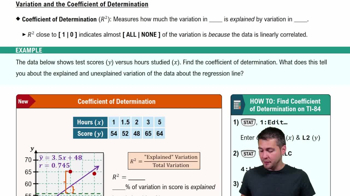
The coefficient of determination, r^2, is the square of the correlation coefficient and represents the proportion of variance in the dependent variable that can be explained by the independent variable in a regression model. It ranges from 0 to 1, where a value closer to 1 indicates that a large proportion of the variance is explained by the model, while a value closer to 0 indicates little explanatory power.
Recommended video:
Guided course
06:14
Coefficient of Determination

Explained vs. Unexplained Variation

Explained variation refers to the portion of the total variation in the dependent variable that is accounted for by the regression model, as indicated by r^2. Conversely, unexplained variation is the portion that remains after accounting for the model, representing factors not captured by the independent variable. Understanding these concepts helps in assessing the effectiveness of the regression model in predicting outcomes.
Recommended video:
Guided course
04:39
Visualizing Qualitative vs. Quantitative Data
Related Practice
Textbook Question

"In Exercises 27 and 28, use the multiple regression equation to predict the y-values for the values of the independent variables.

28. Use the regression equation found in Exercise 25.

a. x_1 = 9.0, x_2 = 0.70

b. x_1 = 3.0, x_2 = 0.25

c. x_1 = 8.0, x_2 = 0.60

d. x_1 = 5.2, x_2 = 0.46"

43
views
Textbook Question

"In Exercises 13-16, use the value of the correlation coefficient r to calculate the coefficient of determination r^2. What does this tell you about the explained variation of the data about the regression line? about the unexplained variation?

15. r = 0.642"

140
views
Textbook Question

"In Exercises 13-16, use the value of the correlation coefficient r to calculate the coefficient of determination r^2. What does this tell you about the explained variation of the data about the regression line? about the unexplained variation?

14.r =- 0.937"

69
views
Textbook Question

"[APPLET] For Exercises 2–9, use the data in the table, which shows the average annual salaries (both in thousands of dollars) for librarians and postsecondary library science teachers in the United States for 12 years. (Source: U.S. Bureau of Labor Statistics)

8. Find the standard error of estimate Se and interpret the result."

66
views
Textbook Question

"The U.S. Food and Drug Administration (FDA) requires nutrition labeling for most foods. Un FDA regulations, manufacturers are required to list the amounts of certain nutrients in their foods, such as calories, sugar, fat, and carbohydrates. This nutritional information is displayed in the ""Nutrition Facts"" panel on the food's package.

The table shows the nutritional content below for one cup of each of 21 different breakfast

cereals.

C = calories

S = sugar in grams

F = fat in grams

R = carbohydrates in grams

7. Use the equations from Exercise 6 to predict the calories in 1 cup of cereal that has 7 grams of sugar, 0.5 gram of fat, and 31 grams of carbohydrates."

50
views
Textbook Question

"In Exercises 19-24, construct the indicated prediction interval and interpret the results.

21. Construct a 95% prediction interval for the number of hours of sleep for an adult in Exercise 11 who is 45 years old."

54
views