
Ch. 9 - Correlation and Regression
Larson - Elementary Statistics: Picturing the World 8th Edition
Larson8th EditionElementary Statistics: Picturing the WorldISBN: 9780137493470Not the one you use?Change textbook
Chapter 9, Problem 9.3.10

"In Exercises 7-10, use the value of the correlation coefficient r to calculate the coefficient of determination r^2. What does this tell you about the explained variation of the data about the regression line? about the unexplained variation?
10. r =0.881"

Verified step by step guidance
1
Step 1: Understand the problem. The correlation coefficient (r) measures the strength and direction of a linear relationship between two variables. The coefficient of determination (r²) quantifies the proportion of the variation in the dependent variable that is explained by the independent variable in the regression model.
Step 2: Calculate the coefficient of determination (r²). To do this, square the given correlation coefficient (r). Use the formula: r2. For this problem, r = 0.881, so compute 0.8812.
Step 3: Interpret the coefficient of determination (r²). The value of r² represents the proportion of the total variation in the dependent variable that is explained by the regression line. For example, if r² = 0.776, it means 77.6% of the variation is explained by the regression model.
Step 4: Determine the unexplained variation. Subtract r² from 1 to find the proportion of variation that is not explained by the regression line. Use the formula: 1-r2. This represents the unexplained variation.
Step 5: Summarize the findings. The explained variation (r²) tells us how well the regression model fits the data, while the unexplained variation (1 - r²) indicates the portion of the data's variability that is not captured by the model. This helps assess the model's effectiveness.

Verified video answer for a similar problem:

This video solution was recommended by our tutors as helpful for the problem above.
Video duration:
1m
Was this helpful?

Key Concepts

Here are the essential concepts you must grasp in order to answer the question correctly.

Correlation Coefficient (r)

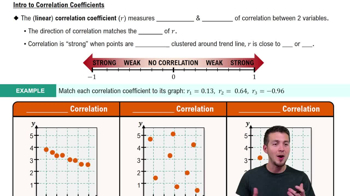
The correlation coefficient, denoted as 'r', measures the strength and direction of a linear relationship between two variables. Its value ranges from -1 to 1, where values close to 1 indicate a strong positive correlation, values close to -1 indicate a strong negative correlation, and values around 0 suggest no linear correlation. In this context, a correlation coefficient of 0.881 indicates a strong positive relationship between the variables.
Recommended video:
Guided course
05:43
Correlation Coefficient

Coefficient of Determination (r^2)

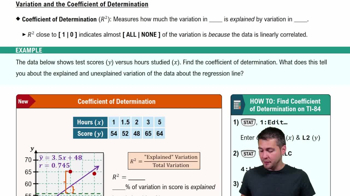
The coefficient of determination, represented as 'r^2', quantifies the proportion of variance in the dependent variable that can be explained by the independent variable in a regression model. It is calculated by squaring the correlation coefficient (r). For an r of 0.881, r^2 would be approximately 0.776, meaning about 77.6% of the variation in the dependent variable is explained by the independent variable.
Recommended video:
Guided course
06:14
Coefficient of Determination

Explained vs. Unexplained Variation

Explained variation refers to the portion of the total variation in the dependent variable that is accounted for by the regression model, while unexplained variation is the portion that remains after accounting for the model. In the context of the coefficient of determination, a higher r^2 value indicates that a larger proportion of the variation is explained by the model, suggesting a better fit. Conversely, the unexplained variation represents the data points that do not conform to the predicted values from the regression line.
Recommended video:
Guided course
04:39
Visualizing Qualitative vs. Quantitative Data
Related Practice
Textbook Question

"Constructing and Interpreting a Prediction Interval In Exercises 21-30, construct the indicated prediction interval and interpret the results.

26. Voter Turnout Construct a 99% prediction interval for number of ballots cast in Exercise 16 when the voting age population is 210 million."

56
views
Textbook Question

In Exercise 26, add data for an international soccer player who can perform the half squat with a maximum of 210 kilograms and can sprint 10 meters in 2.00 seconds. Describe how this affects the correlation coefficient r.

48
views
Textbook Question

"9. Stock Price The equation used to predict the stock price (in dollars) at the end of the year for a restaurant chain is y=- 86+7.46x_1 - 1.61x_2

where x_1 is the total revenue (in billions of dollars) and x_2 is the shareholders' equity (in

billions of dollars). Use the multiple regression equation to predict the y-values for the

values of the independent variables.

a. x_1 = 27.6, x_2 = 15.3

b. x_1 = 24.1, x_2 = 14.6

c. x_1 = 23.5, x_2 = 13.4

d. x_1 = 22.8, x_2 =15.3"

57
views
Textbook Question

"In Exercises 19-22, two variables are given that have been shown to have correlation but no cause-and-effect relationship. Describe at least one possible reason for the correlation.

20. Alcohol use and tobacco use"

52
views
Textbook Question

"Confidence Intervals for y-Intercept and Slope

You can construct confidence intervals for the y-intercept B and slope M of the regression line y = Mx + B for the population by using the inequalities below.

y-intercept B :

b - E < B < b + E

where

E = t_c s_e \(\sqrt{\frac{1}{n}\) + \(\frac{\overline{x}\)^2}{\(\sum\) x^2 - \(\frac{(\Sigma x)^2}{n}\)}}

slope M :

m - E < M < m + E

where

E = \(\frac{t_c s_e}{\sqrt{\sum x^2 - \frac{(\Sigma x)^2}{n}\)}}

The values of m and b are obtained from the sample data, and the critical value t_c is found using Table 5 in Appendix B with n - 2 degrees of freedom.

In Exercises 37 and 38, construct the indicated confidence intervals for B and M using the gross domestic products and carbon dioxide emissions data found in Example 2.

38. 99% confidence interval"

119
views
Textbook Question

"[APPLET] For Exercises 1–8, use the data in the table, which shows the average annual salaries (both in thousands of dollars) for secondary and elementary school teachers, excluding special and vocational education teachers, in the United States for 11 years. (Source: U.S. Bureau of Labor Statistics)

8. Construct a 95% prediction interval for the average annual salary of elementary school teachers when the average annual salary of secondary school teachers is \$63,500. Interpret the results."

86
views