
Ch. 9 - Correlation and Regression
Larson - Elementary Statistics: Picturing the World 8th Edition
Larson8th EditionElementary Statistics: Picturing the WorldISBN: 9780137493470Not the one you use?Change textbook
Chapter 9, Problem 9.3.33

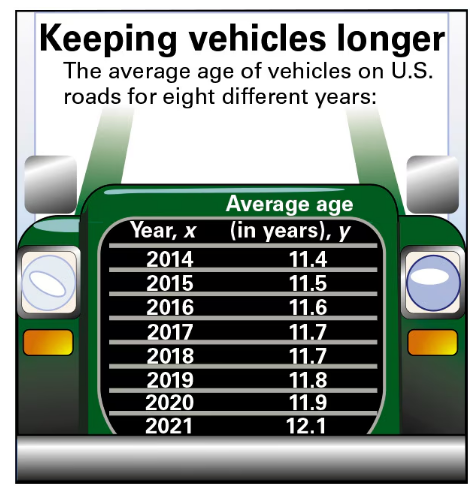
"Old Vehicles In Exercises 31–34, use the figure shown at the left.

33. Coefficient of Determination Find the coefficient of determination r^2 and interpret the results."

Verified step by step guidance
1
Step 1: Identify the variables and data points. Here, the independent variable (x) is the year, and the dependent variable (y) is the average age of vehicles. The data points are given for years 2014 to 2021 with corresponding average ages.
Step 2: Calculate the correlation coefficient (r) between the year (x) and the average age (y). This involves finding the covariance of x and y, and dividing it by the product of their standard deviations. The formula is: r = cov(x,y)var(x)var(y).
Step 3: Once you have the correlation coefficient r, calculate the coefficient of determination r² by squaring r. This value represents the proportion of the variance in the dependent variable (average age) that is predictable from the independent variable (year).
Step 4: Interpret the coefficient of determination r². A value close to 1 indicates a strong linear relationship where the year explains most of the variation in average vehicle age. A value close to 0 indicates a weak relationship.
Step 5: Summarize your findings by stating how well the year predicts the average age of vehicles based on the calculated r² value.

Verified video answer for a similar problem:

This video solution was recommended by our tutors as helpful for the problem above.
Video duration:
3m
Was this helpful?

Key Concepts

Here are the essential concepts you must grasp in order to answer the question correctly.

Coefficient of Determination (r²)

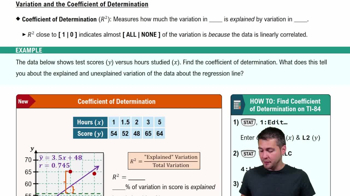
The coefficient of determination, denoted as r², measures the proportion of the variance in the dependent variable that is predictable from the independent variable. It ranges from 0 to 1, where a higher value indicates a better fit of the regression model to the data. In this context, it shows how well the year explains changes in the average vehicle age.
Recommended video:
Guided course
06:14
Coefficient of Determination

Linear Regression

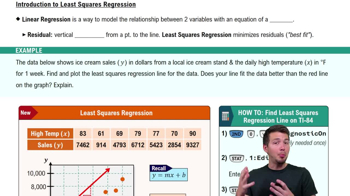
Linear regression is a statistical method used to model the relationship between a dependent variable and one or more independent variables by fitting a linear equation. Here, it helps to analyze how the average age of vehicles changes over the years, providing a basis to calculate r² and interpret trends.
Recommended video:
Guided course
07:01
Intro to Least Squares Regression

Interpretation of Statistical Results

Interpreting statistical results involves understanding what the calculated values imply in real-world terms. For r², this means explaining how much of the variation in vehicle age is explained by the year, which helps in assessing trends and making informed conclusions about vehicle longevity over time.
Recommended video:
07:10
Empirical Rule of Standard Deviation and Range Rule of Thumb
Related Practice
Textbook Question

"Predicting y-Values In Exercises 3-6, use the multiple regression equation to predict the y-values for the values of the independent variables.

6. Elephant Weight The equation used to predict the weight of an elephant (in kilograms) is

y =- 4016+11.5x_1+7.55x_2+12.5x_3

where x_1 represents the girth of the elephant (in centimeters), x_2 represents the length of the elephant (in centimeters), and x_3 represents the circumference of a footpad (in

centimeters). (Source: Field Trip Earth)

a. x_1 = 421, x_2 = 224, x_3 = 144

b. x_1 = 311, x_2 = 171, x_3 = 102

c. x_1 = 376, x_2 = 226, x_3 = 124

d. x_1 =231, x_2 = 135, x_3 = 86"

36
views
Textbook Question

6. Discuss the difference between r and p.

331
views
Textbook Question

5. To predict y-values using the equation of a regression line, what must be true about the correlation coefficient of the variables?

119
views
Textbook Question

2. Describe the range of values for the correlation coefficient.

248
views
Textbook Question

"In Exercises 19-22, two variables are given that have been shown to have correlation but no cause-and-effect relationship. Describe at least one possible reason for the correlation.

22. Marriage rate in Kentucky and number of deaths caused by falling out of a fishing boat"

65
views
Textbook Question

"In Exercises 7-12, match the description in the left column with its symbol(s) in the right column.

12. The point a regression line always passes through

a. \(\hat{y}\)_i

b. y_i

c. b

d. (\(\bar{x}\), \(\bar{y}\))

e. m

f. \(\bar{y}\)"

51
views