1. What is a residual? Explain when a residual is positive, negative, and zero.
Ch. 9 - Correlation and Regression
Larson8th EditionElementary Statistics: Picturing the WorldISBN: 9780137493470Not the one you use?Change textbook
Chapter 9, Problem 9.3.5
What is the coefficient of determination for two variables that have perfect positive linear correlation or perfect negative linear correlation? Interpret your answer.
Verified step by step guidance1
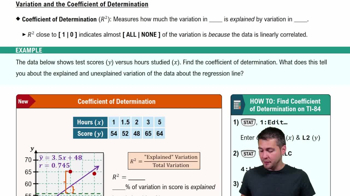
Recall that the coefficient of determination, denoted as , is the square of the correlation coefficient . It measures the proportion of variance in one variable that is predictable from the other variable.
Understand that a perfect positive linear correlation means the correlation coefficient , and a perfect negative linear correlation means .
Calculate the coefficient of determination by squaring the correlation coefficient: . For both and , this will be .
Interpret the coefficient of determination value of 1 as indicating that 100% of the variance in one variable is explained by the variance in the other variable, meaning a perfect linear relationship.
Conclude that whether the correlation is perfectly positive or perfectly negative, the coefficient of determination is 1, showing a perfect linear association in terms of explained variance.

Verified video answer for a similar problem:
This video solution was recommended by our tutors as helpful for the problem above.
Video duration:
3mWas this helpful?
Key Concepts
Here are the essential concepts you must grasp in order to answer the question correctly.
Coefficient of Determination (R²)
The coefficient of determination, denoted as R², measures the proportion of variance in the dependent variable that is predictable from the independent variable. It ranges from 0 to 1, where 1 indicates perfect prediction and 0 indicates no predictive power.
Recommended video:
Guided course
Coefficient of Determination
Correlation Coefficient (r)
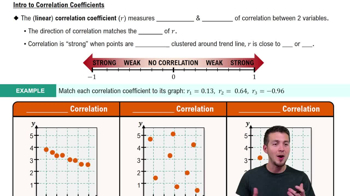
The correlation coefficient, r, quantifies the strength and direction of a linear relationship between two variables. It ranges from -1 (perfect negative linear correlation) to +1 (perfect positive linear correlation), with 0 indicating no linear correlation.
Recommended video:
Guided course
Correlation Coefficient
Relationship Between R² and r
The coefficient of determination R² is the square of the correlation coefficient r. For perfect positive (r = +1) or perfect negative (r = -1) linear correlation, R² equals 1, meaning the model explains 100% of the variance in the data regardless of the correlation's direction.
Recommended video:
Guided course
Probabilities Between Two Values
Related Practice
Textbook Question
216
views
Textbook Question
In Exercise 23, add data for a child who is 6 years old and has a vocabulary of 900 words. Describe how this affects the correlation coefficient r.
54
views
Textbook Question
2. Compare the numbers of dependent and independent variables in a multiple regression equation and a single regression equation.
80
views
Textbook Question
The coefficient of determination r^2 is the ratio of which two types of variations? What does r^2 measure? What does 1 - r^2 measure?
147
views
Textbook Question
6. Why is it not appropriate to use a regression line to predict y-values for x-values that are not in (or close to) the range of x-values found in the data?
299
views
Textbook Question
"Old Vehicles In Exercises 31–34, use the figure shown at the left.
Error of Estimate Find the standard error of estimate Se and interpret the results."
57
views