Ch. 1 - Introduction to Statistics
Triola - Elementary Statistics 14th Edition
Triola14th EditionElementary StatisticsISBN: 9780137366446Not the one you use?Change textbook
Chapter 1, Problem 1.2.33c

Countable For each of the following, categorize the nature of the data using one of these three descriptions: (1) discrete because the number of possible values is finite; (2) discrete because the number of possible values is infinite but countable; (3) continuous because the number of possible values is infinite and not countable.
c. The number of albums sold by the Monkees band

Verified step by step guidance
1
Identify the type of data being described. In this case, it is the number of albums sold by the Monkees band.
Consider whether the data can take on only specific, distinct values or if it can take on any value within a range. The number of albums sold is a count of items, which suggests it is discrete.
Determine if the number of possible values is finite or infinite. Since there is a practical limit to how many albums can be sold (e.g., based on production limits, market size), the number of possible values is finite.
Categorize the data based on the analysis. Since the number of albums sold is a finite count of distinct items, it is best described as discrete with a finite number of possible values.
Conclude that the nature of the data is 'discrete because the number of possible values is finite.'

Verified video answer for a similar problem:

This video solution was recommended by our tutors as helpful for the problem above.
Video duration:
2m
Was this helpful?

Key Concepts

Here are the essential concepts you must grasp in order to answer the question correctly.

Discrete Data

Discrete data refers to countable data that can take on distinct, separate values. These values are often integers, representing counts of items or occurrences. Discrete data can be finite, such as the number of students in a class, or infinite but countable, like the number of times a die can be rolled.
Recommended video:
Guided course
04:48
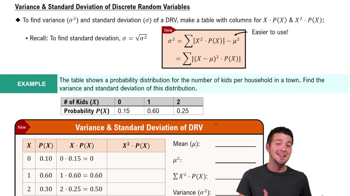
Variance & Standard Deviation of Discrete Random Variables

Continuous Data

Continuous data represents measurements that can take on any value within a given range. Unlike discrete data, continuous data is not countable and can include fractions and decimals. Examples include height, weight, and temperature, where values can be infinitely precise within a range.
Recommended video:
Guided course
04:39
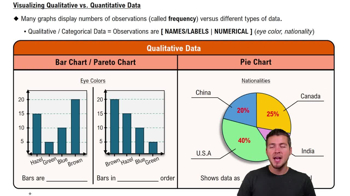
Visualizing Qualitative vs. Quantitative Data

Countable Infinity

Countable infinity refers to a set of values that, while infinite, can be matched one-to-one with the set of natural numbers. This means that even though the set is infinite, its elements can be listed in a sequence. An example is the set of all integers, which can be ordered and counted sequentially.
Recommended video:
Guided course
07:09
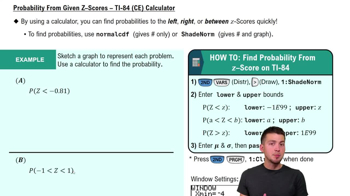
Probability From Given Z-Scores - TI-84 (CE) Calculator