Ch. 1 - Introduction to Statistics
Triola - Elementary Statistics 14th Edition
Triola14th EditionElementary StatisticsISBN: 9780137366446Not the one you use?Change textbook
Chapter 1, Problem 1.2.27

In Exercises 21–28, determine which of the four levels of measurement (nominal, ordinal, interval, ratio) best describes the given data.
Areas of States A data set consists of the areas of each of the 50 United States.

Verified step by step guidance
1
Understand the four levels of measurement: Nominal, Ordinal, Interval, and Ratio. Nominal involves categories without a specific order, Ordinal involves categories with a specific order, Interval involves numerical data without a true zero, and Ratio involves numerical data with a true zero.
Identify the type of data you have. In this case, the data set consists of the areas of each of the 50 United States.
Consider whether the data has a true zero point. Since area can be zero (a state could theoretically have no area), this suggests a true zero exists.
Determine if the data can be compared using multiplication or division. Since you can say one state is twice as large as another, this supports the presence of a ratio level of measurement.
Conclude that the areas of the states are best described by the ratio level of measurement, as they have a true zero and allow for meaningful comparisons using multiplication and division.

Verified video answer for a similar problem:

This video solution was recommended by our tutors as helpful for the problem above.
Video duration:
3m
Was this helpful?

Key Concepts

Here are the essential concepts you must grasp in order to answer the question correctly.

Levels of Measurement

The levels of measurement refer to the different ways in which data can be categorized and quantified. There are four primary levels: nominal (categorical data without a specific order), ordinal (categorical data with a defined order), interval (numerical data with equal intervals but no true zero), and ratio (numerical data with equal intervals and a true zero). Understanding these levels is crucial for correctly analyzing and interpreting data.
Recommended video:
04:46
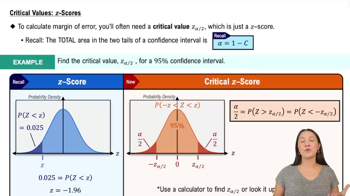
Critical Values: z Scores

Nominal Measurement

Nominal measurement is the simplest level of measurement, where data is categorized without any order or ranking. Examples include gender, race, or types of fruit. In the context of the question, nominal measurement would not apply to the areas of states, as these can be quantitatively compared.
Recommended video:
Guided course
04:39
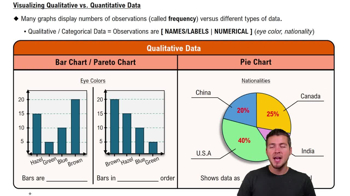
Visualizing Qualitative vs. Quantitative Data

Ratio Measurement

Ratio measurement is the highest level of measurement, characterized by the presence of a true zero point and the ability to perform meaningful mathematical operations. In this level, both differences and ratios are meaningful, allowing for comparisons such as 'twice as large.' The areas of states fit this category, as they can be measured in square miles, allowing for direct comparisons and calculations.
Recommended video:
Guided course
04:39
Visualizing Qualitative vs. Quantitative Data
Related Practice
Textbook Question

In Exercises 13–20, determine whether the results appear to have statistical significance, and also determine whether the results appear to have practical significance.


Bias in Jury Selection In the case of Casteneda v. Partida, it was found that during a period of 11 years in Hidalgo County, Texas, 870 people were selected for grand jury duty, and 39% of them were Americans of Mexican ancestry. Among the people eligible for grand jury duty, 79.1% were Americans of Mexican ancestry.

306
views
Textbook Question

In Exercises 9–20, identify which of these types of sampling is used: random, systematic, convenience, stratified, or cluster.

Cormorant Density Cormorant bird population densities were studied by using the “line transect method” with aircraft observers flying along the shoreline of Lake Huron and collecting sample data at intervals of every 20 km (based on data from Journal of Great Lakes Research).

343
views
Textbook Question

In Exercises 37–44, answer the given questions, which are related to percentages.

Workplace Attire In a survey conducted by Opinion Research Corporation, 1000 adults were asked to identify “what is inappropriate in the workplace.” Of the 1000 subjects, 70% said that miniskirts were not appropriate in the workplace.


b. Among the 1000 respondents, 550 said that shorts are unacceptable in the workplace. What percentage of respondents said that shorts are unacceptable in the workplace?

323
views
Textbook Question

In Exercises 5–8, determine whether the given source has the potential to create a bias in a statistical study.


AAA The American Automobile Association (AAA) is a not-for-profit federation of motor clubs that provides automotive and travel services. AAA conducts a survey of its members about their use of public transportation versus private automobiles.

417
views
Textbook Question

In Exercises 13–20, determine whether the data are from a discrete or continuous data set.

Fraud Detection While monitoring Internet traffic in order to detect fraudulent activity, a researcher records the interarrival times (sec) between incoming Internet queries.

290
views
Textbook Question

In Exercises 29–36, identify what is wrong.

Healthy Water In a USA Today online poll, 951 Internet users chose to respond, and 57% of them said that they prefer drinking bottled water instead of tap water.

279
views