Ch. 1 - Introduction to Statistics
Triola - Elementary Statistics 14th Edition
Triola14th EditionElementary StatisticsISBN: 9780137366446Not the one you use?Change textbook
Chapter 1, Problem 1.1.34

In Exercises 29–36, identify what is wrong.
Storks and Babies In the years following the end of World War II, it was found that there was a strong correlation, or association, between the number of human births and the stork population. It therefore follows that storks cause babies.

Verified step by step guidance
1
Understand the concept of correlation: Correlation measures the strength and direction of a linear relationship between two variables. It does not imply causation.
Identify the logical fallacy: The statement 'storks cause babies' is an example of a post hoc fallacy, where correlation is mistaken for causation.
Consider alternative explanations: There may be external factors influencing both the stork population and human births, such as environmental changes or societal factors post-World War II.
Explore the concept of confounding variables: A confounding variable is an external factor that affects both variables being studied, potentially leading to a spurious correlation.
Emphasize the importance of rigorous analysis: To establish causation, one must conduct controlled experiments or use statistical methods to rule out confounding variables and establish a causal link.

Verified video answer for a similar problem:

This video solution was recommended by our tutors as helpful for the problem above.
Video duration:
3m
Was this helpful?

Key Concepts

Here are the essential concepts you must grasp in order to answer the question correctly.

Correlation vs. Causation

Correlation refers to a statistical relationship between two variables, indicating that they change together. However, this does not imply that one variable causes the other. In the storks and babies example, while there may be a correlation, it is a logical fallacy to conclude that storks cause an increase in human births without further evidence.
Recommended video:
Guided course
04:39
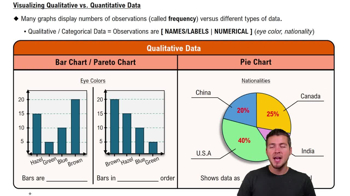
Visualizing Qualitative vs. Quantitative Data

Spurious Correlation

A spurious correlation occurs when two variables appear to be related but are actually influenced by a third variable or are coincidental. In the case of storks and babies, other factors, such as population growth or environmental changes, could be influencing both variables, leading to a misleading association.

Confounding Variables

Confounding variables are external factors that can affect the relationship between the independent and dependent variables in a study. In the stork and baby scenario, factors like socioeconomic conditions or urbanization trends could confound the observed correlation, making it essential to control for these variables to draw valid conclusions.
Recommended video:
Guided course
07:09
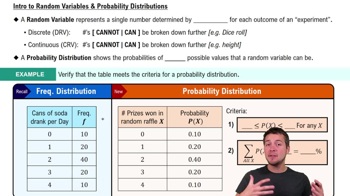
Intro to Random Variables & Probability Distributions
Related Practice
Textbook Question

In Exercises 29–36, identify what is wrong.

Potatoes In a poll sponsored by the Idaho Potato Commission, 1000 adults were asked to select their favorite vegetables, and the favorite choice was potatoes, which were selected by 26% of the respondents.

245
views
Textbook Question

In Exercises 21–28, determine which of the four levels of measurement (nominal, ordinal, interval, ratio) best describes the given data.

Movie Ratings In a college film studies course, students rate ten documentaries using a scale of 0 to 5 stars.

317
views
Textbook Question

In Exercises 13–20, determine whether the results appear to have statistical significance, and also determine whether the results appear to have practical significance.


Mendel’s Genetics Experiments One of Gregor Mendel’s famous hybridization experiments with peas yielded 580 offspring with 152 of those peas (or 26%) having yellow pods. According to Mendel’s theory, 25% of the offspring peas should have yellow pods.

351
views
Textbook Question

In Exercises 37–44, answer the given questions, which are related to percentages.

Checking Job Applicants In a study conducted by the Society for Human Resource Management, 347 human resource professionals were surveyed. Of those surveyed, 73% said that their companies conduct criminal background checks on all job applicants.


a. What is the exact value that is 73% of the 347 survey subjects?

b. Could the result from part (a) be the actual number of survey subjects who said that their companies conduct criminal background checks on all job applicants? Why or why not?
388
views
Textbook Question

Quantitative/Categorical Data Identify each of the following as quantitative data or categorical data


c. The colors of the M&M candies in Data Set 38 “Candies” in Appendix B

206
views
Textbook Question

In Exercises 21–28, determine whether the study is an experiment or an observational study, and then identify a major problem with the study.

Atkins Weight Loss Program An independent researcher tested the effectiveness of the Atkins weight loss program by randomly selecting 1000 subjects using that program. Each of the subjects was called to report their weight before the diet and after the diet.

374
views