
Ch. 1 - Introduction to Statistics
Triola - Elementary Statistics 14th Edition
Triola14th EditionElementary StatisticsISBN: 9780137366446Not the one you use?Change textbook
Chapter 1, Problem 1.2a

Reported Versus Measured In a survey of 1046 adults conducted by Bradley Corporation, subjects were asked how often they wash their hands when using a public restroom, and 70% of the respondents said “always.”


a) Identify the sample and the population.

Verified step by step guidance
1
Identify the population: The population is the entire group that you want to draw conclusions about. In this case, it is all adults who use public restrooms.
Identify the sample: The sample is the subset of the population that is actually observed or surveyed. Here, it is the 1046 adults who participated in the survey conducted by Bradley Corporation.
Understand the relationship: The sample is used to make inferences about the population. The survey results from the sample (1046 adults) are used to estimate the behavior of the entire population of adults.
Consider the representativeness: Evaluate whether the sample is representative of the population. This involves considering how the sample was selected and whether it might be biased.
Reflect on the findings: The survey found that 70% of the sample reported always washing their hands in public restrooms. This statistic is used to infer the handwashing habits of the broader population of adults.

Verified video answer for a similar problem:

This video solution was recommended by our tutors as helpful for the problem above.
Video duration:
2m
Was this helpful?

Key Concepts

Here are the essential concepts you must grasp in order to answer the question correctly.

Sample

In statistics, a sample refers to a subset of individuals or observations selected from a larger population. The sample is used to make inferences about the population. In this context, the sample consists of the 1046 adults who participated in the survey conducted by Bradley Corporation.
Recommended video:
05:11
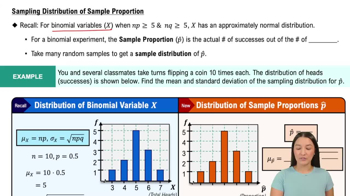
Sampling Distribution of Sample Proportion

Population

The population in statistics is the entire group of individuals or instances about whom we seek to draw conclusions. It encompasses all possible subjects that fit a particular set of criteria. Here, the population would be all adults who use public restrooms, as the survey aims to understand handwashing behavior in this group.
Recommended video:
04:48
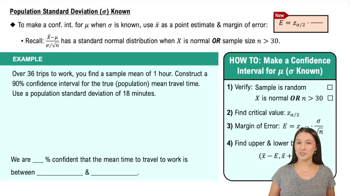
Population Standard Deviation Known

Survey Methodology

Survey methodology involves the techniques and principles used to conduct surveys and collect data from respondents. It includes designing the survey, selecting the sample, and analyzing the results. Understanding this concept helps in evaluating the reliability and validity of the survey results, such as the claim that 70% of respondents 'always' wash their hands in public restrooms.
Recommended video:
Guided course
03:06
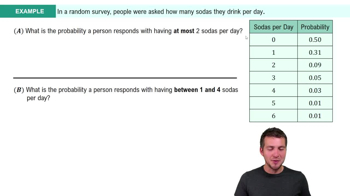
Intro to Random Variables & Probability Distributions Example 1
Related Practice
Textbook Question

Countable For each of the following, categorize the nature of the data using one of these three descriptions: (1) discrete because the number of possible values is finite; (2) discrete because the number of possible values is infinite but countable; (3) continuous because the number of possible values is infinite and not countable.

a. Exact lengths of the feet of members of the band the Monkees

320
views
Textbook Question

State Populations Currently, California has the largest population with 39,776,830 residents, and Wyoming has the smallest population with 573,520 residents.


e. If we randomly select two states and survey all of their adult residents, what type of sample is obtained? (random, systematic, convenience, stratified, cluster)

254
views
Textbook Question

Paying for First Dates USA Today posted this question on the electronic version of its newspaper: “Should guys pay for the first date?” Of the 1148 subjects who decided to respond, 85% of them said “yes.”


a. What is wrong with this survey?

251
views
Textbook Question

Sampling For each of the following, identify the term that best describes the type of sample: systematic, convenience, stratified, cluster, or simple random sample.


b. To test for a gender difference in the way that men and women make online purchases, Gallup surveys 500 randomly selected men and 500 randomly selected women.

269
views
Textbook Question

Simple Random Sample vs. Random Sample Refer to the definition of simple random sample here and its accompanying definition of random sample enclosed within parentheses. Determine whether each of the following is a simple random sample and a random sample.


a. In Major League Baseball, there are 30 teams, each with an active roster of 25 players. The names of the teams are printed on 30 separate index cards, the cards are shuffled, and one card is drawn. The sample consists of the 25 players on the active roster of the selected team.

459
views
Textbook Question

Sampling Method Assume that the population consists of all students currently in your statistics class. Describe how to obtain a sample of six students so that the result is a sample of the given type.


a. Simple random sample

361
views