
Ch. 1 - Introduction to Statistics
Triola - Elementary Statistics 14th Edition
Triola14th EditionElementary StatisticsISBN: 9780137366446Not the one you use?Change textbook
Chapter 1, Problem 1.R.9.b

Types of Data In each of the following, identify the level of measurement of the sample data (nominal, ordinal, interval, ratio) and the type of sampling used to obtain the data (random, systematic, convenience, stratified, cluster).


b. In each of the 50 states, 50 voters are randomly selected and their political party affiliations are identified.

Verified step by step guidance
1
Identify the level of measurement: Political party affiliation is a categorical variable, which means it can be classified into distinct categories without any inherent order. Therefore, the level of measurement for political party affiliation is 'nominal'.
Determine the type of sampling: The problem states that 50 voters are randomly selected in each of the 50 states. This suggests that the sampling method involves dividing the population into groups (states) and then randomly selecting individuals from each group.
Recognize the sampling method: Since the population is divided into groups (states) and a random sample is taken from each group, this is an example of 'stratified sampling'.
Understand stratified sampling: In stratified sampling, the population is divided into subgroups (strata) that share similar characteristics, and random samples are taken from each subgroup to ensure representation from all parts of the population.
Summarize the findings: The level of measurement for the data is 'nominal', and the sampling method used is 'stratified sampling'.

Verified video answer for a similar problem:

This video solution was recommended by our tutors as helpful for the problem above.
Video duration:
3m
Was this helpful?

Key Concepts

Here are the essential concepts you must grasp in order to answer the question correctly.

Levels of Measurement

Levels of measurement refer to the nature of data and include nominal, ordinal, interval, and ratio. Nominal data categorize without a specific order, ordinal data have a defined order, interval data have equal intervals without a true zero, and ratio data have equal intervals with a true zero. Understanding these levels helps in choosing appropriate statistical methods.
Recommended video:
Guided course
10:28
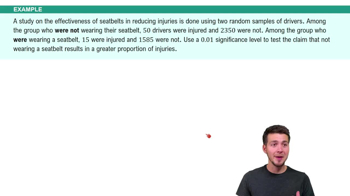
Difference in Proportions: Hypothesis Tests Example 1

Sampling Methods

Sampling methods are techniques used to select a subset of individuals from a population. Common methods include random sampling, where each member has an equal chance of selection; systematic sampling, which selects every nth member; convenience sampling, based on ease of access; stratified sampling, dividing the population into strata and sampling from each; and cluster sampling, selecting entire groups. The choice of method affects the representativeness and reliability of the data.
Recommended video:
05:11
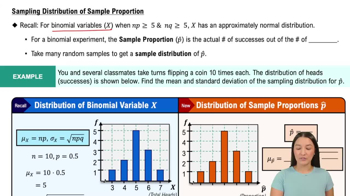
Sampling Distribution of Sample Proportion

Random Sampling

Random sampling is a technique where each member of the population has an equal probability of being selected. This method helps ensure that the sample is representative of the population, reducing bias and allowing for generalization of results. In the given question, selecting 50 voters randomly from each state exemplifies random sampling, aiming for a fair representation of political affiliations across states.
Recommended video:
05:11
Sampling Distribution of Sample Proportion
Related Practice
Textbook Question

In Exercises 9–12, the given expressions are designed to yield results expressed in a form of scientific notation. For example, the calculator-displayed result of 1.23E5 can be expressed as 123,000, and the result of 1.23E-4 can be expressed as 0.000123. Perform the indicated operation and express the result as an ordinary number that is not in scientific notation.


(0.2)^12

282
views
Textbook Question

Survey Which of the following best describes the level of measurement of the numbers 1, 2, 3, . . . , 410 described in Exercise 1: nominal, ordinal, interval, ratio?

344
views
Textbook Question

Percentages

c. In a Pew Research Center poll on driving, 331 of the 1182 respondents said that driving is a chore. What percentage of respondents said that driving is a chore?

251
views
Textbook Question

Percentages

b. In a Pew Research Center poll on driving, 58% of the 1182 respondents said that they like to drive. What is the actual number of respondents who said that they like to drive?

316
views
Textbook Question

Percentages

a. The labels on U-Turn protein energy bars include the statement that these bars contain “125% less fat than the leading chocolate candy brands” (based on data from Consumer Reports magazine). What is wrong with that claim?

254
views
Textbook Question

In Exercises 9–12, the given expressions are designed to yield results expressed in a form of scientific notation. For example, the calculator-displayed result of 1.23E5 can be expressed as 123,000, and the result of 1.23E-4 can be expressed as 0.000123. Perform the indicated operation and express the result as an ordinary number that is not in scientific notation.


(8)^12

252
views