

Ch. 10 - Correlation and Regression
Triola - Elementary Statistics 14th Edition
Triola14th EditionElementary StatisticsISBN: 9780137366446Not the one you use?Change textbook
Chapter 10, Problem 10.5.9

Finding the Best Model
In Exercises 5–16, construct a scatterplot and identify the mathematical model that best fits the given data. Assume that the model is to be used only for the scope of the given data, and consider only linear, quadratic, logarithmic, exponential, and power models.
Population Growth Here are the values of the world population (billions) beginning with the year 2000:
Table showing world population values in billions from 2000 onward, increasing from 6.15 to 7.71 over time.

Verified step by step guidance
1
Step 1: Organize the data by pairing each population value with its corresponding year, starting from 2000. For example, let x = 0 represent the year 2000, x = 1 for 2001, and so on, and y be the population in billions.
Step 2: Construct a scatterplot by plotting the points (x, y) on a graph, where the x-axis represents the years since 2000 and the y-axis represents the population in billions.
Step 3: Visually inspect the scatterplot to identify the general trend of the data points. Determine if the data appears to follow a straight line (linear), a curve that opens up or down (quadratic), a curve that increases rapidly or slowly (exponential), a curve that increases but at a decreasing rate (logarithmic), or a curve that follows a power relationship.
Step 4: Fit each of the candidate models (linear, quadratic, logarithmic, exponential, and power) to the data using appropriate regression techniques or software tools to calculate the best-fit parameters for each model.
Step 5: Compare the goodness of fit for each model, such as by examining the coefficient of determination (\[R^2\]) or residual plots, to identify which model best describes the population growth data within the given range.

Verified video answer for a similar problem:

This video solution was recommended by our tutors as helpful for the problem above.
Video duration:
1m
Was this helpful?

Key Concepts

Here are the essential concepts you must grasp in order to answer the question correctly.

Scatterplot Construction

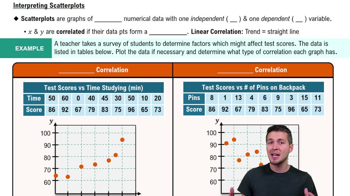
A scatterplot is a graphical representation of data points plotted on a coordinate plane, showing the relationship between two variables. It helps visualize trends, patterns, or correlations, which is essential for selecting an appropriate mathematical model.
Recommended video:
Guided course
06:36
Scatterplots & Intro to Correlation

Types of Mathematical Models

Common models include linear, quadratic, logarithmic, exponential, and power models. Each describes different types of relationships: linear for constant rate changes, quadratic for parabolic trends, logarithmic for rapid initial changes slowing over time, exponential for growth or decay, and power for scaling relationships.
Recommended video:
Guided course
04:24
Types of Data

Model Selection Based on Data Behavior

Choosing the best model involves analyzing the scatterplot to see which model fits the data points most closely within the given range. This includes considering the shape of the data trend and the context, such as population growth, which often follows exponential or logistic patterns.
Recommended video:
4:01
Introduction to Collecting Data
Related Practice
Textbook Question

Finding the Best Model

In Exercises 5–16, construct a scatterplot and identify the mathematical model that best fits the given data. Assume that the model is to be used only for the scope of the given data, and consider only linear, quadratic, logarithmic, exponential, and power models.

Sunspot Numbers Listed below in order by row are annual sunspot numbers beginning with 1980. Is the best model a good model? Carefully examine the scatterplot and identify the pattern of the points. Which of the models fits that pattern?

[IMAGE]

176
views
Textbook Question

Interpreting a Graph The accompanying graph plots the numbers of points scored in each Super Bowl from the first Super Bowl in 1967 (coded as year 1) to the last Super Bowl at the time of this writing. The graph of the quadratic equation that best fits the data is also shown in red. What feature of the graph justifies the value of R^2 = 0.205 for the quadratic model?

154
views
Textbook Question

Sum of Squares Criterion In addition to the value of another measurement used to assess the quality of a model is the sum of squares of the residuals. Recall from Section 10-2 that a residual is (the difference between an observed y value and the value predicted from the model). Better models have smaller sums of squares. Refer to the U.S. population data in Table 10-7.

a. Find the sum of squares of the residuals resulting from the linear model.

187
views
Textbook Question

Testing Hypotheses About Regression Coefficients If the coefficient has a nonzero value, then it is helpful in predicting the value of the response variable. If it is not helpful in predicting the value of the response variable and can be eliminated from the regression equation. To test the claim that use the test statistic Critical values or P-values can be found using the t distribution with degrees of freedom, where k is the number of predictor variables and n is the number of observations in the sample. The standard error is often provided by software. For example, see the accompanying StatCrunch display for Example 1, which shows that (found in the column with the heading of “Std. Err.” and the row corresponding to the first predictor variable of height). Use the sample data in Data Set 1 “Body Data” and the StatCrunch display to test the claim that Also test the claim that What do the results imply about the regression equation?


" style="" width="600">

198
views
Textbook Question

Finding the Best Model

In Exercises 5–16, construct a scatterplot and identify the mathematical model that best fits the given data. Assume that the model is to be used only for the scope of the given data, and consider only linear, quadratic, logarithmic, exponential, and power models.

Earthquakes Listed below are earthquake depths (km) and magnitudes (Richter scale) of different earthquakes. Find the best model and then predict the magnitude for the last earthquake with a depth of 3.78 km. Is the predicted value close to the actual magnitude of 7.1?

24
views
Textbook Question

Garbage: Finding the Best Multiple Regression Equation

In Exercises 9–12, refer to the accompanying table, which was obtained by using the data from 62 households listed in Data Set 42 “Garbage Weight” in Appendix B. The response (y) variable is PLAS (weight of discarded plastic in pounds). The predictor (x) variables are METAL (weight of discarded metals in pounds), PAPER (weight of discarded paper in pounds), and GLASS (weight of discarded glass in pounds).

[IMAGE]

If exactly two predictor (x) variables are to be used to predict the weight of discarded plastic, which two variables should be chosen? Why?

172
views