Ch. 10 - Correlation and Regression
Triola - Elementary Statistics 14th Edition
Triola14th EditionElementary StatisticsISBN: 9780137366446Not the one you use?Change textbook
Chapter 10, Problem 10.1.1c

Notation The author conducted an experiment in which the height of each student was measured in centimeters and those heights were matched with the same students’ scores on the first statistics test.
c. Does r change if the heights are converted from centimeters to inches?

Verified step by step guidance
1
Understand that 'r' refers to the correlation coefficient, which measures the strength and direction of a linear relationship between two variables.
Recall that the correlation coefficient 'r' is a dimensionless quantity, meaning it does not depend on the units of measurement of the variables involved.
Recognize that converting the heights from centimeters to inches is a linear transformation, which involves multiplying each height by a constant factor (1 inch = 2.54 cm).
Note that linear transformations of the form y = ax + b, where a and b are constants, do not affect the correlation coefficient 'r'.
Conclude that since the conversion from centimeters to inches is a linear transformation, the value of 'r' remains unchanged.

Verified video answer for a similar problem:

This video solution was recommended by our tutors as helpful for the problem above.
Video duration:
2m
Was this helpful?

Key Concepts

Here are the essential concepts you must grasp in order to answer the question correctly.

Correlation Coefficient (r)

The correlation coefficient, denoted as 'r', measures the strength and direction of a linear relationship between two variables. It ranges from -1 to 1, where values close to 1 or -1 indicate strong relationships, and values near 0 suggest weak or no linear relationship. It is unaffected by changes in the units of measurement of the variables.
Recommended video:
Guided course
05:43
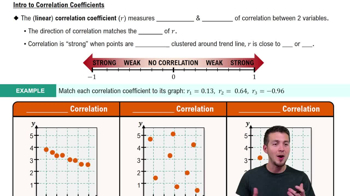
Correlation Coefficient

Unit Conversion

Unit conversion involves changing the measurement units of a variable, such as converting heights from centimeters to inches. While this alters the numerical values of the data, it does not affect the relative positions or the relationship between the variables, meaning the correlation coefficient remains unchanged.
Recommended video:
Guided course
06:21
Step 1: Write Hypotheses

Scale Invariance

Scale invariance refers to the property of a statistical measure that remains unchanged when the scale of measurement is altered. The correlation coefficient is scale invariant, meaning that converting units of measurement, such as from centimeters to inches, does not affect the value of 'r', as it depends only on the relative positions of the data points.
Recommended video:
Guided course
07:10
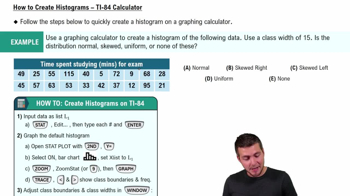
How to Create Histogram - TI-84 Calculator
Related Practice
Textbook Question

Notation Using the weights (lb) and highway fuel consumption amounts (mi/gal) of the 48 cars listed in Data Set 35 “Car Data” of Appendix B, we get this regression equation:

y^ = 58.9 - 0.00749x, where x represents weight.

c. What is the predictor variable?

131
views
Textbook Question

Clusters Refer to the Minitab-generated scatterplot. The four points in the lower left corner are measurements from women, and the four points in the upper right corner are from men.

Find the value of the linear correlation coefficient using all eight points. What does that value suggest about the relationship between x and y?

165
views
Textbook Question

Least-Squares Property According to the least-squares property, the regression line minimizes the sum of the squares of the residuals. Refer to the jackpot/tickets data in Table 10-1 and use the regression equation y^ = -10.9 + 0.174x that was found in Examples 1 and 2 of this section.

b. Find the sum of the squares of the residuals.

302
views
Textbook Question

Sum of Squares Criterion In addition to the value of another measurement used to assess the quality of a model is the sum of squares of the residuals. Recall from Section 10-2 that a residual is (the difference between an observed y value and the value predicted from the model). Better models have smaller sums of squares. Refer to the U.S. population data in Table 10-7.

c. Verify that according to the sum of squares criterion, the quadratic model is better than the linear model.

44
views
Textbook Question

Outlier Refer to the accompanying Minitab-generated scatterplot.

b. After identifying the 10 pairs of coordinates corresponding to the 10 points, find the value of the correlation coefficient r and determine whether there is a linear correlation.

134
views
Textbook Question

Notation The author conducted an experiment in which the height of each student was measured in centimeters and those heights were matched with the same students’ scores on the first statistics test.

b. Without doing any research or calculations, estimate the value of r.

249
views