
Textbook Question
Interaction
a. What is an interaction between two factors?
502
views

 Verified step by step guidance
 06:28
06:28
 07:10
07:10 08:22
08:22Interaction
a. What is an interaction between two factors?
Interaction
b. In general, when using two-way analysis of variance, if we find that there is an interaction effect, how does that affect the procedure?
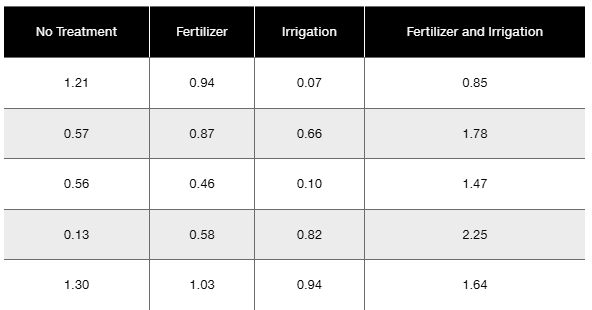
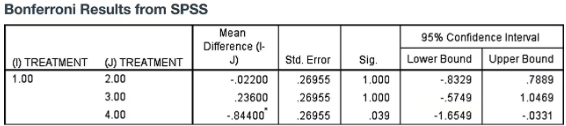
In Exercises 1–4, use the following listed measured amounts of chest compression (mm) from car crash tests (from Data Set 35 “Car Data” in Appendix B). Also shown are the SPSS results from analysis of variance. Assume that we plan to use a 0.05 significance level to test the claim that the different car sizes have the same mean amount of chest compression.
Anova
b. If the objective is to test the claim that the four car sizes have the same mean chest compression, why is the method referred to as analysis of variance?
Transformations of Data Example 1 illustrated the use of two-way ANOVA to analyze the sample data in Table 12-3. How are the results affected in each of the following cases?
a. The same constant is added to each sample value.
Transformations of Data Example 1 illustrated the use of two-way ANOVA to analyze the sample data in Table 12-3. How are the results affected in each of the following cases?
b. Each sample value is multiplied by the same nonzero constant.
In Exercises 1–4, use the following listed measured amounts of chest compression (mm) from car crash tests (from Data Set 35 “Car Data” in Appendix B). Also shown are the SPSS results from analysis of variance. Assume that we plan to use a 0.05 significance level to test the claim that the different car sizes have the same mean amount of chest compression.
Anova
a. What characteristic of the data above indicates that we should use one-way analysis of variance?