Ch. 12 - Analysis of Variance
Triola - Elementary Statistics 14th Edition
Triola14th EditionElementary StatisticsISBN: 9780137366446Not the one you use?Change textbook
Chapter 12, Problem 12.1.4

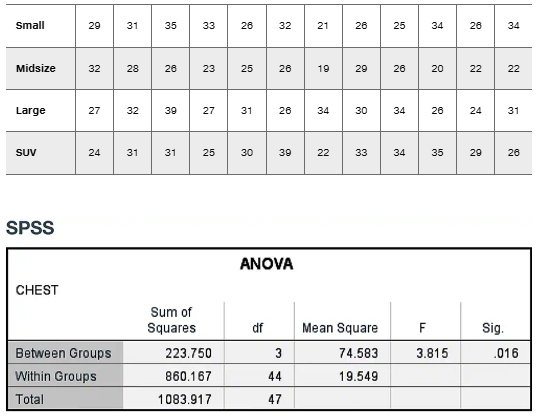
In Exercises 1–4, use the following listed measured amounts of chest compression (mm) from car crash tests (from Data Set 35 “Car Data” in Appendix B). Also shown are the SPSS results from analysis of variance. Assume that we plan to use a 0.05 significance level to test the claim that the different car sizes have the same mean amount of chest compression.
Table showing chest compression measurements by car size and SPSS ANOVA results with sum of squares, degrees of freedom, F-value, and significance.
P-VALUE If we use a 0.05 significance level in analysis of variance with the sample data given in Exercise 1, what is the P-value? What should we conclude? If the four populations have means that do not appear to be the same, does the analysis of variance test enable us to identify which populations have means that are significantly different?

Verified step by step guidance
1
Step 1: Identify the null and alternative hypotheses for the ANOVA test. The null hypothesis (H0) states that all four car size groups have the same mean chest compression, while the alternative hypothesis (Ha) states that at least one group mean is different.
Step 2: Locate the P-value from the ANOVA table. The P-value is given in the 'Sig.' column for 'Between Groups', which is 0.016 in this case.
Step 3: Compare the P-value to the significance level (α = 0.05). Since 0.016 < 0.05, we reject the null hypothesis, indicating there is sufficient evidence to conclude that not all group means are equal.
Step 4: Understand the limitation of the ANOVA test. While ANOVA tells us that at least one group mean differs, it does not specify which groups are significantly different from each other.
Step 5: To identify which specific groups differ, a post hoc test (such as Tukey's HSD) would be required following the ANOVA to perform pairwise comparisons between group means.

Verified video answer for a similar problem:

This video solution was recommended by our tutors as helpful for the problem above.
Video duration:
2m
Was this helpful?

Key Concepts

Here are the essential concepts you must grasp in order to answer the question correctly.

Analysis of Variance (ANOVA)

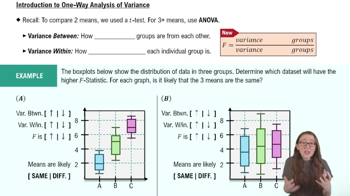
ANOVA is a statistical method used to compare the means of three or more groups to determine if at least one group mean is significantly different from the others. It partitions the total variation into variation between groups and within groups, using the F-statistic to test the null hypothesis that all group means are equal.
Recommended video:
06:46
Introduction to ANOVA

P-value and Significance Level

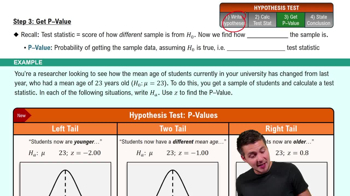
The P-value measures the probability of observing the data, or something more extreme, assuming the null hypothesis is true. A significance level (commonly 0.05) is the threshold for deciding whether to reject the null hypothesis. If the P-value is less than the significance level, we reject the null hypothesis, indicating significant differences among group means.
Recommended video:
Guided course
06:50
Step 3: Get P-Value

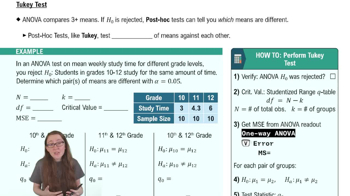
Post Hoc Tests

When ANOVA indicates significant differences among group means, it does not specify which groups differ. Post hoc tests, such as Tukey's HSD, are used after ANOVA to identify exactly which pairs of group means are significantly different, controlling for Type I error across multiple comparisons.
Recommended video:
08:22
Tukey Test
Related Practice
Textbook Question

In Exercises 5–16, use analysis of variance for the indicated test.


Clancy, Rowling, and Tolstoy Ease of Reading Pages were randomly selected from three books: The Bear and the Dragon by Tom Clancy, Harry Potter and the Sorcerer’s Stone by J.K. Rowling, and War and Peace by Leo Tolstoy. Listed below are Flesch Reading Ease Scores for those pages. Use a 0.05 significance level to test the claim that pages from books by those three authors have the same mean Flesch Reading Ease score. Given that higher scores correspond to text that is easier to read, which author appears to be different, and how is that author different?


131
views
Textbook Question

Sitting Heights The sitting height of a person is the vertical distance between the sitting surface and the top of the head. The following table lists sitting heights (mm) of randomly selected U.S. Army personnel collected as part of the ANSUR II study. Using the data with a 0.05 significance level, what do you conclude? Are the results as you would expect?

269
views
Textbook Question

Tukey Test A display of the Bonferroni test results from Table 12-1 (which is part of the Chapter Problem) is provided here. Shown on the top of the next page is the SPSS-generated display of results from the Tukey test using the same data. Compare the Tukey test results to those from the Bonferroni test.

32
views
Textbook Question

Car Crash Test Measurements If we use the data given in Exercise 1 with two-way analysis of variance and a 0.05 significance level, we get the accompanying display. What do you conclude?

104
views
Textbook Question

Cola Weights Data Set 37 “Cola Weights and Volumes” in Appendix B lists the weights (lb) of the contents of cans of cola from four different samples: (1) regular Coke, (2) Diet Coke, (3) regular Pepsi, and (4) Diet Pepsi. The results from analysis of variance are shown in the Minitab display below. What is the null hypothesis for this analysis of variance test? Based on the displayed results, what should you conclude about H_knot. What do you conclude about equality of the mean weights from the four samples?

161
views
Textbook Question

One-Way ANOVA In general, what is one-way analysis of variance used for?

245
views