Ch. 2 - Exploring Data with Tables and Graphs
Triola - Elementary Statistics 14th Edition
Triola14th EditionElementary StatisticsISBN: 9780137366446Not the one you use?Change textbook
Chapter 2, Problem 2.1.1

Boston Commute Time The accompanying table summarizes daily commute times in Boston. How many commute times are included in the summary? Is it possible to identify the exact values of all of the original data amounts?
Table displaying daily commute times in Boston, showing time ranges and their corresponding frequencies.

Verified step by step guidance
1
Step 1: To determine the total number of commute times included in the summary, sum the frequencies provided in the table. The frequencies are: 488, 422, 92, 10, and 8.
Step 2: Add these frequencies together using the formula: \( \text{Total Commute Times} = \text{Frequency}_1 + \text{Frequency}_2 + \text{Frequency}_3 + \text{Frequency}_4 + \text{Frequency}_5 \).
Step 3: To address whether it is possible to identify the exact values of all original data amounts, consider the nature of the data. The table provides grouped data (intervals of commute times) rather than individual commute times. This means the exact values of the original data cannot be determined, only the range within which they fall.
Step 4: Understand that grouped data summarizes the frequency of values within intervals, but does not retain the specific individual data points. For example, in the interval 0–29 minutes, there are 488 commute times, but their exact values are unknown.
Step 5: Conclude that while the total number of commute times can be calculated, the exact values of all original data amounts cannot be identified from the given summary table.

Verified video answer for a similar problem:

This video solution was recommended by our tutors as helpful for the problem above.
Video duration:
2m
Was this helpful?

Key Concepts

Here are the essential concepts you must grasp in order to answer the question correctly.

Frequency Distribution

A frequency distribution is a summary of how often each value occurs in a dataset. In the context of the table, it shows the number of commuters falling within specific time ranges, allowing for a clear understanding of the distribution of commute times in Boston.
Recommended video:
Guided course
06:38
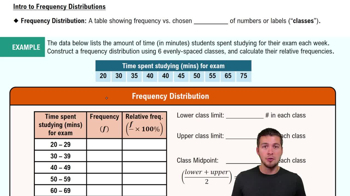
Intro to Frequency Distributions

Cumulative Frequency

Cumulative frequency is the running total of frequencies through the classes in a frequency distribution. It helps in understanding how many observations fall below a particular value, which can be useful for identifying trends in commute times.
Recommended video:
04:41
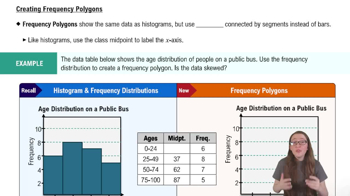
Creating Frequency Polygons

Data Reconstruction

Data reconstruction refers to the process of estimating or inferring the original data values from summarized data, such as frequency distributions. In this case, while we can determine the total number of commute times, we cannot identify the exact values of all original data amounts due to the grouped nature of the data.
Recommended video:
Guided course
04:39
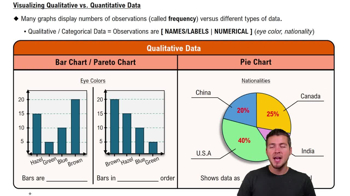
Visualizing Qualitative vs. Quantitative Data
Related Practice
Textbook Question

In Exercises 17–20, identify how the graph is deceptive.


Cost of Giving Birth According to the Agency for Healthcare Research and Quality Healthcare Cost and Utilization Project, the typical cost of a C-section baby delivery is \$4500, and the typical cost of a vaginal delivery is \$2600. See the following illustration.


128
views
Textbook Question

In Exercises 9 and 10, construct the time-series graph.


Home Runs Listed below are the numbers of home runs in Major League Baseball for each year beginning with 1993 (listed in order by row). Is there a trend?

117
views
Textbook Question

In Exercises 9–18, construct the histograms and answer the given questions.


Analysis of Last Digits Use the frequency distribution from Exercise 21 in Section 2-1 to construct a histogram. What can be concluded from the distribution of the digits? Specifically, do the heights appear to be reported or actually measured?

142
views
Textbook Question

In Exercises 5–8, identify the class width, class midpoints, and class boundaries for the given frequency distribution. Also identify the number of individuals included in the summary. The frequency distributions are based on real data from Appendix B.

8.

570
views
Textbook Question

In Exercises 5–8, answer the questions by referring to the following Minitab-generated histogram, which depicts the weights (grams) of all quarters listed in Data Set 40 “Coin Weights” in Appendix B. (Grams are actually units of mass and the values shown on the horizontal scale are rounded.)


Sample Size What is the approximate number of quarters depicted in the three bars farthest to the left?

166
views
Textbook Question

In Exercises 15 and 16, construct the frequency polygons.


Chicago Commute Times Use the frequency distribution from Exercise 13 in Section 2-1 to construct a frequency polygon. Does the graph suggest that the distribution is skewed? If so, how?


111
views