
Ch. 2 - Exploring Data with Tables and Graphs
Triola - Elementary Statistics 14th Edition
Triola14th EditionElementary StatisticsISBN: 9780137366446Not the one you use?Change textbook
Chapter 2, Problem 2.2.6

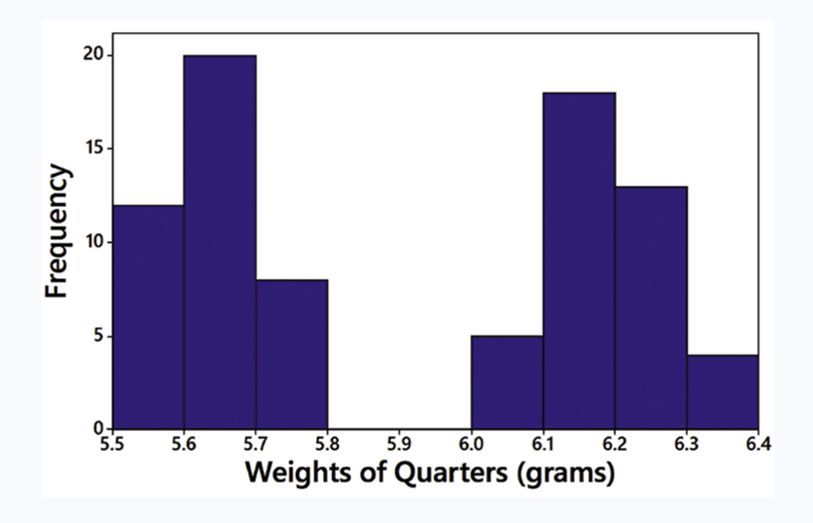
In Exercises 5–8, answer the questions by referring to the following Minitab-generated histogram, which depicts the weights (grams) of all quarters listed in Data Set 40 “Coin Weights” in Appendix B. (Grams are actually units of mass and the values shown on the horizontal scale are rounded.)
Histogram showing the frequency distribution of quarter weights in grams, with values ranging from 5.5 to 6.4 grams.
Class Width and Class Limits Give the approximate values of the class width, and the lower and upper class limits of the class depicted in the bar farthest to the left.

Verified step by step guidance
1
Step 1: Identify the class width by observing the horizontal axis of the histogram. The class width is the difference between the lower boundary of one class and the lower boundary of the next class. For example, the first class starts at 5.5 and the next class starts at 5.6, so the class width is approximately 0.1 grams.
Step 2: Determine the lower class limit of the bar farthest to the left. The bar farthest to the left starts at 5.5 grams, which is the lower class limit for that class.
Step 3: Determine the upper class limit of the bar farthest to the left. The upper class limit is the value at the end of the class interval. Since the class width is 0.1 grams, the upper class limit for the first bar is approximately 5.6 grams.
Step 4: Verify the frequency of the bar farthest to the left. The height of the bar indicates the frequency, which appears to be approximately 10 based on the vertical axis.
Step 5: Summarize the findings: The class width is approximately 0.1 grams, the lower class limit is 5.5 grams, and the upper class limit is 5.6 grams for the bar farthest to the left.

Verified video answer for a similar problem:

This video solution was recommended by our tutors as helpful for the problem above.
Video duration:
2m
Was this helpful?

Key Concepts

Here are the essential concepts you must grasp in order to answer the question correctly.

Histogram

A histogram is a graphical representation of the distribution of numerical data, where the data is divided into intervals or 'bins.' Each bin's height reflects the frequency of data points within that interval. In this case, the histogram displays the weights of quarters, allowing for visual analysis of how these weights are distributed across different ranges.
Recommended video:
Guided course
05:54
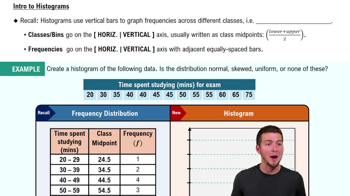
Intro to Histograms

Class Width

Class width refers to the range of values that each bin in a histogram covers. It is calculated by subtracting the lower limit of a class from its upper limit. For the leftmost bar in the histogram, identifying the class width is essential for understanding how the data is grouped and for making comparisons between different intervals.
Recommended video:
Guided course
05:18
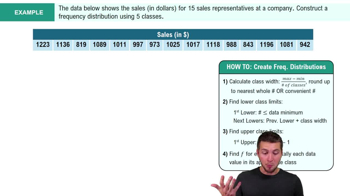
How to Create Frequency Distributions Example 2

Class Limits

Class limits define the boundaries of each bin in a histogram. The lower class limit is the smallest value that can fall into that bin, while the upper class limit is the largest. For the leftmost bar in the histogram, determining these limits is crucial for accurately interpreting the data and understanding the specific range of weights represented.
Recommended video:
Guided course
06:29
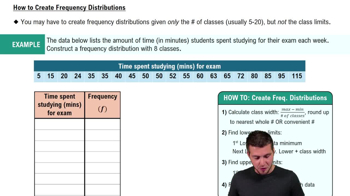
How to Create Frequency Distributions
Related Practice
Textbook Question

In Exercises 9–12, using a loose interpretation of the criteria for determining whether a frequency distribution is approximately a normal distribution, determine whether the given frequency distribution is approximately a normal distribution. Give a brief explanation.

Blood Platelet Counts of Females Refer to the frequency distribution from Exercise 8

125
views
Textbook Question

Causation A study has shown that there is a correlation between body weight and blood pressure. Higher body weights are associated with higher blood pressure levels. Can we conclude that gaining weight is a cause of increased blood pressure?

208
views
Textbook Question

In Exercises 9–18, construct the histograms and answer the given questions.


Burger King Dinner Service Times Use the frequency distribution from Exercise 18 in Section 2-1 to construct a histogram. Using a strict interpretation of the criteria for being a normal distribution, does the histogram appear to depict data from a population with a normal distribution?

187
views
Textbook Question

In Exercises 11 and 12 construct the Pareto chart.


Box Office Boffo Recent annual gross revenue (millions of dollars) for the leading movie studios are as follows: 20th Century Fox (1082), Buena Vista (3092), Paramount (757), Sony/Columbia (1304), Universal (1772), Warner Brothers (1941). Are these data likely to be reasonably accurate?

155
views
Textbook Question

In Exercises 25 and 26, construct the cumulative frequency distribution that corresponds to the frequency distribution in the exercise indicated.


Exercise 5 (Age of Best Actress When Oscar Was Won)

202
views
Textbook Question

In Exercises 5–8, answer the questions by referring to the following Minitab-generated histogram, which depicts the weights (grams) of all quarters listed in Data Set 40 “Coin Weights” in Appendix B. (Grams are actually units of mass and the values shown on the horizontal scale are rounded.)


Relative Frequency Histogram How would the shape of the histogram change if the vertical scale uses relative frequencies expressed in percentages instead of the actual frequency counts as shown here?

183
views