Ch. 2 - Exploring Data with Tables and Graphs
Triola - Elementary Statistics 14th Edition
Triola14th EditionElementary StatisticsISBN: 9780137366446Not the one you use?Change textbook
Chapter 2, Problem 2.2.2

More IQ Scores The population of IQ scores of adults is normally distributed. If we obtain a voluntary response sample of 5000 of those IQ scores, will a histogram of the sample be bell-shaped?

Verified step by step guidance
1
Understand the concept of a voluntary response sample: This type of sample is self-selected, meaning individuals choose to participate. It often leads to bias because those who respond may not represent the entire population.
Recall the properties of a normal distribution: A normal distribution is symmetric and bell-shaped, characterized by its mean and standard deviation.
Consider the Central Limit Theorem: This theorem states that the distribution of the sample mean will be approximately normal if the sample size is large enough, regardless of the population distribution. However, it applies to the distribution of sample means, not the distribution of individual sample values.
Evaluate the impact of sample bias: Since the sample is voluntary, it may not accurately reflect the population's normal distribution. This could affect the shape of the histogram, making it potentially not bell-shaped.
Conclude based on sample characteristics: Due to the voluntary nature of the sample, the histogram may not be bell-shaped even if the population distribution is normal. The sample may be skewed or have other biases that affect its shape.

Verified video answer for a similar problem:

This video solution was recommended by our tutors as helpful for the problem above.
Video duration:
2m
Was this helpful?

Key Concepts

Here are the essential concepts you must grasp in order to answer the question correctly.

Normal Distribution

A normal distribution is a continuous probability distribution characterized by a symmetric, bell-shaped curve. It is defined by its mean and standard deviation, where most of the data points cluster around the mean, and the probabilities for values taper off equally in both directions. Understanding this concept is crucial as it describes the population of IQ scores in the question.
Recommended video:
Guided course
09:47
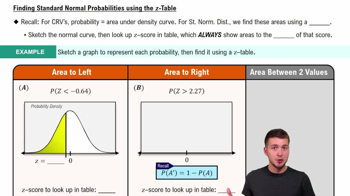
Finding Standard Normal Probabilities using z-Table

Voluntary Response Sample

A voluntary response sample is a type of non-probability sampling where participants self-select into the sample. This method often leads to bias because individuals with strong opinions or interests are more likely to participate, which may not accurately represent the entire population. Recognizing this bias is essential to evaluate whether the sample's histogram will reflect the population's normal distribution.
Recommended video:
05:11
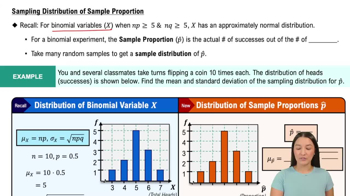
Sampling Distribution of Sample Proportion

Histogram

A histogram is a graphical representation of the distribution of numerical data, where data is grouped into bins or intervals. The height of each bar reflects the frequency of data points within each interval. In the context of the question, understanding how a histogram can visually represent the distribution of IQ scores helps assess whether the sample's distribution is bell-shaped like the population's normal distribution.
Recommended video:
Guided course
05:54
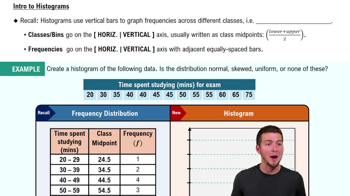
Intro to Histograms
Related Practice
Textbook Question

Normal Distribution If the following data are randomly selected, which are expected to have a normal distribution?


a. Weights of Reese’s Peanut Butter Cups

151
views

Textbook Question

Seatbelts The Beams Seatbelts company manufactures—well, you know. When a sample of seatbelts is tested for breaking point (measured in kilograms), the sample data are explored. Identify the important characteristic of data that is missing from this list: center, distribution, outliers, changing characteristics over time.

105
views
Textbook Question

In Exercises 5 and 6, construct the dotplot.


Pulse Rates Listed below are pulse rates (beats per minute) of females selected from Data Set 1 “Body Data” in Appendix B. All of those pulse rates are even numbers. Is there a pulse rate that appears to be an outlier? What is its value?


142
views
Textbook Question

In Exercises 9–18, construct the histograms and answer the given questions.


Tornadoes Use the frequency distribution from Exercise 16 in Section 2-1 to construct a histogram. Does the histogram appear to be skewed? If so, identify the type of skewness.

134
views
Textbook Question

Tornado Alley A stemplot of the same data summarized in Exercise 1 is created, and one of the rows of that stemplot is 3 | 000144669. Identify the values represented by that row of the stemplot.

96
views
Textbook Question

In Exercises 9–18, construct the histograms and answer the given questions.


Hershey’s Kisses Use the frequency distribution from Exercise 20 in Section 2-1 to construct a histogram. In using a strict interpretation of the criteria for being a normal distribution, does the histogram appear to depict data from a population with a normal distribution?

145
views