

Ch. 3 - Describing, Exploring, and Comparing Data
Triola - Elementary Statistics 14th Edition
Triola14th EditionElementary StatisticsISBN: 9780137366446Not the one you use?Change textbook
Chapter 3, Problem 3.c.4

Percentile Use the weights from Exercise 1 to find the percentile for 3647 mg.

Verified step by step guidance
1
Step 1: Arrange the weights in ascending order. The weights provided are already sorted in ascending order: 3511, 3516, 3521, 3531, 3532, 3545, 3583, 3588, 3590, 3617, 3621, 3635, 3638, 3643, 3645, 3647, 3666, 3673, 3678, 3723.
Step 2: Identify the position of the value 3647 in the sorted list. Count the number of values less than or equal to 3647. In this case, 3647 is the 16th value in the list.
Step 3: Calculate the total number of data points in the list. There are 20 weights in total.
Step 4: Use the formula for percentile rank: \( P = \frac{(L + 0.5)}{N} \times 100 \), where \( L \) is the number of values less than the given value, \( N \) is the total number of values, and \( P \) is the percentile rank.
Step 5: Substitute \( L = 15 \) (since there are 15 values less than 3647), \( N = 20 \), and calculate the percentile rank using the formula. This will give the percentile for 3647 mg.

Verified video answer for a similar problem:

This video solution was recommended by our tutors as helpful for the problem above.
Video duration:
1m
Was this helpful?

Key Concepts

Here are the essential concepts you must grasp in order to answer the question correctly.

Percentile

A percentile is a statistical measure that indicates the value below which a given percentage of observations in a group falls. For example, the 50th percentile (median) is the value that separates the higher half from the lower half of the data set. In this context, finding the percentile for a specific weight, such as 3647 mg, involves determining how many weights in the dataset are less than or equal to 3647 mg.

Data Set

A data set is a collection of related values or observations, often organized in a structured format. In this case, the weights provided in the image represent a data set from which we can analyze the distribution of values. Understanding the data set is crucial for calculating percentiles, as it provides the context and range of values needed for comparison.
Recommended video:
Guided course
04:39
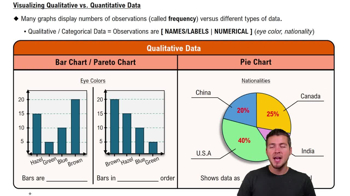
Visualizing Qualitative vs. Quantitative Data

Cumulative Frequency

Cumulative frequency is the running total of frequencies in a data set, showing how many observations fall below a particular value. To find the percentile for 3647 mg, one would calculate the cumulative frequency up to that value, which helps in determining its position relative to the entire data set. This concept is essential for understanding how data accumulates and aids in percentile calculations.
Recommended video:
04:41
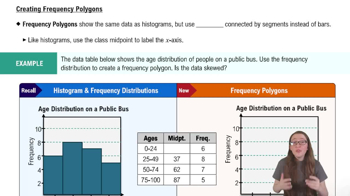
Creating Frequency Polygons
Related Practice
Textbook Question

z Scores. In Exercises 5–8, express all z scores with two decimal places.


Diastolic Blood Pressure of Females For the diastolic blood pressure measurements of females listed in Data Set 1 “Body Data” in Appendix B, the highest measurement is 98 mm Hg. The 147 diastolic blood pressure measurements of females have a mean of 70.2 mm Hg and a standard deviation of 11.2 mm Hg.


c. Convert the highest diastolic blood pressure to a z score.

140
views
Textbook Question

z Scores. In Exercises 5–8, express all z scores with two decimal places.


New York City Commute Time New York City commute times (minutes) are listed in Data Set 31 “Commute Times” in Appendix B. The 1000 times have a mean of 42.6 minutes and a standard deviation of 26.2 minutes. Consider the commute time of 95.0 minutes.


d. Using the criteria summarized in Figure 3-6, is the commute time of 95 minutes significantly low, significantly high, or neither?

160
views
Textbook Question

Why Divide by ? Let a population consist of the values 9 cigarettes, 10 cigarettes, and 20 cigarettes smoked in a day (based on data from the California Health Interview Survey). Assume that samples of two values are randomly selected with replacement from this population. (That is, a selected value is replaced before the second selection is made.)


c. For each of the nine different possible samples of two values selected with replacement, find the variance by treating each sample as if it is a population (using the formula for population variance, which includes division by n); then find the mean of those nine population variances.

133
views
Textbook Question

z Scores. In Exercises 5–8, express all z scores with two decimal places.


New York City Commute Time New York City commute times (minutes) are listed in Data Set 31 “Commute Times” in Appendix B. The 1000 times have a mean of 42.6 minutes and a standard deviation of 26.2 minutes. Consider the commute time of 95.0 minutes.


c. Convert the commute time of 95.0 minutes to a z score.

127
views
Textbook Question

Why Divide by ? Let a population consist of the values 9 cigarettes, 10 cigarettes, and 20 cigarettes smoked in a day (based on data from the California Health Interview Survey). Assume that samples of two values are randomly selected with replacement from this population. (That is, a selected value is replaced before the second selection is made.)


d. Which approach results in values that are better estimates of part (b) or part (c)? Why? When computing variances of samples, should you use division by n or

158
views
Textbook Question

Roller Coaster z Score A larger sample of 92 roller coaster maximum speeds has a mean of 85.9 km/h and a standard deviation of 28.7 km/h. What is the z score for a speed of 34 km/h? Does the z score suggest that the speed of 34 km/h is significantly low?

157
views