Ch. 3 - Describing, Exploring, and Comparing Data
Triola - Elementary Statistics 14th Edition
Triola14th EditionElementary StatisticsISBN: 9780137366446Not the one you use?Change textbook
Chapter 3, Problem 3.1.37

Trimmed Mean Because the mean is very sensitive to extreme values, we say that it is not a resistant measure of center. By deleting some low values and high values, the trimmed mean is more resistant. To find the 10% trimmed mean for a data set, first arrange the data in order, then delete the bottom 10% of the values and delete the top 10% of the values, then calculate the mean of the remaining values. Use the axial loads (pounds) of aluminum cans listed below (from Data Set 41 “Aluminum Cans” in Appendix B) for cans that are 0.0111 in. thick. An axial load is the force at which the top of a can collapses. Identify any outliers, then compare the median, mean, 10% trimmed mean, and 20% trimmed mean.


247 260 268 273 276 279 281 283 284 285 286 288
289 291 293 295 296 299 310 504

Verified step by step guidance
1
Step 1: Arrange the data in ascending order. The given data set is: 247, 260, 268, 273, 276, 279, 281, 283, 284, 285, 286, 288, 289, 291, 293, 295, 296, 299, 310, 504. Sorting it in ascending order ensures that the trimming process is accurate.
Step 2: Identify and remove outliers using a standard method such as the IQR (Interquartile Range). Calculate Q1 (first quartile) and Q3 (third quartile), then compute the IQR as IQR = Q3 - Q1. Any data point below Q1 - 1.5*IQR or above Q3 + 1.5*IQR is considered an outlier. Remove these outliers from the data set.
Step 3: Calculate the 10% trimmed mean. To do this, remove the bottom 10% and top 10% of the data points. For a data set with n values, remove the lowest ⌊0.1 * n⌋ and highest ⌊0.1 * n⌋ values. Then, compute the mean of the remaining data points.
Step 4: Calculate the 20% trimmed mean. Similarly, remove the bottom 20% and top 20% of the data points. For a data set with n values, remove the lowest ⌊0.2 * n⌋ and highest ⌊0.2 * n⌋ values. Compute the mean of the remaining data points.
Step 5: Compare the median, mean, 10% trimmed mean, and 20% trimmed mean. The median is the middle value of the sorted data set, while the mean is the average of all data points. Observe how the trimmed means differ from the mean and median, and note how trimming reduces the influence of extreme values.

Verified video answer for a similar problem:

This video solution was recommended by our tutors as helpful for the problem above.
Video duration:
3m
Was this helpful?

Key Concepts

Here are the essential concepts you must grasp in order to answer the question correctly.

Trimmed Mean

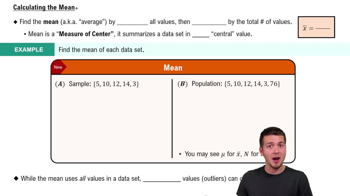
The trimmed mean is a statistical measure that reduces the influence of outliers by removing a specified percentage of the lowest and highest values from a data set before calculating the mean. For example, a 10% trimmed mean involves discarding the lowest 10% and highest 10% of data points, which results in a more robust average that better represents the central tendency of the remaining values.
Recommended video:
Guided course
04:52
Calculating the Mean

Outliers

Outliers are data points that significantly differ from the other observations in a dataset. They can skew the results of statistical analyses, particularly measures like the mean. Identifying outliers is crucial as they can indicate variability in measurement, experimental errors, or novel phenomena that warrant further investigation.
Recommended video:
Guided course
04:48
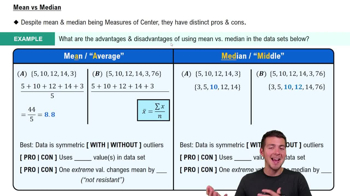
Comparing Mean vs. Median

Measures of Central Tendency

Measures of central tendency, including the mean, median, and mode, summarize a set of data by identifying the center point or typical value. The mean is the arithmetic average, the median is the middle value when data is ordered, and the mode is the most frequently occurring value. Each measure provides different insights, especially in the presence of outliers, making it important to compare them for a comprehensive understanding of the data.
Recommended video:
Guided course
04:52
Calculating the Mean
Related Practice
Textbook Question

In Exercises 21–24, find the mean and median for each of the two samples, then compare the two sets of results.


It’s a Small Wait After All Listed below are the wait times (minutes) at 10 AM for the rides “It’s a Small World” and “Avatar Flight of Passage.” These data are found in Data Set 33 “Disney World Wait Times.” Does a comparison between the means and medians reveal that there is a difference between the two sets of data?

185
views
Textbook Question

Critical Thinking. For Exercises 5–20, watch out for these little buggers. Each of these exercises involves some feature that is somewhat tricky. Find the (a) mean, (b) median, (c) mode, (d) midrange, and then answer the given question.


Smart Thermostats Listed below are selling prices (dollars) of smart thermostats tested by Consumer Reports magazine. If you decide to buy one of these smart thermostats, what statistic is most relevant, other than the measures of central tendency?


250 170 225 100 250 250 130 200 150 250 170 200 180 250

139
views
Textbook Question

Large Data Sets from Appendix B. In Exercises 25–28, refer to the indicated data set in Appendix B. Use software or a calculator to find the means and medians.


Body Temperatures Refer to Data Set 5 “Body Temperatures” in Appendix B and use the body temperatures for 12:00 AM on day 2. Do the results support or contradict the common belief that the mean body temperature is 98.6oF?

136
views
Textbook Question

In Exercises 5–20, find the range, variance, and standard deviation for the given sample data. Include appropriate units (such as “minutes”) in your results. (The same data were used in Section 3-1, where we found measures of center. Here we find measures of variation.) Then answer the given questions.


Jaws 3 Listed below are the number of unprovoked shark attacks worldwide for the last several years. What extremely important characteristic of the data is not considered when finding the measures of variation?


70 54 68 82 79 83 76 73 98 81

217
views
Textbook Question

Quadratic Mean The quadratic mean (or root mean square, or R.M.S.) is used in physical applications, such as power distribution systems. The quadratic mean of a set of values is obtained by squaring each value, adding those squares, dividing the sum by the number of values n, and then taking the square root of that result, as indicated below:


Quadratic mean = sqrt(∑x^2/n)


Find the R.M.S. of these voltages measured from household current: 0, 60, 110, 0. How does the result compare to the mean?

530
views
Textbook Question

In Exercises 21–28, use the same list of cell phone radiation levels given for Exercises 17–20. Find the indicated percentile or quartile.


P50


130
views