Ch. 3 - Describing, Exploring, and Comparing Data
Triola - Elementary Statistics 14th Edition
Triola14th EditionElementary StatisticsISBN: 9780137366446Not the one you use?Change textbook
Chapter 3, Problem 3.3.4

z Scores If your score on your next statistics test is converted to a z score, which of these z scores would you prefer: -2.00, -1.00, 0, 1.00, 2.00? Why?

Verified step by step guidance
1
Understand the concept of a z-score: A z-score measures how many standard deviations a data point is from the mean. A positive z-score indicates a value above the mean, while a negative z-score indicates a value below the mean.
Interpret the given z-scores: A z-score of -2.00 means the score is 2 standard deviations below the mean, -1.00 is 1 standard deviation below the mean, 0 is exactly at the mean, 1.00 is 1 standard deviation above the mean, and 2.00 is 2 standard deviations above the mean.
Consider the context of the problem: Since the question is about a test score, a higher z-score is preferable because it indicates a better performance relative to the average (mean) score.
Compare the z-scores: Among the given z-scores (-2.00, -1.00, 0, 1.00, 2.00), the z-score of 2.00 is the highest, meaning it represents the best performance relative to the mean.
Conclude: You would prefer a z-score of 2.00 because it indicates that your test score is 2 standard deviations above the mean, which is the best performance among the options provided.

Verified video answer for a similar problem:

This video solution was recommended by our tutors as helpful for the problem above.
Video duration:
2m
Was this helpful?

Key Concepts

Here are the essential concepts you must grasp in order to answer the question correctly.

Z Score

A z score, or standard score, indicates how many standard deviations a data point is from the mean of a dataset. It is calculated by subtracting the mean from the data point and then dividing by the standard deviation. Z scores allow for comparison between different datasets by standardizing scores, making it easier to understand relative performance.
Recommended video:
Guided course
06:31
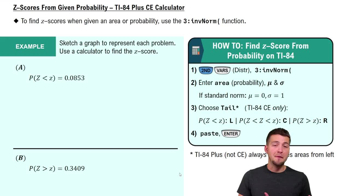
Z-Scores From Given Probability - TI-84 (CE) Calculator

Standard Deviation

Standard deviation is a measure of the amount of variation or dispersion in a set of values. A low standard deviation indicates that the values tend to be close to the mean, while a high standard deviation indicates that the values are spread out over a wider range. Understanding standard deviation is crucial for interpreting z scores, as it affects how far a score is from the mean.
Recommended video:
Guided course
08:45
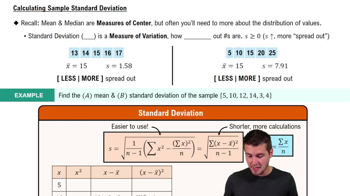
Calculating Standard Deviation

Normal Distribution

Normal distribution is a probability distribution that is symmetric about the mean, showing that data near the mean are more frequent in occurrence than data far from the mean. In a normal distribution, z scores can be used to determine the probability of a score occurring within a certain range. This concept is essential for understanding the implications of different z scores in terms of performance relative to peers.
Recommended video:
Guided course
09:47
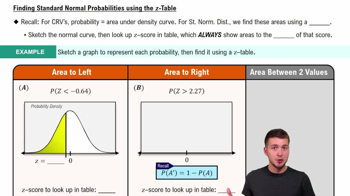
Finding Standard Normal Probabilities using z-Table
Related Practice
Textbook Question

Finding Standard Deviation from a Frequency Distribution. In Exercises 37–40, refer to the frequency distribution in the given exercise and compute the standard deviation by using the formula below, where x represents the class midpoint, f represents the class frequency, and n represents the total number of sample values. Also, compare the computed standard deviations to these standard deviations obtained by using Formula 3-4 with the original list of data values: (Exercise 37) 18.5 minutes; (Exercise 38) 36.7 minutes; (Exercise 39) 6.9 years; (Exercise 40) 20.4 seconds.


Standard deviation for frequency distribution


454
views
Textbook Question

Significant Values. In Exercises 9–12, use the range rule of thumb to identify (a) the values that are significantly low, (b) the values that are significantly high, and (c) the values that are neither significantly low nor significantly high.


IQ Scores The Wechsler test is used to measure intelligence of adults aged 16 to 80. The mean test score is 100 and the standard deviation is 15.

222
views
Textbook Question

In Exercises 21–28, use the same list of cell phone radiation levels given for Exercises 17–20. Find the indicated percentile or quartile.


Q3


149
views
Textbook Question

Finding Standard Deviation from a Frequency Distribution. In Exercises 37–40, refer to the frequency distribution in the given exercise and compute the standard deviation by using the formula below, where x represents the class midpoint, f represents the class frequency, and n represents the total number of sample values. Also, compare the computed standard deviations to these standard deviations obtained by using Formula 3-4 with the original list of data values: (Exercise 37) 18.5 minutes; (Exercise 38) 36.7 minutes; (Exercise 39) 6.9 years; (Exercise 40) 20.4 seconds.


Standard deviation for frequency distribution


292
views
Textbook Question

Boxplots. In Exercises 29–32, use the given data to construct a boxplot and identify the 5-number summary.


Blood Pressure Measurements Fourteen different second-year medical students at Bellevue Hospital measured the blood pressure of the same person. The systolic readings (mm Hg) are listed below.


138 130 135 140 120 125 120 130 130 144 143 140 130 150

197
views
Textbook Question

Why Divide by ? Let a population consist of the values 9 cigarettes, 10 cigarettes, and 20 cigarettes smoked in a day (based on data from the California Health Interview Survey). Assume that samples of two values are randomly selected with replacement from this population. (That is, a selected value is replaced before the second selection is made.)


a. Find the variance of the population {9 cigarettes, 10 cigarettes, 20 cigarettes}.

143
views