
Ch. 4 - Probability
Triola - Elementary Statistics 14th Edition
Triola14th EditionElementary StatisticsISBN: 9780137366446Not the one you use?Change textbook
Chapter 4, Problem 4.1.3c

Dice and Coins


c. Find the probability that when a six-sided die is rolled, the outcome is 7.

Verified step by step guidance
1
Understand the problem: A six-sided die has faces numbered 1 through 6. The problem asks for the probability of rolling a 7, which is outside the range of possible outcomes for this die.
Recall the definition of probability: Probability is calculated as the ratio of favorable outcomes to the total number of possible outcomes. Mathematically, \( P(A) = \frac{\text{Number of favorable outcomes}}{\text{Total number of possible outcomes}} \).
Identify the favorable outcomes: Since a six-sided die only has numbers 1 through 6, there are no favorable outcomes for rolling a 7. This means the number of favorable outcomes is 0.
Determine the total number of possible outcomes: For a six-sided die, the total number of possible outcomes is 6 (one for each face).
Substitute the values into the probability formula: Using \( P(A) = \frac{\text{Number of favorable outcomes}}{\text{Total number of possible outcomes}} \), substitute 0 for the numerator and 6 for the denominator to calculate the probability.

Verified video answer for a similar problem:

This video solution was recommended by our tutors as helpful for the problem above.
Video duration:
1m
Was this helpful?

Key Concepts

Here are the essential concepts you must grasp in order to answer the question correctly.

Probability

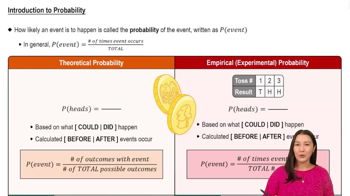
Probability is a measure of the likelihood that a particular event will occur, expressed as a number between 0 and 1. An event with a probability of 0 means it cannot happen, while a probability of 1 means it is certain to happen. In the context of rolling a die, the probability is calculated by dividing the number of favorable outcomes by the total number of possible outcomes.
Recommended video:
5:37
Introduction to Probability

Sample Space

The sample space is the set of all possible outcomes of a random experiment. For a six-sided die, the sample space consists of the numbers 1 through 6, representing each face of the die. Understanding the sample space is crucial for calculating probabilities, as it provides the total number of outcomes against which favorable outcomes are compared.
Recommended video:
05:11
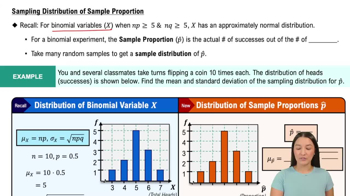
Sampling Distribution of Sample Proportion

Favorable Outcomes

Favorable outcomes are the specific results of an experiment that satisfy the conditions of the event we are interested in. In the case of rolling a six-sided die, there are no favorable outcomes for rolling a 7, as the die only has faces numbered 1 to 6. This concept is essential for determining the probability of an event, as it directly influences the calculation of the probability ratio.
Recommended video:
Guided course
06:00
The Binomial Experiment
Related Practice
Textbook Question

In Exercises 21–24, use these results from the “1-Panel-THC” test for marijuana use, which is provided by the company Drug Test Success: Among 143 subjects with positive test results, there are 24 false positive (incorrect) results; among 157 negative results, there are 3 false negative (incorrect) results. (Hint: Construct a table similar to Table 4-1.)


Testing for Marijuana Use


c. What is the probability that a randomly selected subject had a true negative result?

132
views
Textbook Question

ATM You want to obtain cash by using an ATM, but it’s dark and you can’t see your card when you insert it. The card must be inserted with the front side up and the printing configured so that the beginning of your name enters first.


c. How many random selections are required to be absolutely sure that the card works because it is inserted correctly?

147
views
Textbook Question

Denomination Effect

In Exercises 13–16, use the data in the following table. In an experiment to study the effects of using four quarters versus a \$1 bill, some college students were given four quarters and others were given a \$1 bill, and they could either keep the money or spend it on gum. The results are summarized in the table (based on data from “The Denomination Effect,” by Priya Raghubir and Joydeep Srivastava, Journal of Consumer Research, Vol. 36).


Denomination Effect


b. Find the probability of randomly selecting a student who kept the money, given that the student was given four quarters.


128
views
Textbook Question

Births in Vietnam In Vietnam, the probability of a baby being a boy is 0.526 (based on the data available at this writing). For a family having four children, find the following.


b. The probability that all four children are girls.


166
views
Textbook Question

Corporate Officers and Committees The Self Driving Unicycle Company was recently successfully funded via Kickstarter and must now appoint a president, chief executive officer (CEO), chief operating officer (COO), and chief financial officer (CFO), and chief human resources officer (CHR). It must also appoint a strategic planning committee with five different members. There are 15 qualified candidates, and officers can also serve on the committee.


b. How many different ways can a committee of five be appointed?


146
views
Textbook Question

Kentucky Derby Odds When the horse Justify won the 144th Kentucky Derby, a \$2 bet on a Justify win resulted in a winning ticket worth \(7.80.


c. If the payoff odds were the actual odds found in part (c), what would be the worth of a \)2 win ticket after the Justify win?

194
views