
Ch. 4 - Probability
Triola - Elementary Statistics 14th Edition
Triola14th EditionElementary StatisticsISBN: 9780137366446Not the one you use?Change textbook
Chapter 4, Problem 4.1.41a

Florida Pick 3 In the Florida Pick 3 lottery, you can place a “straight” bet of \(1 by selecting the exact order of three digits between 0 and 9 inclusive (with repetition allowed), so the probability of winning is 1/1000. If the same three numbers are drawn in the same order, you collect \)500, so your net profit is \$499.


a. Find the actual odds against winning.

Verified step by step guidance
1
Step 1: Understand the concept of 'odds against winning'. Odds against winning are expressed as the ratio of the number of unfavorable outcomes to the number of favorable outcomes. In this case, the probability of winning is given as 1/1000, so the probability of losing is 1 - (1/1000).
Step 2: Calculate the probability of losing. Since the total probability must sum to 1, the probability of losing is given by: P(Losing) = 1 - P(Winning). Substitute P(Winning) = 1/1000 into this formula.
Step 3: Express the odds against winning as a ratio. The odds against winning are calculated as: Odds Against = P(Losing) / P(Winning). Use the probabilities from Step 2 to compute this ratio.
Step 4: Simplify the ratio. Simplify the fraction obtained in Step 3 to express the odds against winning in the simplest form. This will involve basic arithmetic operations.
Step 5: Interpret the result. The final odds against winning will be expressed as a ratio of unfavorable outcomes to favorable outcomes, such as '999:1'. This means there are 999 ways to lose for every 1 way to win.

Verified video answer for a similar problem:

This video solution was recommended by our tutors as helpful for the problem above.
Video duration:
3m
Was this helpful?

Key Concepts

Here are the essential concepts you must grasp in order to answer the question correctly.

Probability

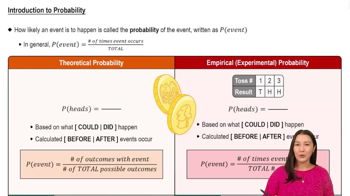
Probability is a measure of the likelihood that a particular event will occur, expressed as a number between 0 and 1. In the context of the Florida Pick 3 lottery, the probability of winning with a straight bet is 1/1000, indicating that there is one favorable outcome (winning) out of 1000 possible outcomes (all combinations of three digits).
Recommended video:
5:37
Introduction to Probability

Odds

Odds represent the ratio of the probability of an event occurring to the probability of it not occurring. In the case of the Florida Pick 3 lottery, the odds against winning can be calculated by comparing the number of losing outcomes (999) to the number of winning outcomes (1), resulting in odds of 999 to 1 against winning.
Recommended video:
Guided course
03:26
Calculating the Median

Net Profit

Net profit is the amount of money gained after subtracting costs or expenses from total revenue. In the Florida Pick 3 lottery, if a player wins $500 from a $1 bet, the net profit is calculated as $500 (winnings) minus $1 (cost of the bet), resulting in a net profit of $499. Understanding net profit is essential for evaluating the financial implications of participating in the lottery.
Recommended video:
Guided course
07:09
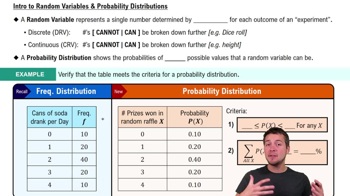
Intro to Random Variables & Probability Distributions
Related Practice
Textbook Question

In Exercises 1–10, use the data in the accompanying table and express all results in decimal form. (The data are from “The Left-Handed: Their Sinister History,” by Elaine Fowler Costas, Education Resources Information Center, Paper 399519.)


" style="" width="320">


Both Lefties If two of the study subjects are randomly selected with replacement, find the probability that they both write with their left hand.

141
views
Textbook Question

In Exercises 21–24, use these results from the “1-Panel-THC” test for marijuana use, which is provided by the company Drug Test Success: Among 143 subjects with positive test results, there are 24 false positive (incorrect) results; among 157 negative results, there are 3 false negative (incorrect) results. (Hint: Construct a table similar to Table 4-1.)


Testing for Marijuana Use


a. How many subjects are included in the study?

134
views
Textbook Question

Denomination Effect

In Exercises 13–16, use the data in the following table. In an experiment to study the effects of using four quarters versus a \$1 bill, some college students were given four quarters and others were given a \$1 bill, and they could either keep the money or spend it on gum. The results are summarized in the table (based on data from “The Denomination Effect,” by Priya Raghubir and Joydeep Srivastava, Journal of Consumer Research, Vol. 36).


Denomination Effect


a. Find the probability of randomly selecting a student who kept the money, given that the student was given four quarters.

125
views
Textbook Question

Vision Correction About 75% of the U.S. population uses some type of vision correction (such as glasses or contact lenses).


b. If four different people are randomly selected, what is the probability that they all use vision correction?

168
views
Textbook Question

In Exercises 1–10, use the data in the accompanying table and express all results in decimal form. (The data are from “The Left-Handed: Their Sinister History,” by Elaine Fowler Costas, Education Resources Information Center, Paper 399519.)


Lefty or Female Find the probability of randomly selecting one of the study subjects and getting someone who writes with their left hand or is a female.

149
views
Textbook Question

ATM You want to obtain cash by using an ATM, but it’s dark and you can’t see your card when you insert it. The card must be inserted with the front side up and the printing configured so that the beginning of your name enters first.


a. What is the probability of selecting a random position and inserting the card with the result that the card is inserted correctly?

148
views