Ch. 4 - Probability
Triola - Elementary Statistics 14th Edition
Triola14th EditionElementary StatisticsISBN: 9780137366446Not the one you use?Change textbook
Chapter 4, Problem 4.1.9

In Exercises 9–12, assume that 100 births are randomly selected. Use subjective judgment to describe the given number of girls as (a) significantly low, (b) significantly high, or (c) neither significantly low nor significantly high.


53 girls.

Verified step by step guidance
1
Step 1: Define the problem context. We are tasked with determining whether the observed number of 53 girls out of 100 births is significantly low, significantly high, or neither. This involves comparing the observed value to the expected distribution under the assumption of a fair 50/50 chance of having a girl or boy at each birth.
Step 2: Identify the statistical distribution. Since the births are independent and there are two possible outcomes (girl or boy), the number of girls in 100 births follows a binomial distribution with parameters n = 100 (number of trials) and p = 0.5 (probability of a girl).
Step 3: Calculate the mean (μ) and standard deviation (σ) of the binomial distribution. The mean is given by μ = n × p, and the standard deviation is given by σ = √(n × p × (1 - p)). Substitute n = 100 and p = 0.5 into these formulas.
Step 4: Determine the range for significantly low and significantly high values. A common rule is to consider values more than 2 standard deviations away from the mean as significant. Calculate the lower threshold as μ - 2σ and the upper threshold as μ + 2σ.
Step 5: Compare the observed value (53 girls) to the thresholds. If the value is below the lower threshold, it is significantly low. If it is above the upper threshold, it is significantly high. If it falls within the range, it is neither significantly low nor significantly high.

Verified video answer for a similar problem:

This video solution was recommended by our tutors as helpful for the problem above.
Video duration:
2m
Was this helpful?

Key Concepts

Here are the essential concepts you must grasp in order to answer the question correctly.

Probability Distribution

A probability distribution describes how the probabilities of a random variable are distributed across its possible values. In the context of births, we can model the number of girls born using a binomial distribution, where each birth can be considered a trial with two outcomes: girl or boy. Understanding this distribution helps in determining what counts as significantly low or high based on expected probabilities.
Recommended video:
Guided course
06:39
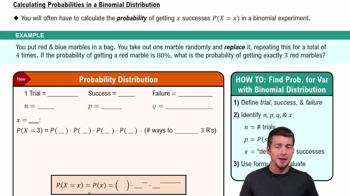
Calculating Probabilities in a Binomial Distribution

Significance Level

The significance level is a threshold used to determine whether a result is statistically significant. In this context, it helps to assess whether the observed number of girls (53) is significantly low or high compared to what would be expected under normal circumstances (typically around 50 girls in 100 births). A common significance level is 0.05, which indicates that results beyond this threshold are considered statistically significant.
Recommended video:
Guided course
04:46
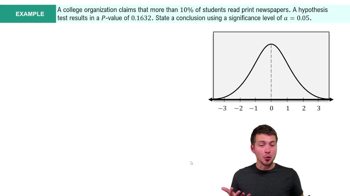
Step 4: State Conclusion Example 4

Subjective Judgment

Subjective judgment refers to the process of making decisions based on personal opinions, interpretations, or feelings rather than objective data. In this exercise, subjective judgment is used to evaluate whether the number of girls (53) is perceived as significantly low, high, or neither, which can vary based on individual perspectives and the context of the situation.
Recommended video:
Guided course
09:27
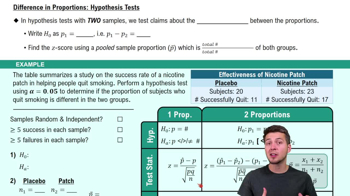
Difference in Proportions: Hypothesis Tests
Related Practice
Textbook Question

In Exercises 13–20, express the indicated degree of likelihood as a probability value between 0 and 1.


Movies Based on a study of the movies made in a recent year, 33 out of every 100 movies have a female lead or co-lead.

119
views
Textbook Question

In Exercises 29–32, use the given sample space or construct the required sample space to find the indicated probability.


Three Children Use this sample space listing the eight simple events that are possible when a couple has three children (as in Example 2): {bbb, bbg, bgb, bgg, gbb, gbg, ggb, ggg}. Assume that boys and girls are equally likely, so that the eight simple events are equally likely. Find the probability that when a couple has three children, there is exactly one girl.

155
views
Textbook Question

Simulating Dice When two dice are rolled, the total is between 2 and 12 inclusive. A student simulates the rolling of two dice by randomly generating numbers between 2 and 12. Does this simulation behave in a way that is similar to actual dice? Why or why not?

246
views
Textbook Question

In Exercises 33–40, use the given probability value to determine whether the sample results are significant.


Voting Repeat Exercise 33 after replacing 40 Democrats being placed on the first line of voting ballots with 27 Democrats being placed on the first line. The probability of getting a result as high as 27 is 0.029792.

103
views
Textbook Question

In Exercises 33–40, use the given probability value to determine whether the sample results are significant.


Selfie Deaths Based on Priceonomics data describing 49 deaths while taking selfies, it was found that 37 of those deaths were males. Assuming that males and females are equally likely to have selfie deaths, there is a 0.000235 probability of getting 37 or more males. Is the result of 37 males significantly low, significantly high, or neither? Does the result suggest that male selfie deaths are more likely than female selfie deaths?

126
views
Textbook Question

In Exercises 29–32, use the given sample space or construct the required sample space to find the indicated probability.


Four Children Exercise 29 lists the sample space for a couple having three children. After identifying the sample space for a couple having four children, find the probability of getting three girls and one boy (in any order).

197
views