Ch. 4 - Probability
Triola - Elementary Statistics 14th Edition
Triola14th EditionElementary StatisticsISBN: 9780137366446Not the one you use?Change textbook
Chapter 4, Problem 4.4.25a

Is the Researcher Cheating? You become suspicious when a genetics researcher “randomly” selects numerous groups of 20 newborn babies and seems to consistently get 10 girls and 10 boys. The researcher claims that it is common to get 10 girls and 10 boys in such cases.


a. If 20 newborn babies are randomly selected, how many different gender sequences are possible?

Verified step by step guidance
1
Step 1: Understand the problem. The researcher is selecting 20 newborn babies and we are tasked with determining the number of different gender sequences possible. Each baby can either be a boy (B) or a girl (G), making this a problem of binary outcomes.
Step 2: Recognize that the number of different gender sequences corresponds to the total number of combinations of boys and girls in the group. Since each baby has two possible outcomes (boy or girl), the total number of sequences can be calculated using the formula for permutations with repetition: \( 2^{n} \), where \( n \) is the number of babies.
Step 3: Substitute \( n = 20 \) into the formula \( 2^{n} \). This gives \( 2^{20} \), which represents the total number of possible gender sequences for 20 babies.
Step 4: To interpret this result, note that \( 2^{20} \) accounts for every possible arrangement of boys and girls, including sequences like all boys, all girls, and any mix in between.
Step 5: Conclude that the calculation of \( 2^{20} \) provides the total number of gender sequences possible, which is a very large number, reflecting the vast number of combinations that can occur when selecting 20 newborns.

Verified video answer for a similar problem:

This video solution was recommended by our tutors as helpful for the problem above.
Video duration:
2m
Was this helpful?

Key Concepts

Here are the essential concepts you must grasp in order to answer the question correctly.

Random Selection

Random selection is a fundamental concept in statistics that refers to the process of choosing individuals from a population in such a way that each individual has an equal chance of being selected. This ensures that the sample is representative of the population, allowing for valid inferences to be made. In the context of the question, it implies that the selection of newborns should not favor one gender over the other.
Recommended video:
Guided course
07:09
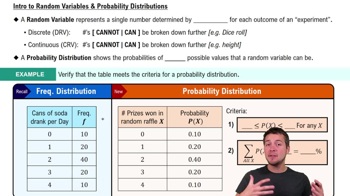
Intro to Random Variables & Probability Distributions

Combinatorics

Combinatorics is a branch of mathematics dealing with combinations and permutations of objects. In this scenario, it helps determine the number of different sequences of genders that can occur when selecting 20 newborns. Specifically, the number of gender sequences can be calculated using the formula for combinations, which accounts for the different ways boys and girls can be arranged in a sequence.

Probability

Probability is a measure of the likelihood that a particular event will occur, expressed as a number between 0 and 1. In this case, it relates to the chance of obtaining a specific gender distribution (e.g., 10 boys and 10 girls) when randomly selecting 20 newborns. Understanding probability is crucial for evaluating whether the researcher's results are statistically significant or if they could occur by chance.
Recommended video:
5:37
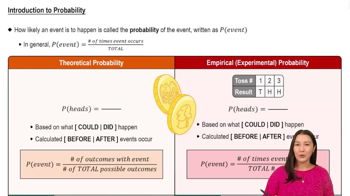
Introduction to Probability
Related Practice
Textbook Question

Alarm Clock Life Hack Each of us must sometimes wake up early for something really important, such as a final exam, job interview, or an early flight. (Professional golfer Jim Furyk was disqualified from a tournament when his cellphone lost power and he overslept.) Assume that a battery-powered alarm clock has a 0.005 probability of failure, a smartphone alarm clock has a 0.052 probability of failure, and an electric alarm clock has a 0.001 probability of failure.

a. What is the probability that your single battery-powered alarm clock works successfully when you need it?

166
views
Textbook Question

Identity Theft with Credit Cards Credit card numbers typically have 16 digits, but not all of them are random.


a. What is the probability of randomly generating 16 digits and getting your MasterCard number?


155
views
Textbook Question

Kentucky Derby Odds When the horse Justify won the 144th Kentucky Derby, a \$2 bet on a Justify win resulted in a winning ticket worth \(7.80.


a. How much net profit was made from a \)2 win bet on Justify?

160
views
Textbook Question

In Exercises 9–20, use the data in the following table, which lists survey results from high school drivers at least 16 years of age (based on data from “Texting While Driving and Other Risky Motor Vehicle Behaviors Among U.S. High School Students,” by O’Malley, Shults, and Eaton, Pediatrics, Vol. 131, No. 6). Assume that subjects are randomly selected from those included in the table. Hint: Be very careful to read the question correctly.

Texting and Alcohol If three of the high school drivers are randomly selected from the 4720 subjects who did not text while driving, find the probability that all three drove when drinking.


a. Assume that the selections are made with replacement. Are the events independent?

163
views
Textbook Question

Dice and Coins


a. Find the probability that when a single six-sided die is rolled, the outcome is 5.

301
views
Textbook Question

Redundancy in Computer Hard Drives The Seagate ST8000NM0055 hard drive has a 1.22% rate of failures in a year (based on data from Backblaze, Inc.). For the following, assume that all hard drives are that Seagate model.


a. If all of your computer data are stored on a hard disk drive with a copy stored on a second hard disk drive, what is the probability that during a year, you can avoid catastrophe with at least one working drive? Express the result with six decimal places.

160
views