Ch. 4 - Probability
Triola - Elementary Statistics 14th Edition
Triola14th EditionElementary StatisticsISBN: 9780137366446Not the one you use?Change textbook
Chapter 4, Problem 4.4.8

Soccer Shootout In the FIFA Women’s World Cup 2019, a tie at the end of two overtime periods leads to a “shootout” with five kicks taken by each team from the penalty mark. Each kick must be taken by a different player. How many ways can 5 players be selected from the 11 eligible players? For the 5 selected players, how many ways can they be designated as first, second, third, fourth, and fifth?

Verified step by step guidance
1
Step 1: Recognize that the problem involves two parts: (1) selecting 5 players from 11 eligible players, and (2) arranging the selected 5 players in a specific order (first, second, third, fourth, and fifth).
Step 2: To calculate the number of ways to select 5 players from 11, use the combination formula: C(n,r)=n!r!(n-r)!, where n is the total number of players (11) and r is the number of players to be selected (5).
Step 3: Substitute n=11 and r=5 into the combination formula to compute the number of ways to select 5 players: C(11,5)=11!5!(11-5)!.
Step 4: To calculate the number of ways to arrange the 5 selected players in a specific order, use the permutation formula: P(n,r)=n!(n-r)!. Substitute n=5 and r=5 to compute the number of arrangements: P(5,5)=5!.
Step 5: Multiply the results from Step 3 (number of ways to select 5 players) and Step 4 (number of ways to arrange the 5 players) to find the total number of ways to select and arrange the players.

Verified video answer for a similar problem:

This video solution was recommended by our tutors as helpful for the problem above.
Video duration:
3m
Was this helpful?

Key Concepts

Here are the essential concepts you must grasp in order to answer the question correctly.

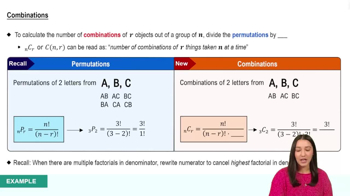
Combinations

Combinations refer to the selection of items from a larger set where the order does not matter. In this context, we need to choose 5 players from a pool of 11 eligible players. The formula for combinations is given by C(n, k) = n! / (k!(n-k)!), where n is the total number of items, k is the number of items to choose, and '!' denotes factorial.
Recommended video:
05:22
Combinations

Permutations

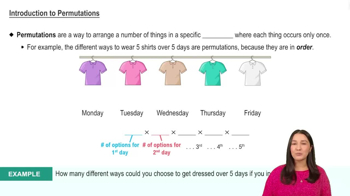
Permutations involve the arrangement of items where the order does matter. After selecting 5 players, we need to determine the different ways to assign them to specific kicking positions (first, second, etc.). The number of permutations of k items from a set of n is calculated using the formula P(n, k) = n! / (n-k)!, which accounts for the order of selection.
Recommended video:
07:11
Introduction to Permutations

Factorial

Factorial is a mathematical operation that multiplies a number by all positive integers less than it. It is denoted by n! and is crucial in both combinations and permutations calculations. For example, 5! = 5 × 4 × 3 × 2 × 1 = 120. Understanding factorials is essential for calculating the total number of ways to select and arrange players in this soccer shootout scenario.
Recommended video:
05:22
Combinations
Related Practice
Textbook Question

Social Security Numbers A Social Security number consists of nine digits in a particular order, and repetition of digits is allowed. After seeing the last four digits printed on a receipt, if you randomly select the other digits, what is the probability of getting the correct Social Security number of the person who was given the receipt?

278
views
Textbook Question

Pick 10 Lottery For the New York Pick 10 lottery, the player first selects 10 numbers from 1 to 80. Then there is an official drawing of 20 numbers from 1 to 80. The prize of \$500,000 is won if the 10 numbers selected by the player are all included in the 20 numbers that are drawn. Find the probability of winning that prize.

209
views
Textbook Question

In Exercises 13–20, express the indicated degree of likelihood as a probability value between 0 and 1.


Square Peg Sydney Smith wrote in “On the Conduct of the Understanding” that it is impossible to fit a square peg in a round hole.

131
views
Textbook Question

Composite Drug Test Based on the data in Table 4-1, assume that the probability of a randomly selected person testing positive for drug use is 0.126. If drug screening samples are collected from 5 random subjects and combined, find the probability that the combined sample will reveal a positive result. Is that probability low enough so that further testing of the individual samples is rarely necessary?

201
views
Textbook Question

In Exercises 9–12, assume that 100 births are randomly selected. Use subjective judgment to describe the given number of girls as (a) significantly low, (b) significantly high, or (c) neither significantly low nor significantly high.


75 girls.

118
views
Textbook Question

Radio Station Call Letters Radio and Television station call letters must begin with either K (for stations west of the Mississippi River) or W (for stations east of the Mississippi River) and must include either two or three additional letters. How many different possibilities are there?

152
views