Ch. 5 - Discrete Probability Distributions
Triola - Elementary Statistics 14th Edition
Triola14th EditionElementary StatisticsISBN: 9780137366446Not the one you use?Change textbook
Chapter 5, Problem 5.1.30d

Expected Value in North Carolina’s Pick 4 Game In North Carolina’s Pick 4 lottery game, you can pay \(1 to select a four-digit number from 0000 through 9999. If you select the same sequence of four digits that are drawn, you win and collect \)5000.


d. Find the expected value.

Verified step by step guidance
1
Step 1: Understand the problem. The expected value (E[X]) is a measure of the average outcome of a random event over the long run. In this case, we are calculating the expected value of playing the Pick 4 lottery game, where you pay \$1 to play and can win \$5000 if your chosen number matches the winning number.
Step 2: Identify the probabilities. There are 10,000 possible four-digit combinations (from 0000 to 9999). The probability of selecting the correct number is \( P(\text{win}) = \frac{1}{10000} \), and the probability of not winning is \( P(\text{lose}) = 1 - \frac{1}{10000} = \frac{9999}{10000} \).
Step 3: Define the outcomes. If you win, your net gain is \( \$5000 - \$1 = \$4999 \). If you lose, your net gain is \( -\$1 \) (since you lose the \$1 you paid to play).
Step 4: Use the expected value formula. The formula for expected value is \( E[X] = \sum (x_i \cdot P(x_i)) \), where \( x_i \) represents each possible outcome and \( P(x_i) \) is the probability of that outcome. Substitute the values: \( E[X] = (4999 \cdot \frac{1}{10000}) + (-1 \cdot \frac{9999}{10000}) \).
Step 5: Simplify the expression. Combine the terms to calculate the expected value: \( E[X] = \frac{4999}{10000} - \frac{9999}{10000} \). This will give you the expected value of playing the game in dollars.

Verified video answer for a similar problem:

This video solution was recommended by our tutors as helpful for the problem above.
Video duration:
3m
Was this helpful?

Key Concepts

Here are the essential concepts you must grasp in order to answer the question correctly.

Expected Value

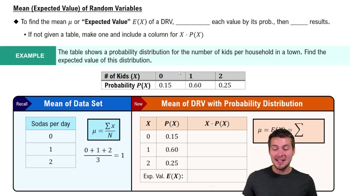
Expected value is a fundamental concept in probability and statistics that represents the average outcome of a random event when repeated many times. It is calculated by multiplying each possible outcome by its probability and summing these products. In the context of a lottery game, the expected value helps determine the average amount a player can expect to win or lose per game played.
Recommended video:
Guided course
04:14
Expected Value (Mean) of Random Variables

Probability

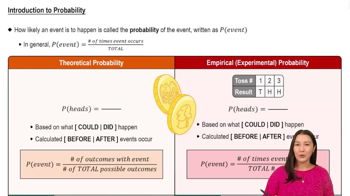
Probability is a measure of the likelihood that a particular event will occur, expressed as a number between 0 and 1. In the Pick 4 lottery, the probability of selecting the winning four-digit number is 1 in 10,000, since there are 10,000 possible combinations (from 0000 to 9999). Understanding probability is essential for calculating the expected value and assessing the game's risk.
Recommended video:
5:37
Introduction to Probability

Payoff

Payoff refers to the amount of money won or lost in a gambling scenario, which is crucial for calculating expected value. In the Pick 4 game, if a player wins, they receive a payoff of $5,000 for their $1 bet. The payoff, combined with the probability of winning, directly influences the expected value calculation, helping players understand the potential financial outcome of their bets.
Related Practice
Textbook Question

In Exercises 25–28, find the probabilities and answer the questions.


Too Young to Tat Based on a Harris poll, among adults who regret getting tattoos, 20% say that they were too young when they got their tattoos. Assume that five adults who regret getting tattoos are randomly selected, and find the indicated probability.


d. If we randomly select five adults, is 1 a significantly low number who say that they were too young to get tattoos?

131
views
Textbook Question

Using Probabilities for Significant Events


d. Is 1 a significantly low number of matches? Why or why not?

179
views
Textbook Question

Using Probabilities for Significant Events


c. Which probability is relevant for determining whether 1 is a significantly low number of matches: the result from part (a) or part (b)?


126
views
Textbook Question

In Exercises 9–16, use the Poisson distribution to find the indicated probabilities.


Births In a recent year (365 days), NYU-Langone Medical Center had 5942 births.


c. Find the probability that in a single day, there are no births. Would 0 births in a single day be a significantly low number of births?

165
views
Textbook Question

Expected Value for the Florida Pick 3 Lottery In the Florida Pick 3 lottery, you can bet \$1 by selecting three digits, each between 0 and 9 inclusive. If the same three numbers are drawn in the same order, you win and collect \(500.


d. Find the expected value for a \)1 bet.

189
views
Textbook Question

Politics The County Clerk in Essex, New Jersey, was accused of cheating by not using randomness in assigning the order in which candidates’ names appeared on voting ballots. Among 41 different ballots, Democrats were assigned the desirable first line 40 times. Assume that Democrats and Republicans are assigned the first line using a method of random selection so that they are equally likely to get that first line.

.

d. Which probability is relevant for determining whether 40 first lines for Democrats is significantly high: the probability from part (b) or part (c)? Based on the relevant probability, is the result of 40 first lines for Democrats significantly high?


88
views