Ch. 5 - Discrete Probability Distributions
Triola - Elementary Statistics 14th Edition
Triola14th EditionElementary StatisticsISBN: 9780137366446Not the one you use?Change textbook
Chapter 5, Problem 5.R.2

In Exercises 1–5, assume that 4.2% of workers test positive when tested for illegal drugs (based on data from Quest Diagnostics). Assume that a group of ten workers is randomly selected.


Workplace Drug Testing Find the probability that at least one of the ten workers tests positive for illegal drugs.

Verified step by step guidance
1
Step 1: Understand the problem. We are tasked with finding the probability that at least one of the ten workers tests positive for illegal drugs. This is a complementary probability problem, where we first calculate the probability that none of the workers test positive and then subtract it from 1.
Step 2: Define the probability of a single worker testing positive. The problem states that the probability of a worker testing positive is 4.2%, or P(positive) = 0.042. Therefore, the probability of a worker not testing positive is P(not positive) = 1 - 0.042 = 0.958.
Step 3: Calculate the probability that all ten workers test negative. Since the workers are selected randomly and independently, the probability that all ten workers test negative is the product of the individual probabilities: P(all negative) = (P(not positive))^10 = (0.958)^10.
Step 4: Use the complement rule to find the probability that at least one worker tests positive. The complement rule states that P(at least one positive) = 1 - P(all negative). Substitute the value of P(all negative) from Step 3 into this formula.
Step 5: Simplify the expression to find the final probability. Perform the subtraction: P(at least one positive) = 1 - (0.958)^10. This will give the desired probability.

Verified video answer for a similar problem:

This video solution was recommended by our tutors as helpful for the problem above.
Video duration:
3m
Was this helpful?

Key Concepts

Here are the essential concepts you must grasp in order to answer the question correctly.

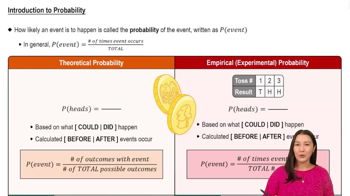
Probability

Probability is a measure of the likelihood that a particular event will occur, expressed as a number between 0 and 1. In this context, it quantifies the chance that at least one worker out of a group tests positive for illegal drugs. Understanding probability is essential for calculating outcomes in scenarios involving random selection.
Recommended video:
5:37
Introduction to Probability

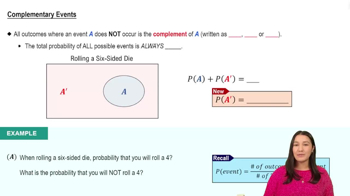
Complement Rule

The Complement Rule states that the probability of an event occurring is equal to one minus the probability of the event not occurring. In this case, to find the probability that at least one worker tests positive, we can first calculate the probability that none test positive and subtract that from 1. This simplifies the calculation significantly.
Recommended video:
4:23
Complementary Events

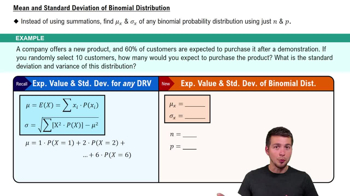
Binomial Distribution

The Binomial Distribution models the number of successes in a fixed number of independent trials, each with the same probability of success. Here, testing positive for drugs can be seen as a 'success,' and the distribution helps in determining the probabilities of different outcomes for the ten workers selected. It is crucial for understanding how to apply the probability calculations in this scenario.
Recommended video:
Guided course
03:28
Mean & Standard Deviation of Binomial Distribution
Related Practice
Textbook Question

Poisson: Deaths Currently, an average of 7 residents of the village of Westport (population 760) die each year (based on data from the U.S. National Center for Health Statistics).


b. Find the probability that on a given day, there are no deaths.

137
views
Textbook Question

Poisson: Deaths Currently, an average of 7 residents of the village of Westport (population 760) die each year (based on data from the U.S. National Center for Health Statistics).


c. Find the probability that on a given day, there is more than one death.


145
views
Textbook Question

In Exercises 1–5, assume that 4.2% of workers test positive when tested for illegal drugs (based on data from Quest Diagnostics). Assume that a group of ten workers is randomly selected.


Workplace Drug Testing Find the mean and standard deviation for the numbers of workers in groups of ten who test positive for illegal drugs.

121
views
Textbook Question

In Exercises 1–5, assume that 4.2% of workers test positive when tested for illegal drugs (based on data from Quest Diagnostics). Assume that a group of ten workers is randomly selected.


Workplace Drug Testing If none of the ten workers tests positive for illegal drugs, is that a significantly low result?

132
views
Textbook Question

Poisson: Deaths Currently, an average of 7 residents of the village of Westport (population 760) die each year (based on data from the U.S. National Center for Health Statistics).

a. Find the mean number of deaths per day.

125
views
Textbook Question

In Exercises 1–5, assume that 4.2% of workers test positive when tested for illegal drugs (based on data from Quest Diagnostics). Assume that a group of ten workers is randomly selected.


Workplace Drug Testing If four of the ten workers test positive for illegal drugs, is that a significantly high result?

112
views