Ch. 5 - Discrete Probability Distributions
Triola - Elementary Statistics 14th Edition
Triola14th EditionElementary StatisticsISBN: 9780137366446Not the one you use?Change textbook
Chapter 5, Problem 5.2.25

In Exercises 25–28, find the probabilities and answer the questions.


Whitus v. Georgia In the classic legal case of Whitus v. Georgia, a jury pool of 90 people was supposed to be randomly selected from a population in which 27% were minorities. Among the 90 people selected, 7 were minorities. Find the probability of getting 7 or fewer minorities if the jury pool was randomly selected. Is the result of 7 minorities significantly low? What does the result suggest about the jury selection process?

Verified step by step guidance
1
Step 1: Identify the problem as a binomial probability problem. The population proportion of minorities is 27% (p = 0.27), the sample size is 90 (n = 90), and we are interested in the probability of getting 7 or fewer minorities (X ≤ 7).
Step 2: Define the binomial random variable X, which represents the number of minorities in the jury pool. The probability mass function for a binomial distribution is given by P(X = k) = (n choose k) * p^k * (1-p)^(n-k), where 'n choose k' is the binomial coefficient.
Step 3: To find P(X ≤ 7), calculate the cumulative probability by summing the probabilities for X = 0, 1, 2, ..., 7. This can be expressed as P(X ≤ 7) = Σ P(X = k) for k = 0 to 7. Use the binomial probability formula for each term.
Step 4: Alternatively, use a statistical calculator or software to compute P(X ≤ 7) directly. Input the parameters n = 90, p = 0.27, and calculate the cumulative probability for X ≤ 7.
Step 5: To determine if 7 minorities is significantly low, compare the result to a significance level (e.g., α = 0.05). If P(X ≤ 7) is less than the significance level, the result is considered significantly low. Interpret the result in the context of the jury selection process to assess whether it suggests potential bias.

Verified video answer for a similar problem:

This video solution was recommended by our tutors as helpful for the problem above.
Video duration:
11m
Was this helpful?

Key Concepts

Here are the essential concepts you must grasp in order to answer the question correctly.

Probability Distribution

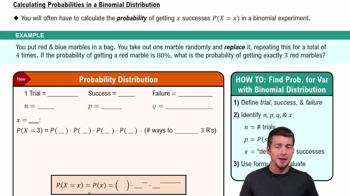
A probability distribution describes how the probabilities are distributed over the values of a random variable. In this case, we can use the binomial distribution to model the selection of minorities in the jury pool, where each selection can be seen as a Bernoulli trial with two outcomes: minority or non-minority. Understanding this distribution is crucial for calculating the probability of obtaining 7 or fewer minorities.
Recommended video:
Guided course
06:39
Calculating Probabilities in a Binomial Distribution

Binomial Probability Formula

The binomial probability formula calculates the likelihood of obtaining a specific number of successes in a fixed number of independent Bernoulli trials. It is expressed as P(X = k) = (n choose k) * p^k * (1-p)^(n-k), where n is the number of trials, k is the number of successes, and p is the probability of success. This formula will help determine the probability of selecting 7 or fewer minorities from the jury pool.
Recommended video:
Guided course
06:39
Calculating Probabilities in a Binomial Distribution

Statistical Significance

Statistical significance assesses whether the observed results are unlikely to have occurred by random chance. In this context, we need to determine if the occurrence of 7 minorities in the jury pool is significantly low compared to the expected number based on the population proportion. This involves comparing the calculated probability to a significance level, often set at 0.05, to draw conclusions about the jury selection process.
Recommended video:
Guided course
05:53
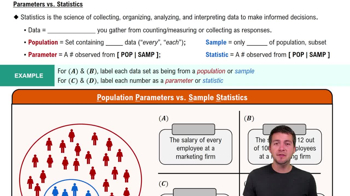
Parameters vs. Statistics
Related Practice
Textbook Question

40% of consumers believe that cash will be obsolete in the next 20 years (based on a survey by J.P. Morgan Chase). In each of Exercises 15–20, assume that 8 consumers are randomly selected. Find the indicated probability.


Find the probability that fewer than 3 of the selected consumers believe that cash will be obsolete in the next 20 years.

214
views
Textbook Question

Identifying Probability Distributions. In Exercises 7–14, determine whether a probability distribution is given. If a probability distribution is given, find its mean and standard deviation. If a probability distribution is not given, identify the requirements that are not satisfied.

Online Courses College students are randomly selected and arranged in groups of three. The random variable x is the number in the group who say that they take one or more online courses (based on data from Sallie Mae).

253
views
Textbook Question

Texting and Driving. In Exercises 21–26, refer to the accompanying table, which describes probabilities for groups of five drivers. The random variable x is the number of drivers in a group who say that they text while driving (based on data from an Arity survey of drivers).

Range Rule of Thumb for Significant Events Use the range rule of thumb to determine whether 4 is a significantly high number of drivers who say that they text while driving.

132
views
Textbook Question

In Exercises 9–16, use the Poisson distribution to find the indicated probabilities.


Murders In a recent year (365 days), there were 650 murders in Chicago. Find the mean number of murders per day, then use that result to find the probability that in a single day, there are no murders. Would 0 murders in a single day be a significantly low number of murders?

12
views
Textbook Question

Random Variable The accompanying table lists probabilities for the corresponding numbers of unlicensed software packages when four software packages are randomly selected in China. What is the random variable, what are its possible values, and are its values numerical?


" style="" width="330">

146
views
Textbook Question

In Exercises 5–12, determine whether the given procedure results in a binomial distribution or a distribution that can be treated as binomial (by applying the 5% guideline for cumbersome calculations). For those that are not binomial and cannot be treated as binomial, identify at least one requirement that is not satisfied.


LOL In a U.S. Cellular survey of 500 smartphone users, subjects are asked if they find abbreviations (such as LOL or BFF) annoying, and each response was recorded as “yes,” “no,” or “not sure.”

278
views