Ch. 5 - Discrete Probability Distributions
Triola - Elementary Statistics 14th Edition
Triola14th EditionElementary StatisticsISBN: 9780137366446Not the one you use?Change textbook
Chapter 5, Problem 5.Q.10

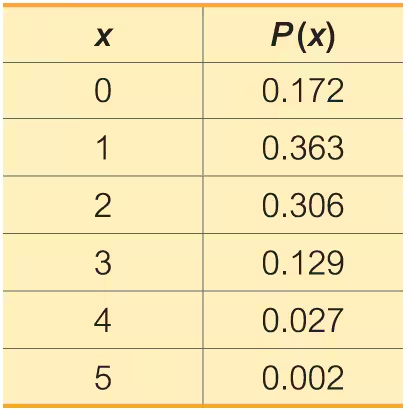
In Exercises 6–10, refer to the accompanying table, which describes the numbers of adults in groups of five who reported sleepwalking (based on data from “Prevalence and Comorbidity of Nocturnal Wandering In the U.S. Adult General Population,” by Ohayon et al., Neurology, Vol. 78, No. 20).
Table showing values of x from 0 to 5 with corresponding probabilities P(x) ranging from 0.002 to 0.363.
Significant Events Is 4 a significantly high number of sleepwalkers in a group of 5 adults? Explain.

Verified step by step guidance
1
Step 1: Understand the problem. We are tasked with determining whether 4 is a significantly high number of sleepwalkers in a group of 5 adults. To do this, we will use the probability distribution provided in the table and apply statistical concepts such as the rare event rule.
Step 2: Recall the rare event rule. According to this rule, an event is considered significantly high if its probability is very small, typically less than or equal to 0.05. We will compare the probability of having 4 sleepwalkers (P(x=4)) to this threshold.
Step 3: Locate the probability of 4 sleepwalkers in the table. From the table, P(x=4) = 0.027. This value represents the likelihood of observing 4 sleepwalkers in a group of 5 adults.
Step 4: Compare P(x=4) to the threshold of 0.05. If P(x=4) ≤ 0.05, then 4 sleepwalkers can be considered a significantly high number based on the rare event rule.
Step 5: Interpret the result. Based on the comparison, determine whether the probability of 4 sleepwalkers is rare enough to be considered significant. Provide reasoning based on the threshold and the probability value.

Verified video answer for a similar problem:

This video solution was recommended by our tutors as helpful for the problem above.
Video duration:
2m
Was this helpful?

Key Concepts

Here are the essential concepts you must grasp in order to answer the question correctly.

Probability Distribution

A probability distribution describes how the probabilities of a random variable are distributed across its possible values. In this case, the table shows the probabilities of different numbers of sleepwalkers (x) in a group of five adults. Understanding this distribution helps in assessing the likelihood of observing a specific number of sleepwalkers.
Recommended video:
Guided course
06:39
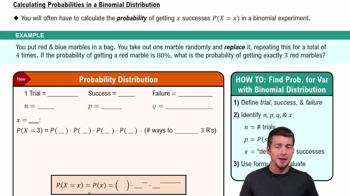
Calculating Probabilities in a Binomial Distribution

Significance Level

The significance level is a threshold used to determine whether a result is statistically significant. In this context, we assess whether having 4 sleepwalkers in a group of 5 is significantly high by comparing its probability to a predefined significance level, often set at 0.05. If the probability of observing 4 or more sleepwalkers is low, it may be considered significant.
Recommended video:
03:33
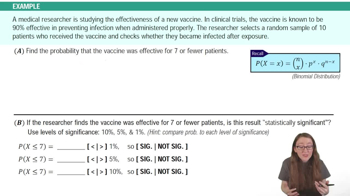
Finding Binomial Probabilities Using TI-84 Example 1

Cumulative Probability

Cumulative probability refers to the probability of a random variable being less than or equal to a certain value. To determine if 4 sleepwalkers is significantly high, we can calculate the cumulative probability of observing 0, 1, 2, 3, or 4 sleepwalkers and compare it to the probability of observing 5. This helps in understanding the rarity of the event in the context of the distribution.
Recommended video:
5:37
Introduction to Probability