
Ch. 6 - Normal Probability Distributions
Triola - Elementary Statistics 14th Edition
Triola14th EditionElementary StatisticsISBN: 9780137366446Not the one you use?Change textbook
Chapter 6, Problem 6.R.5c

Birth Weights Based on Data Set 6 “Births” in Appendix B, birth weights of girls are normally distributed with a mean of 3037.1 g and a standard deviation of 706.3 g.


c. What is the value of the mode?

Verified step by step guidance
1
The mode is the value that appears most frequently in a data set. For a normal distribution, the mode is the same as the mean and the median because the distribution is symmetric.
In this problem, the birth weights of girls are described as being normally distributed. This means the mode will coincide with the mean of the distribution.
The mean of the birth weights is given as 3037.1 g. Therefore, the mode is also 3037.1 g.
No further calculations are needed because the mode for a normal distribution is directly equal to the mean.
Thus, the mode of the birth weights is the same as the mean, which is 3037.1 g.

Verified video answer for a similar problem:

This video solution was recommended by our tutors as helpful for the problem above.
Video duration:
1m
Was this helpful?

Key Concepts

Here are the essential concepts you must grasp in order to answer the question correctly.

Normal Distribution

Normal distribution is a probability distribution that is symmetric about the mean, indicating that data near the mean are more frequent in occurrence than data far from the mean. In a normal distribution, the mean, median, and mode are all equal, which simplifies the analysis of data sets that follow this pattern.
Recommended video:
Guided course
09:47
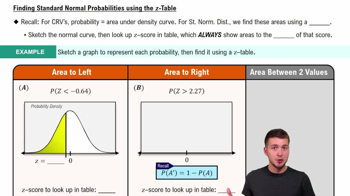
Finding Standard Normal Probabilities using z-Table

Mean, Median, and Mode

The mean is the average of a data set, the median is the middle value when the data is ordered, and the mode is the most frequently occurring value. In a normal distribution, these three measures of central tendency coincide, making it easier to identify the central point of the data.
Recommended video:
Guided course
04:48
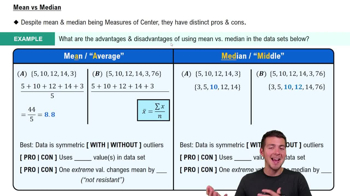
Comparing Mean vs. Median

Standard Deviation

Standard deviation is a measure of the amount of variation or dispersion in a set of values. A low standard deviation indicates that the values tend to be close to the mean, while a high standard deviation indicates that the values are spread out over a wider range. In the context of normal distribution, it helps to understand how data points are distributed around the mean.
Recommended video:
Guided course
08:45
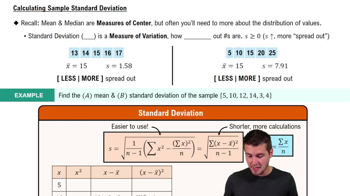
Calculating Standard Deviation
Related Practice
Textbook Question

In Exercises 8 and 9, assume that women have standing eye heights that are normally distributed with a mean of 59.7 in. and a standard deviation of 2.5 in. (based on anthropometric survey data from Gordon, Churchill, et al.).

a. If an eye recognition security system is positioned at a height that is uncomfortable for women with standing eye heights less than 54 in., what percentage of women will find that height uncomfortable?

106
views
Textbook Question

Bone Density Test A bone mineral density test is used to identify a bone disease. The result of a bone density test is commonly measured as a z score, and the population of z scores is normally distributed with a mean of 0 and a standard deviation of 1.

e. If the mean bone density test score is found for 9 randomly selected subjects, find the probability that the mean is greater than 0.23.

179
views
Textbook Question

Arm Circumferences Arm circumferences of adult men are normally distributed with a mean of 33.64 cm and a standard deviation of 4.14 cm (based on Data Set 1 “Body Data” in Appendix B). A sample of 25 men is randomly selected and the mean of the arm circumferences is obtained.

b. What is the mean of all such sample means?

181
views
Textbook Question

Mensa Membership in Mensa requires a score in the top 2% on a standard intelligence test. The Wechsler IQ test is designed for a mean of 100 and a standard deviation of 15, and scores are normally distributed.


c. If 4 subjects take the Wechsler IQ test and they have a mean of 131 but the individual scores are lost, can we conclude that all 4 of them have scores of at least 131?

150
views
Textbook Question

Birth Weights Based on Data Set 6 “Births” in Appendix B, birth weights of girls are normally distributed with a mean of 3037.1 g and a standard deviation of 706.3 g.


b. What is the value of the median?

107
views
Textbook Question

In Exercises 7–10, use the same population of {4, 5, 9} that was used in Examples 2 and 5. As in Examples 2 and 5, assume that samples of size n = 2 are randomly selected with replacement.


Sampling Distribution of the Sample Variance


a. Find the value of the population variance σ2.

144
views