Ch. 6 - Normal Probability Distributions
Triola - Elementary Statistics 14th Edition
Triola14th EditionElementary StatisticsISBN: 9780137366446Not the one you use?Change textbook
Chapter 6, Problem 6.CRE.4c

Blue Eyes Assume that 35% of us have blue eyes (based on a study by Dr. P. Soria at Indiana University).


c. Find the probability of randomly selecting three different people and finding that all of them have blue eyes.

Verified step by step guidance
1
Step 1: Understand the problem. The probability of a single person having blue eyes is given as 35%, or 0.35. We are tasked with finding the probability that all three randomly selected people have blue eyes.
Step 2: Recognize that this is a problem involving independent events. The probability of all three people having blue eyes can be calculated by multiplying the probabilities of each individual event, since the selection of one person does not affect the others.
Step 3: Write the formula for the probability of all three events occurring. This can be expressed as: P(All three have blue eyes) = P(Person 1 has blue eyes) × P(Person 2 has blue eyes) × P(Person 3 has blue eyes).
Step 4: Substitute the given probability (0.35) into the formula. This becomes: P(All three have blue eyes) = 0.35 × 0.35 × 0.35.
Step 5: Simplify the expression by multiplying the probabilities together. This will give the final probability of all three people having blue eyes.

Verified video answer for a similar problem:

This video solution was recommended by our tutors as helpful for the problem above.
Video duration:
1m
Was this helpful?

Key Concepts

Here are the essential concepts you must grasp in order to answer the question correctly.

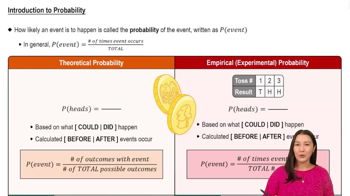
Probability

Probability is a measure of the likelihood that a particular event will occur, expressed as a number between 0 and 1. In this context, it refers to the chance of selecting individuals with blue eyes from a population where 35% have this trait. The probability of independent events can be calculated by multiplying the probabilities of each event occurring.
Recommended video:
5:37
Introduction to Probability

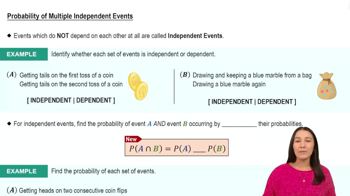
Independent Events

Independent events are those whose outcomes do not affect each other. In this scenario, selecting one person with blue eyes does not influence the likelihood of the next person also having blue eyes. This property allows us to multiply the probabilities of each selection to find the overall probability of all selected individuals having blue eyes.
Recommended video:
05:54
Probability of Multiple Independent Events

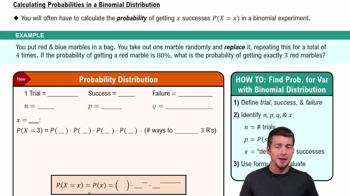
Binomial Probability

Binomial probability refers to the probability of obtaining a fixed number of successes in a fixed number of independent Bernoulli trials, each with the same probability of success. In this case, we can use the binomial formula to calculate the probability of selecting three people, all of whom have blue eyes, given the probability of any one person having blue eyes is 0.35.
Recommended video:
Guided course
06:39
Calculating Probabilities in a Binomial Distribution
Related Practice
Textbook Question

In Exercises 1 and 2, use the following wait times (minutes) at 10:00 AM for the Tower of Terror ride at Disney World (from Data Set 33 “Disney World Wait Times” in Appendix B).


35 35 20 50 95 75 45 50 30 35 30 30


d. The accompanying normal quantile plot is obtained by using all 50 wait times at 10:00 AM for the Tower of Terror ride at Disney World. Based on this normal quantile plot, do the sample data appear to be from a normally distributed population?

147
views
Textbook Question

Mensa Membership in Mensa requires a score in the top 2% on a standard intelligence test. The Wechsler IQ test is designed for a mean of 100 and a standard deviation of 15, and scores are normally distributed.


b. If 4 randomly selected adults take the Wechsler IQ test, find the probability that their mean score is at least 131.

233
views
Textbook Question

In Exercises 8 and 9, assume that women have standing eye heights that are normally distributed with a mean of 59.7 in. and a standard deviation of 2.5 in. (based on anthropometric survey data from Gordon, Churchill, et al.).


Significance Instead of using 0.05 for identifying significant values, use the criteria that a value x is significantly high if P(x or greater) ≤ 0.01 and a value is significantly low if P(x or less) ≤ 0.01. Find the standing eye heights of women that separate significant values from those that are not significant. Using these criteria, is a woman’s standing eye height of 67 in. significantly high?

104
views
Textbook Question

In Exercises 1 and 2, use the following wait times (minutes) at 10:00 AM for the Tower of Terror ride at Disney World (from Data Set 33 “Disney World Wait Times” in Appendix B).


35 35 20 50 95 75 45 50 30 35 30 30


e. Convert the longest wait time to a z score.

f. Based on the result from part (e), is the longest wait time significantly high?

112
views
Textbook Question

Blue Eyes Assume that 35% of us have blue eyes (based on a study by Dr. P. Soria at Indiana University).


b. Find the value of P(B_bar).

152
views
Textbook Question

Mensa Membership in Mensa requires a score in the top 2% on a standard intelligence test. The Wechsler IQ test is designed for a mean of 100 and a standard deviation of 15, and scores are normally distributed.


a. Find the minimum Wechsler IQ test score that satisfies the Mensa requirement.

481
views