
Ch. 6 - Normal Probability Distributions
Triola - Elementary Statistics 14th Edition
Triola14th EditionElementary StatisticsISBN: 9780137366446Not the one you use?Change textbook
Chapter 6, Problem 6.4.13a

Ergonomics. Exercises 9–16 involve applications to ergonomics, as described in the Chapter Problem.


Redesign of Ejection Seats When women were finally allowed to become pilots of fighter jets, engineers needed to redesign the ejection seats because they had been originally designed for men only. The ACES-II ejection seats were designed for men weighing between 140 lb and 211 lb. Weights of women are now normally distributed with a mean of 171 lb and a standard deviation of 46 lb (based on Data Set 1 “Body Data” in Appendix B).


a. If 1 woman is randomly selected, find the probability that her weight is between 140 lb and 211 lb.

Verified step by step guidance
1
Step 1: Identify the problem as a probability question involving a normal distribution. The weights of women are normally distributed with a mean (μ) of 171 lb and a standard deviation (σ) of 46 lb. We are tasked with finding the probability that a randomly selected woman's weight is between 140 lb and 211 lb.
Step 2: Standardize the given weights (140 lb and 211 lb) using the z-score formula: z = (x - μ) / σ. For each weight, substitute the values of x (140 and 211), μ (171), and σ (46) into the formula to calculate the corresponding z-scores.
Step 3: Use the z-scores obtained in Step 2 to find the cumulative probabilities from the standard normal distribution table (or a statistical software). The cumulative probability for a z-score represents the area under the standard normal curve to the left of that z-score.
Step 4: To find the probability that the weight is between 140 lb and 211 lb, subtract the cumulative probability corresponding to the lower z-score (for 140 lb) from the cumulative probability corresponding to the higher z-score (for 211 lb). This difference gives the probability of the weight falling within the specified range.
Step 5: Interpret the result. The final probability represents the likelihood that a randomly selected woman's weight is between 140 lb and 211 lb, based on the given normal distribution parameters.

Verified video answer for a similar problem:

This video solution was recommended by our tutors as helpful for the problem above.
Video duration:
7m
Was this helpful?

Key Concepts

Here are the essential concepts you must grasp in order to answer the question correctly.

Normal Distribution

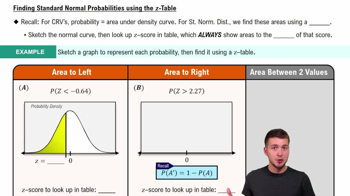
Normal distribution is a probability distribution that is symmetric about the mean, depicting that data near the mean are more frequent in occurrence than data far from the mean. In this context, the weights of women are normally distributed, which allows us to use the properties of the normal curve to calculate probabilities related to weight.
Recommended video:
Guided course
09:47
Finding Standard Normal Probabilities using z-Table

Z-Scores

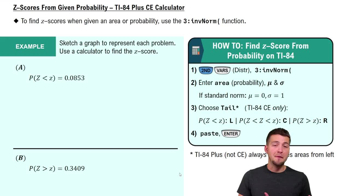
A Z-score represents the number of standard deviations a data point is from the mean. It is calculated by subtracting the mean from the value and then dividing by the standard deviation. In this problem, Z-scores will help determine the probability of a woman's weight falling between 140 lb and 211 lb by converting these weights into Z-scores.
Recommended video:
Guided course
06:31
Z-Scores From Given Probability - TI-84 (CE) Calculator

Probability Calculation

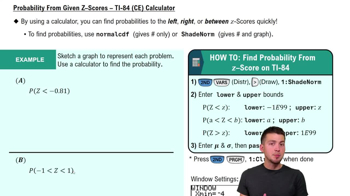
Probability calculation involves determining the likelihood of a specific event occurring within a defined set of outcomes. In this scenario, we will calculate the probability that a randomly selected woman weighs between 140 lb and 211 lb by finding the area under the normal distribution curve between the corresponding Z-scores.
Recommended video:
Guided course
07:09
Probability From Given Z-Scores - TI-84 (CE) Calculator
Related Practice
Textbook Question

Ergonomics. Exercises 9–16 involve applications to ergonomics, as described in the Chapter Problem.


Aircraft Cockpit The overhead panel in an aircraft cockpit typically includes controls for such features as landing lights, fuel booster pumps, and oxygen. It is important for pilots to be able to reach those overhead controls while sitting. Seated adult males have overhead grip reaches that are normally distributed with a mean of 51.6 in. and a standard deviation of 2.2 in.


a. If an aircraft is designed for pilots with an overhead grip reach of 53 in., what percentage of adult males would not be able to reach the overhead controls? Is that percentage too high?

110
views
Textbook Question

Using the Central Limit Theorem. In Exercises 5–8, assume that the amounts of weight that male college students gain during their freshman year are normally distributed with a mean of 1.2 kg and a standard deviation of 4.9 kg (based on Data Set 13 “Freshman 15” in Appendix B).


a. If 1 male college student is randomly selected, find the probability that he gains at least 2.0 kg during his freshman year..)

164
views
Textbook Question

Hybridization A hybridization experiment begins with four peas having yellow pods and one pea having a green pod. Two of the peas are randomly selected with replacement from this population.


a. After identifying the 25 different possible samples, find the proportion of peas with yellow pods in each of them, then construct a table to des

143
views
Textbook Question

Using the Central Limit Theorem. In Exercises 5–8, assume that the amounts of weight that male college students gain during their freshman year are normally distributed with a mean of 1.2 kg and a standard deviation of 4.9 kg (based on Data Set 13 “Freshman 15” in Appendix B).

a. If 1 male college student is randomly selected, find the probability that he gains between 0 kg and 3 kg during freshman year.

149
views
Textbook Question

In Exercises 7–10, use the same population of {4, 5, 9} that was used in Examples 2 and 5. As in Examples 2 and 5, assume that samples of size n = 2 are randomly selected with replacement.


Sampling Distribution of the Sample Median


a. Find the value of the population median.

141
views
Textbook Question

Continuity Correction In testing the assumption that the probability of a baby boy is 0.512, a geneticist obtains a random sample of 1000 births and finds that 502 of them are boys. Using the continuity correction, describe the area under the graph of a normal distribution corresponding to the following. (For example, the area corresponding to “the probability of at least 502 boys” is this: the area to the right of 501.5.)


a. The probability of 502 or fewer boys

206
views