
Ch. 6 - Normal Probability Distributions
Triola - Elementary Statistics 14th Edition
Triola14th EditionElementary StatisticsISBN: 9780137366446Not the one you use?Change textbook
Chapter 6, Problem 6.CRE.2b

In Exercises 1 and 2, use the following wait times (minutes) at 10:00 AM for the Tower of Terror ride at Disney World (from Data Set 33 “Disney World Wait Times” in Appendix B).


35 35 20 50 95 75 45 50 30 35 30 30


b. Construct a boxplot.

Verified step by step guidance
1
Step 1: Organize the data in ascending order. The given wait times are: 35, 35, 20, 50, 95, 75, 45, 50, 30, 35, 30, 30. Arrange them in increasing order: 20, 30, 30, 30, 35, 35, 35, 45, 50, 50, 75, 95.
Step 2: Identify the five-number summary for the data. These include the minimum value, first quartile (Q1), median (Q2), third quartile (Q3), and maximum value. Use the ordered data to calculate these values.
Step 3: Calculate Q1 (first quartile) and Q3 (third quartile). Q1 is the median of the lower half of the data (excluding the overall median), and Q3 is the median of the upper half of the data (excluding the overall median).
Step 4: Determine the interquartile range (IQR) using the formula: IQR=Q3-Q1. Use the IQR to identify any potential outliers, which are values below Q1-1.5×IQR or above Q3+1.5×IQR.
Step 5: Construct the boxplot. Draw a box from Q1 to Q3 with a line at the median (Q2). Extend whiskers from the box to the minimum and maximum values that are not outliers. Mark any outliers separately as individual points.

Verified video answer for a similar problem:

This video solution was recommended by our tutors as helpful for the problem above.
Video duration:
6m
Was this helpful?

Key Concepts

Here are the essential concepts you must grasp in order to answer the question correctly.

Boxplot

A boxplot, or box-and-whisker plot, is a graphical representation of a dataset that displays its central tendency and variability. It shows the median, quartiles, and potential outliers, providing a visual summary of the distribution. The box represents the interquartile range (IQR), which contains the middle 50% of the data, while the 'whiskers' extend to the smallest and largest values within 1.5 times the IQR from the quartiles.

Quartiles

Quartiles are values that divide a dataset into four equal parts, helping to understand its distribution. The first quartile (Q1) is the median of the lower half of the data, the second quartile (Q2) is the overall median, and the third quartile (Q3) is the median of the upper half. These values are essential for constructing a boxplot, as they determine the box's edges and the whiskers' extent.
Recommended video:
Guided course
04:51
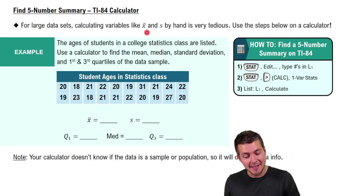
Find 5-Number Summary - TI-84 Calculator

Outliers

Outliers are data points that significantly differ from other observations in a dataset. They can skew the results and affect statistical analyses. In the context of a boxplot, outliers are typically identified as points that lie beyond 1.5 times the IQR from the quartiles, and they are often represented as individual dots outside the whiskers, indicating their potential impact on the overall data interpretation.
Recommended video:
Guided course
04:48
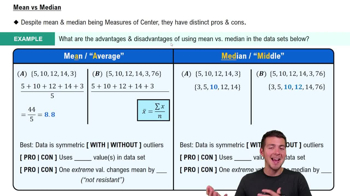
Comparing Mean vs. Median
Related Practice
Textbook Question

In Exercises 1 and 2, use the following wait times (minutes) at 10:00 AM for the Tower of Terror ride at Disney World (from Data Set 33 “Disney World Wait Times” in Appendix B).


35 35 20 50 95 75 45 50 30 35 30 30


d. The accompanying normal quantile plot is obtained by using all 50 wait times at 10:00 AM for the Tower of Terror ride at Disney World. Based on this normal quantile plot, do the sample data appear to be from a normally distributed population?

147
views
Textbook Question

Normal Distribution Using a larger data set than the one given for the preceding exercises, assume that cell phone radiation amounts are normally distributed with a mean of 1.17 W/kg and a standard deviation of 0.29 W/kg.

a. Find the probability that a randomly selected cell phone has a radiation amount that exceeds the U.S. standard of 1.6 W/kg or less.

115
views
Textbook Question

Blue Eyes Assume that 35% of us have blue eyes (based on a study by Dr. P. Soria at Indiana University).


b. Find the value of P(B_bar).

152
views
Textbook Question

In Exercises 1 and 2, use the following wait times (minutes) at 10:00 AM for the Tower of Terror ride at Disney World (from Data Set 33 “Disney World Wait Times” in Appendix B).


35 35 20 50 95 75 45 50 30 35 30 30


a. Find the mean xbar.

106
views
Textbook Question

Foot Lengths of Women Assume that foot lengths of adult females are normally distributed with a mean of 246.3 mm and a standard deviation of 12.4 mm (based on Data Set 3 “ANSUR II 2012” in Appendix B).


d. Find the probability that 16 adult females have foot lengths with a mean greater than 250 mm.

108
views
Textbook Question

In Exercises 1 and 2, use the following wait times (minutes) at 10:00 AM for the Tower of Terror ride at Disney World (from Data Set 33 “Disney World Wait Times” in Appendix B).


35 35 20 50 95 75 45 50 30 35 30 30 


b. Find the median.

132
views