Ch. 6 - Normal Probability Distributions
Triola - Elementary Statistics 14th Edition
Triola14th EditionElementary StatisticsISBN: 9780137366446Not the one you use?Change textbook
Chapter 6, Problem 6.2.21

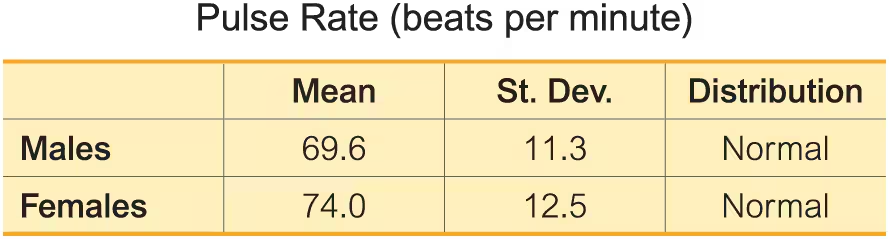
Pulse Rates. In Exercises 13–24, use the data in the table below for pulse rates of adult males and females (based on Data Set 1 “Body Data” in Appendix B). Hint: Draw a graph in each case.


<IMAGE>


For males, find P90 which is the pulse rate separating the bottom 90% from the top 10%.

Verified step by step guidance
1
Identify the given data: The mean pulse rate for males is 69.6 beats per minute, the standard deviation is 11.3 beats per minute, and the distribution is normal. We are tasked with finding P90, the 90th percentile, which separates the bottom 90% from the top 10%.
Recall that for a normal distribution, the z-score corresponding to the 90th percentile (P90) can be found using a z-table or statistical software. The z-score for P90 is approximately 1.28.
Use the z-score formula to find the value of P90: \( z = \frac{X - \mu}{\sigma} \), where \( X \) is the value we are solving for (P90), \( \mu \) is the mean, and \( \sigma \) is the standard deviation. Rearrange the formula to solve for \( X \): \( X = z \cdot \sigma + \mu \).
Substitute the known values into the formula: \( X = 1.28 \cdot 11.3 + 69.6 \).
Simplify the expression to calculate the value of P90. This will give the pulse rate that separates the bottom 90% of male pulse rates from the top 10%.

Verified video answer for a similar problem:

This video solution was recommended by our tutors as helpful for the problem above.
Video duration:
4m
Was this helpful?

Key Concepts

Here are the essential concepts you must grasp in order to answer the question correctly.

Percentiles

A percentile is a measure used in statistics to indicate the value below which a given percentage of observations fall. For example, P90 (the 90th percentile) is the value below which 90% of the data points lie. Understanding percentiles is crucial for interpreting data distributions and making comparisons between different datasets.

Normal Distribution

Normal distribution is a probability distribution that is symmetric about the mean, showing that data near the mean are more frequent in occurrence than data far from the mean. It is characterized by its bell-shaped curve and is defined by two parameters: the mean and the standard deviation. Many statistical methods assume normality, making it essential for analyzing data sets.
Recommended video:
Guided course
09:47
Finding Standard Normal Probabilities using z-Table

Standard Deviation

Standard deviation is a statistic that measures the dispersion or variability of a dataset relative to its mean. A low standard deviation indicates that the data points tend to be close to the mean, while a high standard deviation indicates a wider spread. It is a key concept in understanding the distribution of data and is used in calculating percentiles.
Recommended video:
Guided course
08:45
Calculating Standard Deviation
Related Practice
Textbook Question

Satisfying Requirements Data Set 1 “Body Data” in Appendix B includes a sample of 147 pulse rates of randomly selected women. Does that sample satisfy the following requirement: (1) The sample appears to be from a normally distributed population; or (2) the sample has a size of n>30?

162
views
Textbook Question

Standard Normal Distribution. In Exercises 17–36, assume that a randomly selected subject is given a bone density test. Those test scores are normally distributed with a mean of 0 and a standard deviation of 1. In each case, draw a graph, then find the probability of the given bone density test scores. If using technology instead of Table A-2, round answers to four decimal places.


Less than -2.00

207
views
Textbook Question

Continuous Uniform Distribution. In Exercises 5–8, refer to the continuous uniform distribution depicted in Figure 6-2 and described in Example 1. Assume that a passenger is randomly selected, and find the probability that the waiting time is within the given range.


" style="" width="225">


Greater than 3.00 minutes

363
views
Textbook Question

IQ Scores. In Exercises 5–8, find the area of the shaded region. The graphs depict IQ scores of adults, and those scores are normally distributed with a mean of 100 and a standard deviation of 15 (as on the Wechsler IQ test).

230
views
Textbook Question

Interpreting Normal Quantile Plots. In Exercises 5–8, examine the normal quantile plot and determine whether the sample data appear to be from a population with a normal distribution.


Ages of Presidents The normal quantile plot represents the ages of presidents of the United States at the times of their inaugurations. The data are from Data Set 22 “Presidents” in Appendix B.

183
views
Textbook Question

Critical Values. In Exercises 41–44, find the indicated critical value. Round results to two decimal places.


z0.90

230
views